India’s Surrender-cum-Rehabilitation Scheme for Left Wing Extremists (LWEs) has become an important instrument in the country’s long-running effort to curb Maoist insurgency. The policy offers financial assistance, vocational training, and structured rehabilitation to encourage armed cadres to abandon violence and reintegrate into society.
The scheme gained renewed attention following the surrender of senior Maoist commander Devuji in Chhattisgarh, an event that officials described as a major breakthrough in weakening insurgent networks. Authorities believe such high-profile surrenders demonstrate the effectiveness of combining strong security operations with rehabilitation opportunities.
The rehabilitation framework is currently valid until March 31, 2026, and is part of the Union government’s broader conflict-resolution approach in Left Wing Extremism-affected states. The policy seeks to ensure that surrendered cadres do not return to insurgency by providing them with stable livelihoods and social support.
Financial assistance based on rank
One of the central components of the scheme is financial assistance, which varies according to the rank and role of the surrendered cadre.
Senior-level Maoist leaders, including state committee and central committee members, are eligible for a financial grant of up to Rs 5 lakh. Middle- and lower-ranking cadres may receive assistance of up to Rs 2.5 lakh.
The money is deposited in a fixed deposit account in the name of the surrendered individual. The amount can be withdrawn only after three years and subject to certification of good behaviour by authorities.
Officials say this mechanism ensures that the funds are used responsibly and encourages long-term rehabilitation rather than short-term benefits. The fixed deposit can also be used as collateral for loans to start small businesses or self-employment ventures.
Incentives for surrendering weapons
The policy also provides separate incentives for surrendered weapons, recognising that disarmament is a crucial component of counter-insurgency.
Cadres who surrender heavy weapons such as light machine guns or sniper rifles may receive incentives of up to Rs 35,000 per weapon. AK-series rifles carry incentives of around Rs 25,000, while pistols and carbines may fetch Rs 10,000.
Compensation is also available for explosives, grenades, detonators, communication devices, and ammunition. Like financial grants, these payments are deposited in fixed deposits and released after a three-year period.
Officials believe this approach reduces the possibility of weapons being retained or diverted while encouraging genuine surrender.
Training and rehabilitation support
Beyond financial incentives, the policy emphasises long-term reintegration into society.
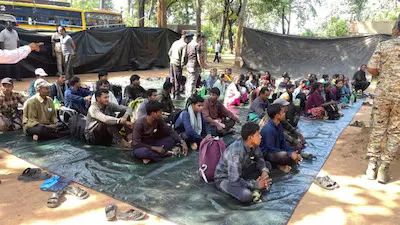
After surrendering, former cadres are accommodated in rehabilitation camps where they receive vocational training tailored to their skills and interests. Training programmes may include agriculture, carpentry, tailoring, and other trades designed to improve employability.
During the rehabilitation period, surrendered individuals receive a monthly stipend of Rs 10,000 for up to three years. This financial support is intended to provide stability during the transition to civilian life.
If a surrendered cadre secures government employment or a stable source of income before the completion of the three-year period, the stipend is discontinued.
Officials say the objective is not merely surrender but sustainable reintegration so that former insurgents are not driven back to militancy due to economic hardship.
Strict verification procedures
Authorities emphasise that not every surrender automatically qualifies for rehabilitation benefits.
Each case is examined by a Screening-cum-Rehabilitation Committee constituted by the respective state government. The committee includes senior police officials, representatives of the Home Department, and officers from Central Armed Police Forces.
The committee evaluates the genuineness of the surrender and ensures that the individual was actively associated with extremist organisations.
Surrendered cadres must disclose details of their activities and provide information about Maoist operations, including planners, financiers, and weapons supply networks.
Officials say this requirement helps security agencies gather intelligence while preventing misuse of the scheme.
The policy specifically prohibits so-called “tactical surrenders,” where insurgents attempt to exploit rehabilitation benefits without genuinely abandoning militancy.
Surrender under the rehabilitation scheme does not automatically grant immunity from prosecution.
Serious criminal cases, especially those involving heinous offences, may continue through the judicial process. However, state governments may consider withdrawing minor cases depending on individual circumstances.
In some instances, fast-track courts may be established to expedite the disposal of cases involving surrendered cadres.
Officials say the approach balances rehabilitation with accountability, ensuring that justice is not compromised.
Shared funding between centre and states
The scheme operates under a joint funding model between the Union government and the states.
Under the Security Related Expenditure (SRE) scheme, the Centre reimburses 60 percent of the rehabilitation expenditure incurred by states, while states bear the remaining 40 percent.
This arrangement allows financially weaker states affected by Left Wing Extremism to implement rehabilitation measures without excessive fiscal pressure.
The surrender of Maoist commander Devuji is seen as an important development within the framework of the rehabilitation policy.
As a senior leader operating in Maoist-affected regions of Chhattisgarh, Devuji’s decision to lay down arms reflects the growing pressure on insurgent groups due to sustained security operations and expanding rehabilitation initiatives.
Officials believe that the surrender of senior leaders weakens operational networks and reduces morale among active cadres.
High-profile surrenders also send a signal to lower-ranking Maoists that an organised pathway exists for returning to normal life.
The surrender-cum-rehabilitation policy represents a key element of India’s broader strategy to address Left Wing Extremism.
While security forces continue operations against armed insurgents, the rehabilitation scheme provides an alternative for those willing to abandon violence.
Authorities hope that continued implementation and periodic reviews of the scheme will encourage more insurgents to surrender.
With the policy currently in force until 2026, officials expect the combination of security pressure and rehabilitation incentives to further reduce the influence of Maoist groups in affected regions.
Over time, policymakers believe the strategy could help bring lasting peace and development to areas once dominated by Left Wing Extremism.