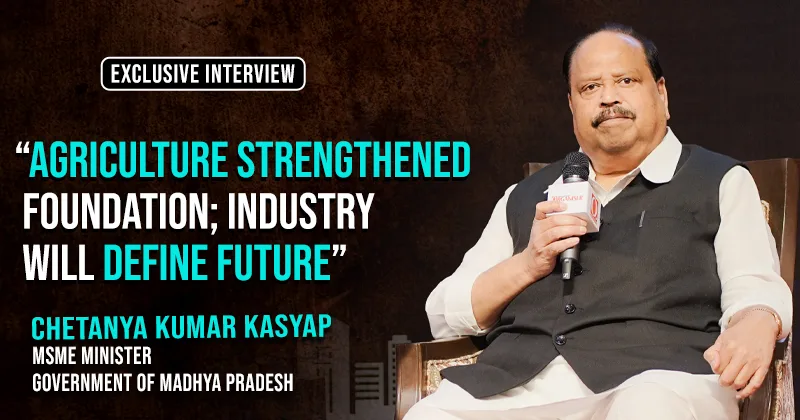
Speaking with Organiser Weekly’s Senior Assistant Editor, Nishant Kumar Azad, at Abhyudaya – Industry Leadership Conclave 2026, MSME Minister Chetanya Kasyap outlined how inclusive growth, women entrepreneurship, AI adoption, and district-level industrialisation are shaping the next phase of Madhya Pradesh’s rise. Excerpts:
Madhya Pradesh has transformed as one of the top-performing States on various growth parameters. Earlier governments focused heavily on agriculture. What led the current Government to shift its focus strongly towards MSMEs and industrial growth?
For nearly two decades, the State concentrated on agriculture. Irrigated land expanded from about 5-6 lakh hectares to over 45 lakh hectares, significantly strengthening agricultural economy. As a result, agriculture began contributing nearly 40 per cent to State’s GDP, while industry remained around 19-20 per cent. Nationally, the industry contributes nearly 29-30 per cent to GDP. Recognising this gap, Chief Minister Dr Mohan Yadav declared 2025 as the “Year of Industry and Employment.” The aim is not just to give a large industries but MSMEs, which historically powered Bharat’s economic strength. Through Regional Industrial Summits across all divisions, we created a platform where large investors, local entrepreneurs, startups, and global companies interact. This integrated approach has brought Madhya Pradesh into national and international focus.
For NDA, women have always been central to both national and State policies. What specific measures is the Government taking to increase women’s participation in the MSME sector?
The Ladli Behna Scheme has provided a strong foundation for women’s financial empowerment. Now, we are ensuring sustainability by connecting women-led Self-Help Groups (SHGs) to formal enterprise systems. Nearly one lakh SHGs are being registered under Udyam. We are helping them onboard digital marketplaces such as ONDC, Amazon, and Flipkart.
Under the MSME Incentive Policy 2025, women entrepreneurs receive enhanced benefits. While the general capital subsidy is 40 per cent, women entrepreneurs receive 48 per cent. Additionally, we are constructing four women’s hostels in industrial centres and developing flatted industrial areas, beginning in Govindpura (Bhopal), to provide safe and accessible workspaces for women entrepreneurs.
Industrial development often concentrates in major cities like Bhopal and Indore. What is the Government’s strategy to ensure inclusive industrial growth in smaller towns and Janajati regions such as Mandla, Dindori, Betul, and Dhar?
We have decided to establish at least one industrial area in every Assembly constituency of Madhya Pradesh. In Mandla, for example, a new industrial zone is under development. In urban areas, we develop flat industrial complexes due to land constraints. In rural and vanavasi areas, we provide smaller plots, sheds, and plug-and-play facilities. In Budhni, where toy-making is a traditional activity, we have built such infrastructure to support artisans, many of whom are women. We are also establishing Common Facility Centres wherever required to ensure regional entrepreneurs receive technical and infrastructural support.
Prime Minister Modi has emphasised “Vocal for Local” and “Local to Global.” We have seen how he pushed Bihar’s Makhana onto the global stage. How is MP promoting its regional products, such as Chanderi sarees, at national and global levels?
Through the One District One Product (ODOP) initiative, we have identified key regional products. Morena’s gajak and Ratlami sev have received GI tags. Chanderi sarees are being promoted through workshops and displayed in Mrignayani outlets nationwide.To expand globally, we are training artisans in branding and digital marketing. We are onboarding them to e-commerce platforms and ONDC. Our goal is to combine GI recognition, branding, digital presence, and international certification to ensure regional artisans, particularly women, gain global market access.
The data shows that the growth of MSME sector declined in the State, and shutdowns are higher than in previous years. How do you see this claim?
Data from the Udyam Registration Portal (URP) must be carefully interpreted. Actual closures are below 1 per cent. Many “closures” reflect status changes, such as restructuring partnerships or converting firm structures, not genuine shutdowns. We have flexible land and lease policies. If enterprises face difficulty, we offer restructuring support and revival mechanisms under exit policies. District trade centres actively engage with struggling enterprises to help them restart operations.
How significant is the MSME sector in achieving the national vision of Viksit Bharat 2047?
Bharat is a highly populated country, and large-scale employment generation can only happen through MSMEs. The Government of India has expanded credit guarantee schemes, improved bill discounting systems, and strengthened trade platforms to enhance financial inclusion. Through digital systems, even entrepreneurs in remote tribal districts can access national markets. MSMEs will be the backbone of employment and economic growth.
What was the core thinking behind launching Regional Industrial Conclaves? How do these differ from conventional investor summits?
We received investment intentions worth approximately Rs 30 lakh crore through these conclaves. Nationally, typically only 8-10 per cent of MoUs convert into ground investments. In Madhya Pradesh, nearly Rs 8 lakh crore worth of projects have moved into implementation within 2 years, with a 20–25 per cent realisation rate, significantly above the national average. We have allocated about 1,200 plots across 13 industrial areas, purchased by nearly 1,300 entrepreneurs. The State now has over 4,500 registered startups.
What is being done to support entrepreneurship for vanavasis?
Vanavasis constitute nearly 20 per cent of Madhya Pradesh’s population. We are promoting entrepreneurship through schemes like Mukhyamantri Udyam Kranti Yojana and skill training programmes such as Drone Didi. In Alirajpur, we approved a Rs 12 crore Common Facility Centre to support automated furniture production. Education levels are rising in vanavasi regions, and entrepreneurship opportunities are expanding accordingly.n