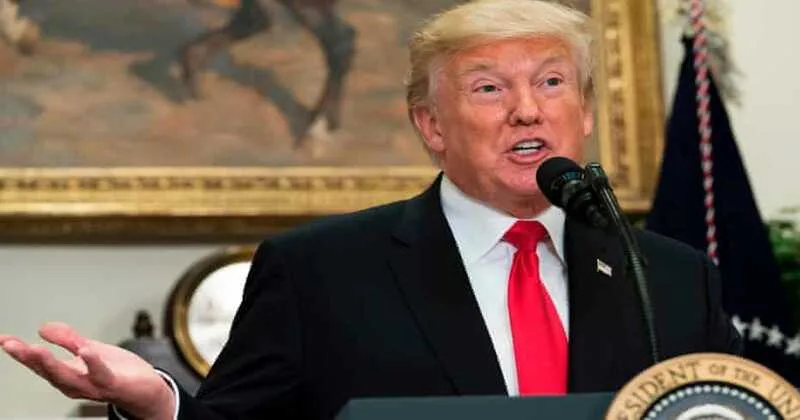
Washington: US President Donald Trump has hit back at the judiciary after a major setback to his trade policies, announcing a sharp increase in temporary import tariffs from 10 per cent to 15 per cent on goods coming into the United States from all countries, effective Saturday. The move comes just hours after the Supreme Court of the United States struck down Trump’s sweeping import tax hikes imposed under the Emergency Economic and Social Security Act (IEEPA). In a 6–3 verdict, the court ruled that the president had abused his authority and declared the tariff regime unconstitutional.
Trump announced the new tariff hike on his social media platform Truth Social, writing that this is a response to the countries that have been robbing America for decades. We are raising taxes to the maximum rate legally allowed, 15 percent. Addressing a press conference soon after, Trump reacted angrily to the ruling, “I have the power to destroy a country, I have the power to impose sanctions, but to say I can’t impose a single dollar of taxes is ridiculous,” he said, calling the court’s decision stupid and un-American. Trump insisted that as an elected president he should be allowed to act freely, while opponents argue that constitutional limits cannot be ignored.
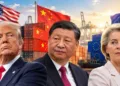
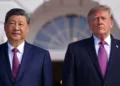
His administration is now attempting to invoke Section 122 to justify the fresh tariff hike, a move that is also expected to face legal scrutiny. The sudden 15 per cent levy has raised global alarm, with economists warning that it will lead to widespread price increases inside the United States. Countries such as China are expected to retaliate with restrictions on the US exports. What is now at stake, observers say, is the stability of global trade itself. The Trump administration has indicated that additional “legal tariffs” could be announced by February 25, making the coming days crucial for world markets.
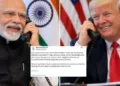
India, meanwhile, has received a relief. After the Supreme Court struck down Trump’s earlier tariff framework, New Delhi had expected a reduction of the proposed 25 per cent duty to 18 per cent under an ongoing trade deal. The revised 15 per cent rate is being seen as a relative win. It also prevents the possibility of tariffs being imposed arbitrarily. Even if new duties are introduced, Trump will now have to follow proper legal procedures and timelines. If the 15 per cent tariff expires after 150 days, India could gain further relief.
Back-to-Back Economic Shocks: GDP slumps and inflation surges
Trump’s tariff escalation comes amid a series of economic setbacks that delivered what economists describe as a “double blow” to his administration in a single day. Shortly after the Supreme Court verdict, fresh data showed that US economic growth had slowed dramatically in the October–December quarter. While Trump administration had forecast GDP growth of 2.5 per cent, the economy expanded by just 1.4 per cent. Overall growth for 2025 also dropped sharply to 2.2 per cent, down from 2.8 per cent in 2024. Inflation added to Trump’s troubles. The core personal consumption expenditure price index, excluding food and energy, rose to 3 per cent in December, significantly above the Federal Reserve’s 2 per cent target. This has reduced expectations that the Federal Reserve will cut interest rates anytime soon.
Trump quickly blamed Democrats for the slowdown, claiming the government shutdown had damaged growth. He also renewed attacks on Jerome Powell, chairman of the Federal Reserve, accusing him of keeping interest rates too high and hurting the economy. Trump has previously used harsh language against Powell, calling him “enemy of America,” “fool,” and “too late Powell”. Financial markets reacted negatively to the data. Dow futures fell 136 points, while S&P 500 futures declined 0.3 per cent and Nasdaq 100 futures dropped 0.5 per cent. The broader Dow Jones Industrial Average also faced heavier losses than anticipated, reflecting investor anxiety over slowing growth and escalating trade tensions.
$175 billion refunds, judicial rebuke and global fallout
The Supreme Court ruling has also triggered massive financial consequences. Most of the compensation collected under Trump’s tariff regime has now been cancelled. As a result, the administration is legally obligated to refund approximately $175 billion (around ₹27.7 lakh crore), including amounts paid by Indian companies. The judgment represents a major setback to Trump’s long-standing strategy of using tariffs as a geopolitical weapon. The court made clear that the president can no longer impose sweeping trade taxes without congressional approval. Analysts say this effectively weakens Washington’s leverage on the international stage, as Trump’s pressure tactics through tariffs are now severely constrained.
The nine-judge bench ruled 6–3 against Trump’s measures. Justices Clarence Thomas, Samuel A. Alito Jr., and Brett Kavanaugh dissented in support of the tariffs. Kavanaugh also defended Trump’s earlier decision to impose a 25 per cent tariff on Russian oil imported by India.
With the court firmly reasserting constitutional limits, Trump’s claim that a president can act without restraint has been decisively challenged. Legal experts warn that any further attempts to bypass Congress are likely to face immediate judicial resistance. As Trump battles courts, slowing growth, rising inflation, and jittery markets, all while escalating trade conflicts, uncertainty now hangs over the global economy. For many countries, including India, the ruling marks a turning point. For Trump, it signals a narrowing path forward as legal checks, economic realities, and international pushback converge at once.