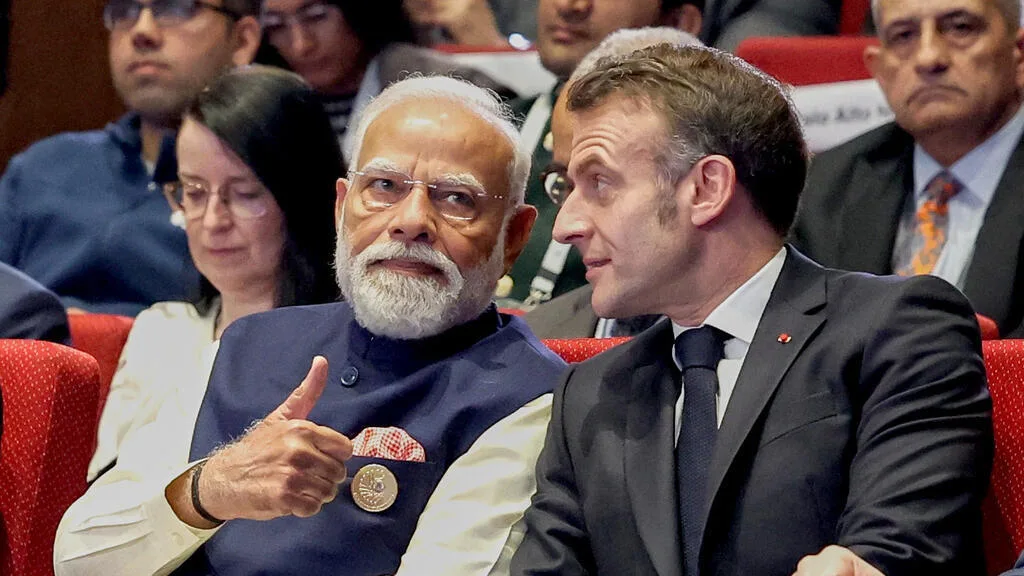
The India AI Impact Summit 2026 in New Delhi marked a defining moment in India’s global technology diplomacy, as Europe turned out in unprecedented numbers to engage with India’s rapidly evolving artificial intelligence ecosystem. With 11 heads of state or government and official representation from 26 European countries, the summit saw the largest European delegation ever to attend a technology-focused event in India.
The scale and composition of the European presence, led by leaders such as French President Emmanuel Macron, Spanish Prime Minister Pedro Sanchez, Finnish Prime Minister Petteri Orpo, and Swedish Deputy Prime Minister Ebba Busch, signalled far more than diplomatic courtesy. It reflected a strategic recalibration in Europe’s outlook towards India as a central actor in the global AI and technology order.
Prime Minister Narendra Modi held multiple bilateral meetings on the sidelines of the summit, including with Macron, Sanchez, Orpo, and leaders from Estonia, Serbia, Croatia and Switzerland. Further engagements were lined up with representatives from the Netherlands and Switzerland, highlighting a dense calendar of strategic interactions tied to AI, trade, defence and digital innovation.
Europe’s strategic turn toward India
The breadth of European participation demonstrated that the continent increasingly sees India not merely as a large consumer market but as a co-architect of global technological governance. The summit took place against the backdrop of advancing negotiations and political momentum around the proposed India-EU Free Trade Agreement (FTA), adding economic weight to the technological discussions.
European leaders explicitly linked AI cooperation with long-term trade integration. Ebba Busch described the India-EU FTA as “more than just trade,” framing it as a value-based alignment between democratic economies. Her remarks highlighted that Europe views India as a strategic partner in shaping the future of digital economies grounded in shared principles such as transparency, accountability and human-centric development.
Similarly, Petteri Orpo emphasised that an EU-India trade deal represents what “the world needs, not tariffs,” signalling Europe’s broader push for diversified and resilient economic partnerships amid rising global protectionism.
The turnout also reflected growing European confidence in India’s economic trajectory and regulatory maturity. After years of negotiations, the renewed momentum in trade talks appears to have strengthened Europe’s willingness to engage more deeply in India’s technology ecosystem.
India as a co-architect of global AI norms
At the heart of the summit was artificial intelligence and the question of who shapes its global governance framework. Europe, home to the world’s first comprehensive AI legislation, positioned itself as a global leader in responsible AI regulation. However, the tone at the summit was not prescriptive but collaborative.
President Emmanuel Macron openly praised India’s digital public infrastructure, noting that India had built “a digital identity for 1.4 billion people” and a payment system processing billions of monthly transactions. His remarks were widely interpreted as recognition of India’s scalable, inclusive technology model, including Aadhaar and UPI, which has attracted global interest as a replicable template.
Macron further stressed that Europe is determined to “shape the rules of the game” in partnership with allies like India. The message was clear: Europe sees India not as a passive rule-taker but as a partner in crafting global AI standards.
Spanish Prime Minister Pedro Sánchez echoed this approach, underlining the need for AI that “puts people at the centre.” This aligns closely with India’s narrative of AI as a tool for inclusive growth and social development, rather than purely commercial acceleration.
Sweden’s Ebba Busch added that it was no coincidence India was hosting the summit in the Global South for the first time. Her statement acknowledged India’s rising leadership role among emerging economies in shaping technology governance.
Together, these remarks pointed to a growing convergence between Europe’s regulatory philosophy and India’s development-oriented AI framework, potentially laying the groundwork for regulatory interoperability between the two regions.
Semiconductor diplomacy and supply chain realignment
Beyond AI governance, the summit carried strong geopolitical undertones related to semiconductor manufacturing and supply chain diversification.
Countries such as the Netherlands and Belgium play critical roles in the global semiconductor ecosystem, particularly in advanced lithography equipment and supply chain components. Germany, meanwhile, is emerging as Europe’s chip manufacturing hub. Estonia is widely recognised for its vibrant AI startup ecosystem, while Switzerland is known for its world-class AI research institutions.
For India, which has been aggressively pursuing semiconductor manufacturing under its national technology mission, these engagements present strategic opportunities. Partnerships with European chip leaders could help India:
1. Reduce dependence on East Asian semiconductor supply chains
2. Accelerate domestic chip fabrication and design capabilities
3. Integrate into trusted global technology supply networks
4. Enhance resilience in critical technology infrastructure
The size of the European delegation, representing 26 nations, sent a broader geopolitical message: Europe seeks deeper technological and economic integration with India amid shifting global alignments and rising strategic competition in the Indo-Pacific.
Elevation of strategic partnerships
The summit also witnessed the elevation of India-France relations to a Special Global Strategic level, reinforcing cooperation across defence, space, nuclear energy and AI innovation. France has long been one of India’s most reliable strategic partners in Europe, and the new designation formalises deeper coordination in emerging technologies and global governance platforms.
Simultaneously, progress in India-United Kingdom FTA negotiations and defence roadmap discussions indicated that AI cooperation is embedded within a larger matrix of defence technology co-development, cybersecurity collaboration and mobility agreements.
Meetings with leaders from Finland, Serbia, Croatia, Estonia and Switzerland expanded India’s diplomatic footprint beyond traditional Western European powers into Northern, Central and Eastern Europe. This diversification suggests that India is broadening its European engagement strategy, aligning innovation partnerships with regional strengths.
From optics to operational outcomes
While high-level attendance often generates headlines, the operational implications of this summit appear substantial.
First, it strengthens India’s position as a convening power in global AI governance, particularly within the Global South. By attracting Europe’s top political leadership, India signalled its capacity to bridge developed and developing economies in discussions around ethical AI, regulatory harmonisation and innovation financing.
Second, the summit reinforced the political momentum behind the India-EU FTA. Leaders repeatedly framed technology cooperation as inseparable from economic integration, suggesting that progress in trade negotiations could unlock deeper AI and semiconductor partnerships.
Third, the discussions underscored a shared commitment to democratic technology governance. As global debates intensify over surveillance models, data sovereignty and AI weaponisation, India and Europe appear to be exploring a collaborative framework rooted in rights-based principles.
Finally, the summit embedded AI cooperation within broader strategic themes, defence, space collaboration, supply chain resilience and innovation ecosystems, indicating that technology diplomacy is now central to India-Europe relations.
The India AI Impact Summit 2026 may ultimately be remembered as a turning point in India–Europe engagement. The scale of participation, the substance of bilateral meetings, and the alignment around regulatory and economic integration all point toward a more integrated and forward-looking partnership.
For India, Europe’s strong presence validates its ambition to be a global leader in AI governance and digital innovation. For Europe, deeper engagement with India offers access to a vast digital economy, trusted strategic alignment in the Indo-Pacific, and partnership in shaping global technological norms.
As India positions itself at the centre of global AI conversations, Europe’s high-level endorsement suggests that the next phase of India-EU relations will be driven not only by trade volumes, but by co-created rules, co-developed technologies and shared strategic interests in an increasingly complex digital world.