
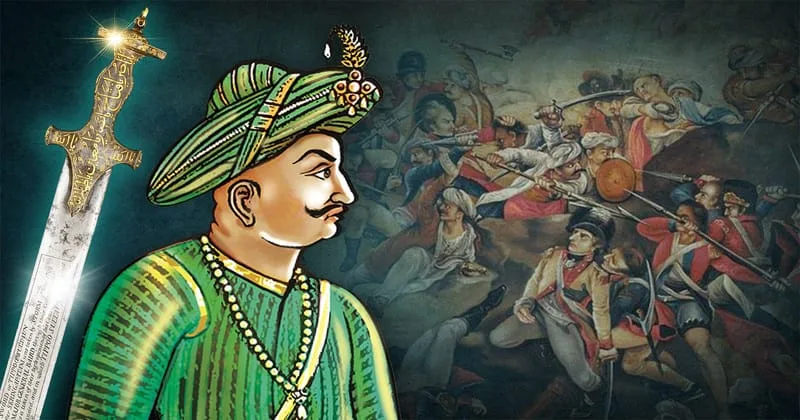
Tipu Sultan, often celebrated as a secular anti-colonial hero, presents a far more complex and troubling picture when examined through contemporary Persian letters, British military reports, missionary accounts, and regional gazetteers. While nationalist narratives highlight his resistance against colonial forces, historical sources reveal systematic persecution, forced conversions, deportations, and temple destruction across his kingdom.
Tipu Sultan is often described as a secular anti-colonial hero.
But Persian letters, British military reports, missionary writings, and regional gazetteers document large-scale killings, forced conversions, deportations, and temple destruction during his campaigns.
Here is what… pic.twitter.com/pLw2QdKWBB
— The Indian Matrix (@indianmatrix) February 16, 2026
Letters of Coercion: Conversion as policy
Persian correspondence attributed to Tipu Sultan between 1788 and 1790 explicitly frames religious conversion as state policy. Notable entries include:
A letter dated March 22, 1788, reportedly documents the forcible conversion of over 12,000 Hindus, while a subsequent communication on January 19, 1790, claims that “four lakh” people were converted in Malabar. The letters also describe conversions in Calicut as a religious achievement, indicating that these actions were deliberate and organised rather than accidental consequences of military campaigns. If authentic, these correspondences suggest that Tipu Sultan institutionalised forced religious conversion as a key component of his governance and military strategy.
The Malabar Campaign: Terror and conversion
British reports and regional sources detail widespread atrocities in Malabar:During the Malabar campaigns, Nair communities were subjected to forced conversion, and resisting groups were executed. Historian L.B. Boury records the deaths of thousands of Brahmin families in Kozhikode, while William Logan’s Malabar Manual documents systematic temple destruction across the region, reflecting both religious targeting and psychological subjugation. Colonel Fullarton’s reports further describe the public display of executed Brahmins, the forced circumcision of Hindu nobles, and the march of captives to Seringapatam, highlighting how military conquest was closely intertwined with religious coercion.
Canara and Mangalore: Displacement and forced conversion
Missionary accounts describe the deportation of Mangalorean Catholics, the confiscation of church property, and imprisonment or forced conversion of captives. Thousands were displaced, and mortality was significant, though exact figures vary. These accounts portray a climate of fear and subjugation extending beyond Hindus to include Christian communities.
Kodagu (Coorg) Campaigns: Mass captivity
Regional chronicles recount the large-scale capture of Kodavas, many of whom were forcibly circumcised, converted, and relocated to Seringapatam, often incorporated into Tipu’s military units. Estimates suggest several thousand to tens of thousands were affected.
Temple destruction and confiscation
Tipu’s campaigns saw widespread damage or destruction of Hindu temples across the kingdom. Sources such as the Malabar Manual, Mysore Gazetteer, and regional histories cite affected sites including Thalipparampu, Thrichambaram, Tellicherry, and Badakara. Scholars debate whether these acts were ideologically driven or retaliatory wartime measures, but the pattern indicates targeted attacks on religious and cultural institutions. While Tipu Sultan’s military prowess and anti-colonial resistance are often celebrated, the historical record presents a ruler who employed religious coercion, terror, and forced population displacement as tools of governance.