The editorial, published in Shiv Sena’s (UBT) mouthpiece Saamana, highlights the growing debate over leadership within the INDIA bloc, particularly after the Lok Sabha elections. It warns that internal friction and indecision could undermine the opposition’s ability to present a unified front against the ruling government in upcoming polls across West Bengal, Kerala, Tamil Nadu, Assam, Maharashtra, and Puducherry.
Highlighting regional political challenges, the editorial noted, “In West Bengal, Trinamool will challenge Congress; in Kerala, the Left continues to be a competitor; and in Maharashtra, historical local divisions have favored the BJP. Although the current Modi-led government does not hold a full majority and is dependent on alliances, its seeming strength continues to obstruct the opposition. Ultimately, the INDIA bloc must arrive at a consensus regarding a unified direction and a leader be it Mamata, Stalin, or another individual, to confront the national crisis.”
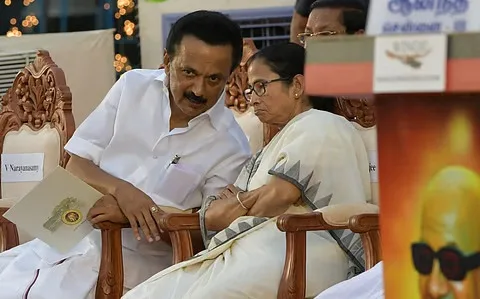
The Uddhav Thackeray-led party referred to voices from disgruntled Congress members and those associated with the UPA dispensation, who suggested that the INDIA bloc leadership should be given to West Bengal Chief Minister Mamata Banerjee or Tamil Nadu CM M K Stalin.
Saamana drew parallels to historical leadership challenges, stating, “While Mahatma Gandhi once relied on his ‘inner voice’ for spiritual and patriotic direction, the contemporary Congress is experiencing a different type of internal dissonance. Senior leaders and advisors are voicing divergent opinions when unity is crucial for the forthcoming elections.”
The editorial further emphasised the importance of deciding on a leader before formal election announcements, warning that post-announcement alliances often lack the strategic clarity necessary to counter the ruling government’s narrative. “The government has skillfully harnessed religious sentiments to sway public opinion, leading some segments of the populace to view international subservience like to President Trump, as a ‘divine blessing’. In this context, the opposition faces a pressing dilemma: Who will spearhead the effort to counter this narrative?” the editorial said.
On the internal debate, the editorial stated that various sections of the alliance are backing different leaders, creating a risk of “friendly fire” within the bloc. “The inner consciences of the people are awakening, and this reality cannot be overlooked. A resolution is necessary: Mamata, Stalin, or someone else,” it concluded.
The Congress has been helming the INDIA bloc, a coalition of Opposition parties formed before the 2024 Lok Sabha elections to counter the ruling BJP-led National Democratic Alliance.
The Shiv Sena (UBT), in its Saamana editorial, praised Congress leader and Lok Sabha Opposition Leader Rahul Gandhi for his resilience, noting that he remains unbothered by threats of being “thrown out of Parliament” or facing government-initiated cases. “This reflects his fighting spirit,” the editorial said.
However, the editorial also expressed concern over the broader state of the Congress and alliance workers. “Even capable leaders cannot compensate when workers grow lethargic due to prolonged absence from power, losing the hunger to return to governance,” it observed.
Commenting on the BJP’s position at the Centre, the Sena (UBT) said that despite the ruling party not having a full majority in the 2024 Lok Sabha elections and surviving on alliances, its “arrogance” remains unabated.
The editorial reiterated that the party’s disappointment with the Congress is not new. In a recent interview with PTI, Shiv Sena chief Uddhav Thackeray questioned the functional unity of the INDIA bloc, saying, “Probe a bit and check whether the INDIA bloc is there or not. It is true that we met only once after the parliamentary polls, at Rahul ji’s residence.”
The editorial in Saamana subtly raises questions about the confidence that INDI alliance partners still place in Rahul Gandhi. While it does not directly challenge his leadership, the repeated emphasis on deciding whether Mamata Banerjee, MK Stalin, or “someone else” should lead the bloc points to a possible erosion of trust in his ability to unify regional parties. The internal debates and divergent preferences among allies suggest that the Congress leader’s authority as the natural consensus choice may no longer be as uncontested as it once was, highlighting the strategic vulnerability of the alliance ahead of crucial state elections.