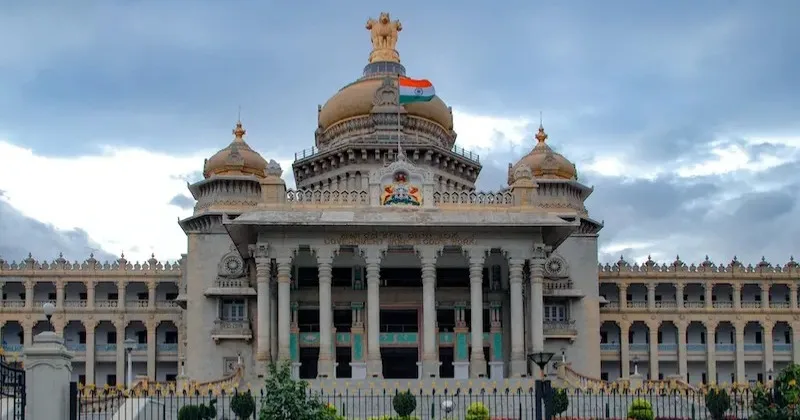
BENGALURU: Days after a 300-gram gold bar was allegedly stolen from outside a minister’s chamber inside Vidhana Soudha, the Government of Karnataka has issued fresh restrictions on media movement within the premises, citing security concerns. The move has sparked sharp criticism from media bodies and opposition leaders, who have accused the government of attempting to stifle press freedom.
According to official communication, the Department of Personnel and Administrative Reforms (DPAR) has written to the Department of Information and Public Relations, directing that journalists be confined to designated “media points” within Vidhana Soudha. Under the new guidelines, reporters will no longer be allowed to approach legislators, ministers, or officials in corridors or outside chambers for on-the-spot reactions.
Security lapse triggers new rules
The order comes in the wake of a major security embarrassment for the government. Last week, a 300-gram gold chain was reportedly stolen from outside the municipal administration minister Byrati Suresh’s room within the high-security zone of Vidhana Soudha. The incident, allegedly involving staff linked to the administrative department, raised serious questions about internal security arrangements.
Media coverage of the theft and repeated reports of security lapses inside the legislature complex are believed to have irked sections of the administration. Critics argue that instead of strengthening security protocols, the government has chosen to restrict journalistic access.
‘Lakshmana rekha’ for media
Under the new rules, journalists must obtain reactions from elected representatives only at specified official media interaction zones. Cameras and recording equipment will not be permitted in corridors, near ministerial chambers, or outside the Chief Minister’s office.
Until now, reporters stationed inside Vidhana Soudha could swiftly seek comments from leaders as political developments unfolded. Corridor interactions often provided real-time insights into legislative strategies, intra-party dissent, and government responses to emerging controversies.
Media representatives fear that the restrictions will significantly slow down news gathering and reduce spontaneous accountability. “Democracy’s fourth pillar cannot function if access is limited to curated spaces,” a senior journalist said, requesting anonymity.
Opposition alleges suppression
Opposition parties have questioned the timing of the order, linking it directly to the gold theft controversy. They argue that the new restrictions appear aimed at preventing further exposure of administrative lapses and shielding the government from uncomfortable questions.
Leaders noted that the Vidhana Soudha corridors have traditionally been spaces where the opposition has addressed the press on issues ranging from corruption allegations to governance failures. By restricting media presence in these areas, critics claim, the government may be attempting to control the narrative.
Government defends move
Officials, however, maintain that the decision is purely administrative and intended to enhance security and streamline media interactions. They argue that the unregulated movement of cameras and crew in sensitive areas poses logistical and safety challenges, especially during Assembly sessions.
The government has also stated that structured media points will ensure orderly briefings without disrupting official work.
Debate over press freedom
The development has reignited a broader debate over media freedom and transparency within legislative institutions. While security concerns are acknowledged, media organisations contend that access restrictions must not compromise the public’s right to know.
With Assembly proceedings underway and political tensions high, the new order is likely to remain a flashpoint. Whether the restrictions are temporary or signal a long-term shift in media policy inside Vidhana Soudha remains to be seen.