1946 Naval Revolt in Bombay: When sailors defied the British Raj
June 26, 2026
  • Read Ecopy
  • Circulation
  • Advertise
  • Careers
  • About Us
  • Contact Us
Android AppiPhone AppArattai
Organiser
  • ‌
  • Bharat
    • Assam
    • Bihar
    • Chhattisgarh
    • Jharkhand
    • Maharashtra
    • View All States
  • World
    • Asia
    • Europe
    • North America
    • South America
    • Africa
    • Australia
  • Editorial
  • International
  • Opinion
  • RSS @ 100
  • More
    • Op Sindoor
    • Analysis
    • Sports
    • Defence
    • Politics
    • Business
    • Economy
    • Culture
    • Special Report
    • Sci & Tech
    • Entertainment
    • G20
    • Azadi Ka Amrit Mahotsav
    • Vocal4Local
    • Web Stories
    • Education
    • Employment
    • Books
    • Interviews
    • Travel
    • Law
    • Health
    • Obituary
  • Subscribe
    • Subscribe Print Edition
    • Subscribe Ecopy
    • Read Ecopy
  • ‌
  • Bharat
    • Assam
    • Bihar
    • Chhattisgarh
    • Jharkhand
    • Maharashtra
    • View All States
  • World
    • Asia
    • Europe
    • North America
    • South America
    • Africa
    • Australia
  • Editorial
  • International
  • Opinion
  • RSS @ 100
  • More
    • Op Sindoor
    • Analysis
    • Sports
    • Defence
    • Politics
    • Business
    • Economy
    • Culture
    • Special Report
    • Sci & Tech
    • Entertainment
    • G20
    • Azadi Ka Amrit Mahotsav
    • Vocal4Local
    • Web Stories
    • Education
    • Employment
    • Books
    • Interviews
    • Travel
    • Law
    • Health
    • Obituary
  • Subscribe
    • Subscribe Print Edition
    • Subscribe Ecopy
    • Read Ecopy
Organiser
  • Home
  • Bharat
  • World
  • Operation Sindoor
  • Editorial
  • Analysis
  • Opinion
  • Culture
  • Defence
  • International Edition
  • RSS @ 100
  • Magazine
  • Read Ecopy
Home World Europe

Feb 18, 1946 Naval Revolt that shook foundation of the British Raj 80 years ago; Continued legacy of Azad Hind Fauz

On February 18, 1946, a spark inside a naval establishment in Bombay ignited one of the most dramatic and consequential uprisings in the final phase of India’s struggle for independence. The Royal Indian Navy uprising  not only rattled the foundations of British authority but also exposed the Congress party which did not stand up with the brave sailors

WEBDESKWEBDESK
Feb 18, 2026, 08:30 am IST
in Europe, Bharat, World, International Edition
Follow on Google News
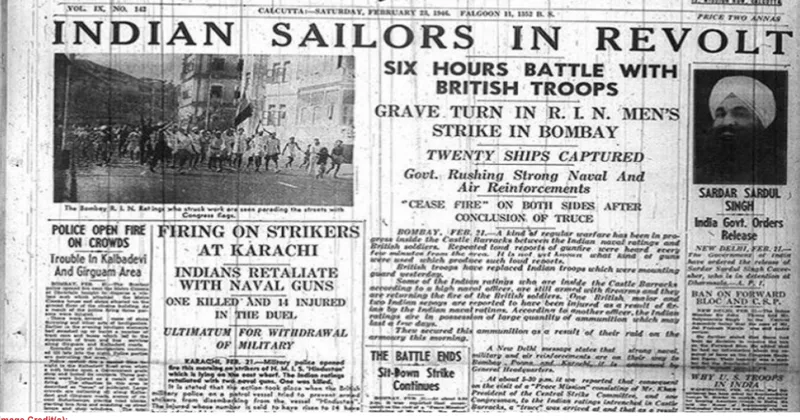
1946 Revolt by the Sailors of Royal Indian Navy against the British Raj

1946 Revolt by the Sailors of Royal Indian Navy against the British Raj

FacebookTwitterWhatsAppTelegramEmail

On February 18, 1946, approximately 2,000 Indian sailors of the Royal Indian Navy launched a strike in Bombay, setting in motion a chain of events that would shake the British Empire at its core. Over the next five days, the protest transformed into a full-scale uprising involving nearly 20,000 ratings across 78 ships and shore establishments.

The revolt began at HMIS Talwar, where young sailors—many between the ages of 15 and 24—refused to work in protest against inedible food, racial insults, and degrading treatment by British officers. The tipping point came when their commanding officer, Arthur Frederick King, allegedly used racial slurs against Indian ratings. In retaliation, sailors deflated his car tyres and painted “Quit India” on the bonnet.

By the next morning, the protest had escalated. The work call bugle went unanswered. Naval personnel began offering left-handed salutes to British officers and openly defied orders. The sailors replaced the Union Jack with the flags of the Indian National Congress, the Muslim League, and the Communist Party of India, symbolising a rare moment of unity across political and communal lines.

Also Read: Operation Sindoor intensifies as India set to stop Ravi River flow to Pakistan, deepening Islamabad’s economic crisis

The uprising spread rapidly. By February 19, an estimated 20,000 sailors from Bombay’s 11 naval units had joined. Soon, unrest rippled through Karachi, Madras, Poona, and even Aden. Indian Army garrisons reported disturbances. Ships in Bombay harbour were commandeered. The sailors trained their guns toward iconic landmarks such as the Gateway of India and the Taj Mahal Hotel, warning of retaliation if attacked.

The revolt was no longer about food. It had become a direct political challenge to British rule.

A City in Revolt

Bombay erupted in solidarity. Civilians poured onto the streets, bringing food, milk, fruits, and bread to the starving ratings. Hindu, Muslim, and Iranian shopkeepers opened their stores to supply provisions. On February 22, the city came to a standstill. Public transport shut down, trains were set ablaze, roads were blocked, and shops closed. Eleven military trucks were torched.

British authorities responded with force. Water and electricity to naval barracks were cut off. Troops were deployed with shoot-on-sight orders. In two days of violence, approximately 400 civilians were killed and over 1,500 injured. The Army fired indiscriminately into crowds. The city burned.

The revolt had clearly demonstrated that even the armed forces—the backbone of colonial control—were no longer immune to nationalist sentiment.

Former British Prime Minister Clement Attlee would later acknowledge that while multiple factors led to Britain’s decision to quit India, the unrest within the armed forces, including the naval revolt, significantly underscored the untenability of continued colonial rule.

Betrayal by Congress Party

Yet, at the height of the uprising, India’s principal political parties distanced themselves. The Indian National Congress condemned the revolt. Mahatma Gandhi criticised the freedom fighters for acting without political guidance, arguing that rebellion without discipline or moral authority could lead to chaos. The Congress urged people to “go about their work as usual.”

The All-India Muslim League, led by Muhammad Ali Jinnah, also disapproved, insisting that constitutional methods, not armed revolt, were the appropriate path forward.

For many historians and commentators, this marked a critical turning point. The last battle of India’s freedom struggle was not orchestrated by political elites but driven by rank-and-file servicemen. Political leaders, accustomed to negotiating with the British within structured frameworks, were wary of a spontaneous mass uprising that could slip beyond their control.

As the sailors appealed—“You, our people and our respected political leaders come to our aid”—the anticipated political backing did not materialise.

Suppression and Aftermath

Sensing isolation, the British moved decisively. Admiral Godfrey reportedly persuaded the Naval Central Strike Committee (NCSC) to return to their ships and barracks under the pretext of negotiations. Once regrouped, the Army surrounded the establishments. Faced with overwhelming force and lacking political support, the naval personnel were compelled to surrender on February 23.

Around 400 alleged ringleaders were arrested. More than 500 ratings were detained in harsh conditions in Mulund (Bombay) and Malir (Karachi). They were court-martialled, dismissed from service, and sent home with one-way train tickets. Uniform damages were deducted from their pay. Many were barred from returning to Bombay.

In independent India, recognition was slow and limited. Only in 1973 were a few participants acknowledged as freedom fighters. Pension claims largely went unanswered. In the 1990s, two naval tugboats were named after  BC Dutt and Madan Singh. A statue commemorating the uprising was installed in Colaba in 2001—more than half a century after the revolt.

A Legacy Revisited

The 1946 Naval Uprising remains a complex chapter in India’s freedom struggle. It was a dramatic demonstration that British authority was eroding from within the very institutions designed to uphold it. It accelerated the psychological collapse of imperial confidence and signalled that colonial rule could no longer rely on unquestioned loyalty from Indian servicemen.

At the same time, it revealed the cautious pragmatism of India’s mainstream political leadership, which prioritised negotiated transition over revolutionary upheaval.

Today, wreaths laid at memorials in Mumbai serve as reminders of a revolt that shook an empire and challenged the political calculus of the time. The young sailors who rose in February 1946 forced history to move faster—even if their own recognition came far too late.

Topics: Mahatma GandhiJawaharlal NehruBritish RajFreedom struggleRoyal Indian NavyCongress Betrayal
ShareTweetSendShareSend
✮ Subscribe Organiser YouTube Channel. ✮
✮ Join Organiser's WhatsApp channel for Nationalist views beyond the news. ✮
Previous News

Operation Sindoor intensifies as India set to stop Ravi River flow to Pakistan, deepening Islamabad’s economic crisis

Next News

Chhattisgarh: SC upholds Gram Sabha resolutions restricting entry of Christian missionaries in tribal villages

Related News

India’s history is not merely a tale of foreign domination but also a remarkable story of resilience, resistance & civilisational continuity

Indian History: Not just foreign rule, but a timeless story of resistance, self-respect and civilisational resilience

Maharana Pratap

Maharana Pratap and the Immortal Struggle of Haldighati: Eternal symbols of self-respect, freedom & indomitable courage

PM Modi to Overtake Nehru as India's Longest-Serving Elected Prime Minister on June 10

PM Modi set to surpass Nehru’s record, become India’s longest-serving elected Prime Minister

From Partition to the National Advisory Council in 2004, Congress-led decisions are seen as having lasting impacts on India’s territorial integrity

Dark Chapter of Congress: How partition, territorial concessions and political decisions shaped India’s troubled legacy

Akhil Bharatiya Adhivakta Parishad explores India’s early constitutional battles over free speech and judicial review

The First Amendment at 75: Revisiting Organiser’s historic free speech battle against the Nehru government

Union Home Minister Amit Shah and other leaders paid tributes to revolutionary Sukhdev Thapar on his birth anniversary

Sukhdev Thapar Birth Anniversary: Amit Shah and other leaders pay tribute to fearless revolutionary hero

Load More

Latest News

Massive explosion rocks Agartala Apartment

Tripura Blast: Massive explosion in Agartala apartment leaves several injured, probe underway

Joint Drill being held by security forces in Arunachal Pradesh

Arunachal Pradesh: Army-ITBP joint drill boosts border security readiness

Tamil Nadu: ED raids 21 sites in probe into 2017 TRB polytechnic lecturer recruitment scam, freezes 56 bank accounts

FCRA 2026: Centre bans foreign funds for religious conversion activities (This is an AI generated image)

FCRA 2026: Centre bans use of foreign funds for religious conversion, tightens NGO oversight

Uttar Pradesh's education system undergoes transformation under Yogi government

Uttar Pradesh’s Education Sector’s Transformation Story: From access to excellence under the Yogi government

Mounting debt and shrinking revenues are forcing Beijing to rethink the size and structure of its sprawling bureaucracy

China’s Economic Crisis Reaches the Bureaucracy: Beijing downgrades officials amid debt and fiscal strain

Y.D. Manjunath, Additional Excise Commissioner and brother-in-law of Karnataka PWD Minister Satish Jarkiholi

ED raids Karnataka Excise Dept officials: Rs 13.3 Cr seized, Minister Satish Jarkiholi’s brother-in-law under scanner

Former -DMK Minister EV Velu (File Photo)

Tamil Nadu: Anti-graft agency raids 13 locations linked to ex-DMK Minister EV Velu over alleged contract irregularities

Government introduces AIR SUVIDHA portal following WHO Ebola emergency for international travellers

The Emergency: India’s darkest chapter, the struggle for democracy and the ban on the RSS

Load More
  • Privacy
  • Terms
  • Cookie Policy
  • Refund and Cancellation
  • Delivery and Shipping

© Bharat Prakashan (Delhi) Limited.
Tech-enabled by Ananthapuri Technologies

  • Home
  • Search Organiser
  • Bharat
    • Assam
    • Bihar
    • Chhattisgarh
    • Jharkhand
    • Maharashtra
    • View All States
  • World
    • Asia
    • Africa
    • North America
    • South America
    • Europe
    • Australia
  • Editorial
  • Operation Sindoor
  • Opinion
  • Analysis
  • Defence
  • Culture
  • Sports
  • Business
  • RSS @ 100
  • Entertainment
  • More ..
    • Sci & Tech
    • Vocal4Local
    • Special Report
    • Education
    • Employment
    • Books
    • Interviews
    • Travel
    • Health
    • Politics
    • Law
    • Economy
    • Obituary
  • Subscribe Magazine
  • Read Ecopy
  • Advertise
  • Circulation
  • Careers
  • About Us
  • Contact Us
  • Policies & Terms
    • Privacy Policy
    • Cookie Policy
    • Refund and Cancellation
    • Terms of Use

© Bharat Prakashan (Delhi) Limited.
Tech-enabled by Ananthapuri Technologies