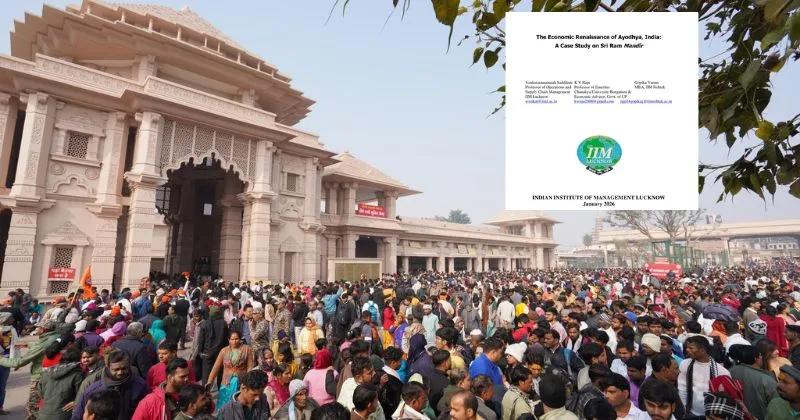
Ayodhya, the birthplace of Bhagwan Ram and one of India’s most sacred cities, is witnessing an unprecedented transformation. What was once a small, seasonal pilgrimage town has become one of the most dynamic spiritual and economic hubs of modern India. The pran pratistha of the Ram Mandir in January 2024 has not only fulfilled a centuries-old cultural aspiration but also set in motion an “economic renaissance,” as a recent study from IIM Lucknow termed it. The IIM Lucknow study, led by Professor Venkatramaniah Saddikuti from the operations and supply chain management department, along with K. V. Raju, Chief Economic Advisor to the Uttar Pradesh government and Gopika Varma, provides an academic lens to this growth.
The report concludes that Ayodhya’s post-temple economy represents one of India’s most successful cases of religious tourism-led urban rejuvenation. It draws parallels with global examples such as Mecca, Vatican City, and Jerusalem, where faith tourism drives large-scale employment and infrastructural development.
Check this IIM Lucknow @IIML report on Economic Renaissance of Ayodhya 🛕
You will realize that likes of @yadavakhilesh & @RahulGandhi were not only stopping the contribution of Sri Ram Temple, they were also stopping the economic prosperity of the region.
Ayodhya Economy —… pic.twitter.com/S2SOHW2FDK
— Shantanu Gupta (@shantanug_) February 16, 2026
The study highlights a fivefold rise in local incomes, a surge in tourism, and large-scale redevelopment projects reshaping Ayodhya’s skyline. The city has become a living example of how faith, infrastructure, and vision can together drive holistic growth.
Before the construction of the Ram Temple began, Ayodhya’s economy was modest and largely seasonal. The city attracted around 1.7 lakh visitors annually, mostly during festivals such as Ram Navami and Diwali. Tourism was limited to short stays, and spending patterns were modest.
Local shopkeepers, many of whom ran small eateries, religious merchandise stalls, or lodging houses, earned only Rs 400- Rs 500 a day. The lack of infrastructure and poor connectivity made it difficult to attract larger numbers of visitors or investors. The railway station was old and congested, and the city had no airport, limiting accessibility. Hotels were few and small in size, with no presence of national or international chains. The absence of quality accommodation and modern facilities kept Ayodhya off the radar of mainstream tourists.
Real estate prices remained largely stagnant, and the city saw youth migration to nearby districts like Lucknow, Faizabad, and Varanasi for employment. Most residents relied on temple-related livelihoods: priests, small dhabas, and souvenir sellers. Government investment was minimal, and there was little private participation in city development. In short, Ayodhya’s economy before the temple was symbolic of cultural glory but limited in economic potential.
The Turning Point: Building the Ram Temple
The turning point came with the historic Supreme Court verdict in 2019, paving the way for the construction of the Ram Temple. The groundwork began not only for the temple but also for a complete urban and economic rejuvenation plan for Ayodhya. The Uttar Pradesh government, led by Chief Minister Yogi Adityanath, envisioned Ayodhya as a global spiritual destination. The aim was to integrate religious tourism with modern infrastructure, thereby creating employment, improving connectivity, and preserving the city’s heritage.
Massive investments began pouring in. The Ayodhya Master Plan 2031 was announced, which included an international airport, new roads, riverfront beautification, upgraded civic facilities, and large hospitality projects. The Ram Path, Bhakti Path, and Janmabhoomi Path projects were launched to improve mobility and ease pilgrim flow.
Post-Temple Era: A City Reborn
The pran pratistha of the Ram Mandir on January 22, 2024, was a new dawn for Ayodhya. Within six months of the temple’s opening, the city witnessed a staggering 11 crore visitors, according to official estimates and the IIM Lucknow study.
The inflow of tourists led to a surge in business for local shopkeepers, hoteliers, and transport operators. The IIM study found that average shopkeeper income rose from Rs 400-Rs 500 per day to nearly Rs 2,500 per day, a fivefold increase. The hospitality industry saw record occupancies, and new businesses mushroomed to meet the growing demand for accommodation, food, and travel services.
Redevelopment and Infrastructure Boom: The transformation of Ayodhya is supported by an Rs 85,000 crore redevelopment plan, with ongoing and upcoming projects covering nearly every aspect of urban life.
Connectivity Revolution: Maharishi Valmiki International Airport, inaugurated in December 2023, now connects Ayodhya to major Indian cities like Delhi, Mumbai, Kolkata, and Bengaluru, and is set to handle international flights soon. The Ayodhya Dham railway station has been completely rebuilt with modern amenities, designed to handle the surge in passenger numbers. Wider roads, organized parking zones, and e-transport systems ensure smoother mobility within the city.
Hospitality & Real Estate Growth: Renowned hotel chains like Taj Hotels, Marriott International, and Wyndham Hotels & Resorts have entered the Ayodhya market, with several high-end and mid-range properties under construction. Real estate prices have surged by 25-40% overall, and by five to ten times near the temple area. Demand for residential and commercial properties has led to new housing colonies, guest houses, and retail spaces.
Smart City Initiatives: The city is being developed with smart lighting, upgraded drainage systems, solid waste management, and 24×7 surveillance for pilgrims’ safety. Riverfront areas along the Saryu River are being beautified to promote cultural tourism and eco-tourism.
The new Ayodhya economy is generating jobs across multiple sectors. The IIM Lucknow report 2026 estimates over 1.2 lakh new jobs have been created in tourism, transport, retail, construction, and hospitality. From temple guides and travel agents to hotel staff and artisans, local residents are benefiting from the boom. Women’s self-help groups are also taking part by producing handicrafts, prasad boxes, and local delicacies for sale to visitors.
Taxi and e-rickshaw drivers, food stall owners, and homestay operators report consistent income growth. The demand for English-speaking guides, digital payment service providers, and photographers has also expanded, introducing new skill-based professions into the local economy.
Ayodhya’s fiscal contribution to the state economy has grown sharply. The city generated Rs 400 crore in GST revenue within months of the temple’s opening. The annual tourism revenue potential is now pegged at Rs 10,000 crore (Rs 100 billion), as per the IIM study titled “The Economic Renaissance of Ayodhya: A Case Study on Sri Ram Mandir.” The report also highlights that this growth is sustainable and is driven by a combination of faith-based tourism, heritage conservation, and infrastructure development.
One of the most notable aspects of Ayodhya’s development model is its emphasis on sustainability and cultural preservation. The government has ensured that modernization does not compromise the city’s spiritual and historical essence. Efforts include:
- Use of traditional architecture in public buildings and hotels
- Green zones and eco-friendly materials in construction
- Solar-powered street lighting and e-vehicles for intra-city transport
- Waste segregation and water recycling systems near temple and ghats
With the success of Ayodhya, the Uttar Pradesh government plans to develop “Ramayan Circuits” connecting places linked to Lord Ram’s life. This will promote cultural tourism across multiple states.