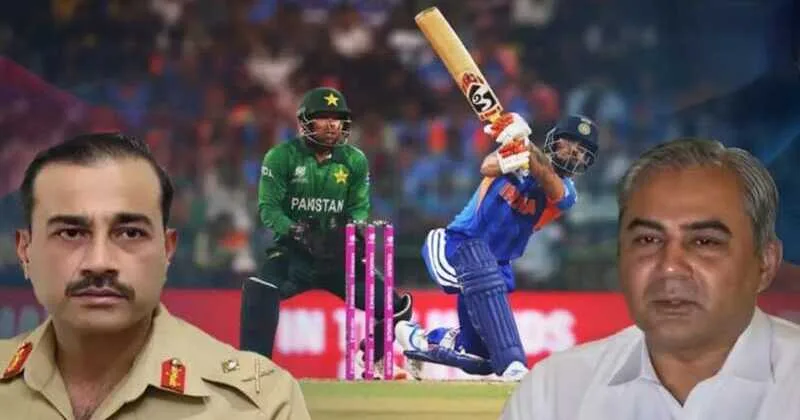
Colombo/Islamabad: Pakistan’s latest cricket defeat to India has spiralled far beyond the boundary ropes, triggering a political and institutional crisis that now threatens the leadership of the Pakistan Cricket Board (PCB). What began as another one-sided loss on the field has evolved into a sensitive civil–military confrontation following controversial remarks by PCB Chairman and Interior Minister Mohsin Naqvi. Speaking at a press conference ahead of the India–Pakistan clash in the ICC Men’s T20 World Cup, Naqvi declared that neither he nor the Pakistani government feared India or the International Cricket Council.
More controversially, he referred to Pakistan Army Chief Asim Munir as a “field marshal” and claimed that the military leadership was also unafraid of external pressure. “I am not afraid of threats from India and the ICC, and neither is the Pakistani government. As for Field Marshal Asim Munir, as you know about him, he is not afraid at all. We are not worried about sanctions,” Naqvi said. The comments backfired almost immediately after Pakistan suffered a humiliating defeat against India. According to sources, the statement angered Army Headquarters in Rawalpindi, which viewed Naqvi’s use of the army chief’s name as a breach of military protocol and an unnecessary intrusion of cricket administration into national security affairs. What was already a painful sporting loss has now escalated into a strategic dispute between the PCB chairman and the army leadership.
Former players demand accountability as team faces heavy criticism
Pakistan’s crushing defeat reverberated across the country, drawing sharp reactions from former cricketers and analysts who blamed both players and management for the poor performance.
Former player Mohammad Yousuf joined others in calling for major changes in the squad, including the possible removal of senior players such as Babar Azam and pace spearhead Shaheen Shah Afridi.
The highly anticipated clash between the two cricketing rivals was expected to be fiercely competitive. Instead, India dominated from start to finish. Pakistan never gained control at any stage of the match. Indian batters dismantled Shaheen Afridi’s bowling, and later India’s bowlers dismantled Pakistan’s batting lineup with equal authority.
Critics questioned Pakistan’s tactical decisions, particularly after the team won the toss and opted to bowl. Several former players described captain Salman’s choice to introduce Usman Tariq only in the 11th over as a costly misjudgment. Tariq was expected to be a surprise weapon, but the delayed introduction proved ineffective.
Former captain Mohammad Hafeez placed responsibility squarely on senior players, arguing that despite having played over 100 T20 internationals, Babar Azam once again failed to deliver in a high-pressure encounter against India.
Spinner Saqlain Mushtaq took a different view, stating openly that the blame should fall on team management rather than the players. He emphasised systemic failures in preparation and strategy. All-rounder Shadab Khan, Mushtaq’s nephew, also came under scrutiny amid the broader critique.
Adding to the backlash, former fast bowler Shoaib Akhtar launched a scathing attack on Naqvi during a live television programme, calling him “incompetent and ignorant.”
“The PCB has made a person who knows nothing the chairman. Giving big positions to ignorant people is the biggest crime in the world,” Akhtar said.
Army displeasure, fuel price hike deepen national crisis
Behind the scenes, the situation has become increasingly tense. Reports indicate that Army Chief Asim Munir conveyed his disappointment over both the team’s performance and Naqvi’s remarks to Prime Minister Shehbaz Sharif. Military officials reportedly objected strongly to Naqvi referring to Munir as a “field marshal,” a rank he does not hold, calling it technically incorrect and a violation of protocol. The army leadership views the episode as damaging to national prestige. For Pakistan, cricket matches against India carry deep political and symbolic significance. Senior officers believe that inadequate preparation by the PCB, combined with Naqvi’s provocative statements, worsened the fallout from defeat.
Sources in Islamabad say Munir communicated his concerns to the prime minister through his military secretary, highlighting mismanagement within the PCB. There is growing speculation that Naqvi’s position as PCB chairman may now be in jeopardy, with Shehbaz Sharif reportedly considering organisational changes to appease the army and restore confidence in cricket governance. As political uncertainty grows, ordinary Pakistanis are facing yet another economic shock. The government has announced a fresh hike in fuel prices, increasing petrol by Rs 5 per litre and diesel by Rs 7.32. Petrol now costs Rs 258.17 per litre (approximately Rs 83.75 in Indian currency), while diesel stands at Rs 275.70 (around Rs 89.45).
The increase is expected to intensify inflationary pressures already burdening households. Higher fuel prices will raise transportation costs, push up food prices, and increase production expenses in agriculture, a sector that employs a large portion of the population. Analysts warn that the combined impact of sporting humiliation, institutional conflict, and economic strain is deepening public frustration. Within military circles, the defeat against India is being seen not merely as a loss in cricket but as a blow to national morale. The army has reportedly expressed anger over what it considers poor team preparation and Naqvi’s immature public messaging. Dragging the army chief’s name into a cricket controversy without prior approval has been described as unacceptable interference.
Cricket in Pakistan has always been more than a game; it mirrors the country’s political stability and governance. As tensions simmer between civilian authorities and the military establishment, developments in Islamabad over the coming days are likely to shape not only the future of the PCB but also the direction of Pakistani cricket itself.