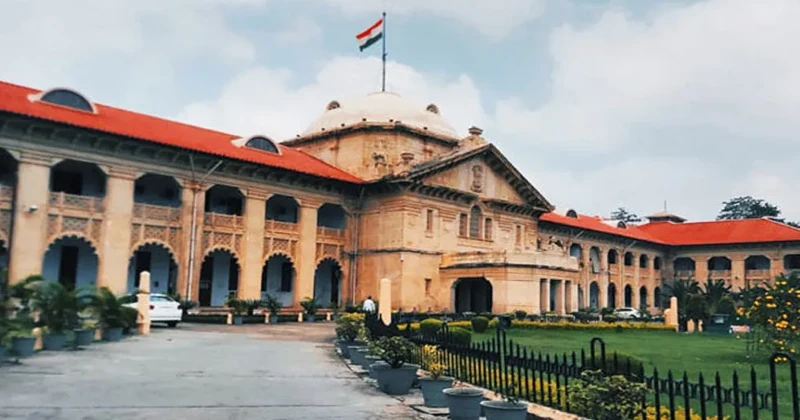
On 10 February 2026, the Allahabad High Court ruled that caste, which is determined by birth, does not change due to inter-caste marriage or conversion to another religion. The judgment was delivered by Justice Anil Kumar while hearing a criminal appeal in a case registered under the Scheduled Castes and Scheduled Tribes (Prevention of Atrocities) Act.
The case arose from an incident in Aligarh district of Uttar Pradesh involving a Scheduled Caste (SC) woman who had married a man from the Jat community. The accused, including Dinesh and eight others, had challenged an order of the Special Judge under the SC/ST Act summoning them to face trial for offences under Sections 323, 506, 452 and 354 of the Indian Penal Code (IPC), along with Section 3(1)(R) of the SC/ST Act.
The High Court dismissed the appeal, holding that the arguments raised by the appellants lacked merit.
Background of the case
The complainant, Jyotirai Devi, alleged that she was assaulted and subjected to casteist abuse by the accused during an altercation. According to the complaint, the incident occurred on 6 September 2021 in Aligarh district.
She stated that during the confrontation, the accused attacked her and members of her family, hurled caste-based slurs, and caused injuries. She further alleged that Dinesh grabbed her private parts during the assault. The complaint mentioned that three persons, including the informant, were injured.
The High Court noted that the events described in the First Information Report (FIR) and the complaint occurred on the same day.
The court observed, “The allegation in the complaint is that the informant was assaulted and abused by the appellants. The complainant has also stated that the appellants used casteist slurs during the altercation. Three persons, including the informant, were injured in the incident. Hence, the claim of the appellants that the present complaint was lodged as a counterblast is untenable. Therefore, this criminal appeal lacks merit and is liable to be dismissed.”
Appellants’ arguments before the court
The appellants contended that they had been falsely implicated in the case and that an FIR had already been lodged against the complainant’s side before the filing of the present complaint. They argued that medical reports showed that members of their family had also sustained injuries.
A central argument raised by the appellants concerned the caste status of the complainant. They submitted that the complainant was originally a resident of West Bengal and belonged to the SC/ST community there. However, they argued that she had married a man belonging to the Jat community and had concealed this fact while claiming protection under the SC/ST Act.
They maintained, “Once she married a person belonging to the Jat community, she cannot claim herself to be a woman belonging to the SC/ST community.”
According to the appellants, a woman who marries outside her caste loses her original caste and adopts the caste of her husband. On that basis, they argued that proceedings under the SC/ST Act were not sustainable.
Court’s observations and verdict
The High Court rejected these arguments. It observed that the existence of a cross-case does not automatically invalidate a complaint filed by the opposing party. The court stated, “The existence of a cross-case does not constitute a ground to discard a complaint filed by the opposite party on a rival version. Hence, it cannot be said that the learned trial court has committed any illegality in summoning the appellants for the alleged offences.”
On the issue of caste identity, the court held, “So far as the contention that the informant has lost her caste after marrying a person belonging to the Jat community is concerned, the said contention has no force. Though a person may change religion, his or her caste remains the same despite conversion to another religion. Hence, marriage does not change a person’s caste. Therefore, the said contention is unsustainable. Accordingly, the appeal is dismissed.”
With this, the High Court upheld the summoning order passed by the Special Judge under the SC/ST Act.
Order of the special Judge under SC/ST Act
Earlier, on 27 July 2022, Special Judge Sanjeev Kumar Singh, presiding over the SC/ST (Prevention of Atrocities) Act court, had directed several accused persons to stand trial based on the complaint filed by Jyotirai Devi.
In her complaint, Jyotirai Devi stated that she had contested the village pradhan election the previous year, which allegedly led to hostility from the accused. She claimed that on 6 September 2021, while she was preparing food in her courtyard, bricks were thrown into her premises.
When she objected, several accused persons allegedly entered her house armed with sticks, bricks, a country-made pistol, an iron pipe, and a sickle. According to the complaint, she and her family members were assaulted and abused. She alleged that Bharat Bhushan fired a shot with intent to kill, but her family narrowly escaped serious harm.
She further claimed that neighbours Dharamveer and Sitaram arrived upon hearing the commotion but were threatened by the accused.
After the incident, she attempted to file a complaint at the police station, but it was allegedly not accepted. She then submitted an application to the Senior Superintendent of Police (SSP), Aligarh, on 21 September 2021, but stated that no action was taken.
The Special Judge examined oral evidence under Sections 200 and 202 of the Code of Criminal Procedure (CrPC). Medical reports relating to Jyotirai Devi and others were placed on record. The court found that a prima facie case was made out under Sections 323, 506, 452 and 354 IPC and Section 3(1)(R) of the SC/ST Act, and directed the accused to face trial.
Cross FIR filed by Lotan Singh
On 7 September 2021, an FIR was filed by Lotan Singh at Khair Police Station in Aligarh district. In his complaint, he alleged that Vishnu and others had forcibly entered his residence armed with sticks and bricks and assaulted him around 6:30 pm on 6 September 2021.
He claimed that Dinesh and Satish rushed to intervene but were also attacked. According to the FIR, his sons Bharat and Dinesh sustained serious head injuries. He alleged that he himself had also suffered injuries.
The police invoked Sections 147, 323, 308 and 452 of the IPC in that case.
The existence of this cross FIR formed part of the appellants’ argument before the High Court. However, as noted, the court held that a cross-case does not automatically negate the complaint filed by the opposite party.
Broader legal context
Indian courts have consistently maintained that caste-based reservation benefits are not available to individuals who have left Hinduism and converted to Christianity. In a separate development last year, the Allahabad High Court directed district magistrates in Uttar Pradesh to identify individuals who had converted but continued to claim SC status, describing such actions as a “fraud on the Constitution.”
In the present case, however, the court’s focus was not on reservation benefits but on whether marriage or conversion affects caste identity for the purposes of invoking protections under the SC/ST Act.
The Allahabad High Court’s ruling clarifies that caste, as recognised in law, remains tied to birth and is not altered by inter-caste marriage or religious conversion. By dismissing the criminal appeal and upholding the summoning order, the court reaffirmed that such personal changes do not invalidate protections available under the SC/ST (Prevention of Atrocities) Act.
The verdict has drawn attention for its interpretation of caste identity and its implications in cases involving marriage, conversion, and the application of protective legislation.