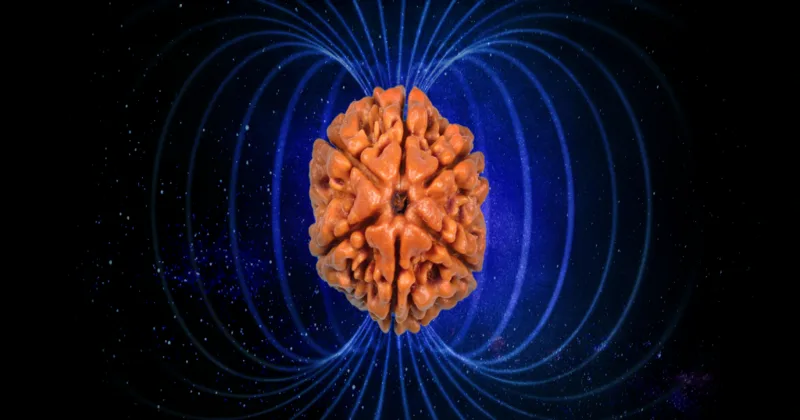
Rudraksha beads have been revered for centuries in Indian spiritual traditions, especially in Shaiva and yogic practices. Traditionally associated with meditation, mental stability and spiritual growth, Rudraksha has often been discussed in symbolic or mythological terms. However, in recent decades, interest has grown in examining Rudraksha from a scientific and biophysical perspective, particularly its dielectric behaviour, electromagnetic interaction with the human body and possible biotechnical effects.
Viewed through the lens of modern physics, materials science and neurobiology, Rudraksha emerges not merely as a sacred object, but as a natural bio-material with intriguing electro-physical characteristics.
Rudraksha is the seed of the plant Elaeocarpus ganitrus and can be scientifically understood as a natural biomaterial rather than merely a religious object. From a materials science perspective, it is a complex organic composite made up mainly of cellulose, lignin and other natural polymers arranged in a highly organized, porous microstructure.
This porous architecture allows the bead to interact with its surroundings, including moisture, temperature and electromagnetic fields. In addition, trace amounts of naturally embedded minerals further modify its electrical response. The surface of Rudraksha is characterized by multiple grooves, known as mukhis, which significantly increase its surface area and create localized electric field variations.
Unlike metals, Rudraksha does not allow free flow of electric charge, instead it behaves as a dielectric material, capable of storing electric energy and responding to external electric fields. This dielectric behaviour is crucial because the human body itself operates through bioelectric signals generated by nerves, muscles and the heart. When worn in close contact with the skin, Rudraksha may therefore interact with the body’s weak electrical fields, providing a plausible scientific basis for its reported biotechnical and physiological effects.
Dielectric Properties
A dielectric material is one that becomes polarized when placed in an electric field, meaning it can store electrical energy without allowing current to flow freely. Human biological systems, particularly the nervous system and the heart function through precisely regulated bioelectric signals produced by the movement of ions across cell membranes. In this context, Rudraksha becomes scientifically interesting.
Limited but steadily growing laboratory studies suggest that Rudraksha beads possess measurable dielectric constant values and exhibit clear capacitive behaviour, similar to many natural insulating materials used in modern technology. Its porous internal structure enables localized charge storage and gradual redistribution of electric charge.
When worn in direct contact with the skin, Rudraksha may therefore function as a micro-dielectric modulator, subtly interacting with the body’s weak electromagnetic fields. Importantly, this interaction does not imply the generation of energy in a mystical sense, rather it represents passive field modulation, comparable to the role dielectric materials play in sensors, capacitors and biomedical interfaces designed to interact safely with living tissues.
Interaction with human bioelectric fields
The human body continuously generates weak, but measurable electromagnetic fields as part of its normal physiological functioning. The heart produces rhythmic electrical signals that can be recorded as an electrocardiogram (ECG), the brain operates through complex electrical oscillations observed in electroencephalograms (EEG) and nerve impulses propagate via electrochemical signalling along neural pathways.
When a dielectric object such as Rudraksha remains in close contact with the skin, particularly at pulse points where bioelectric activity is pronounced, it may influence local charge distribution, electrostatic balance, and the stabilization of microcurrents at the skin – tissue interface. Some experimental observations suggest that Rudraksha can help dampen high-frequency electrical noise associated with stress driven sympathetic nervous system activity. This provides a scientifically plausible explanation that aligns with traditional descriptions of Rudraksha as promoting calmness, emotional balance and mental stability, without invoking non-physical or mystical energy concepts.
Biotechnical effects on the nervous system
From a neurobiological standpoint, the effects associated with Rudraksha are best understood as indirect yet meaningful outcomes of sensory and physiological modulation. One important mechanism is tactile neural feedback. Handling or wearing Rudraksha beads provides continuous, gentle tactile stimulation that activates sensory nerve endings in the skin. This stimulation can enhance parasympathetic nervous system activity, which is responsible for calming and restorative functions in the body, while also reinforcing mindfulness through sustained physical awareness. In this respect, Rudraksha functions in a manner similar to stress balls, prayer beads, or modern haptic feedback tools, all of which are known to reduce anxiety by engaging the senses and anchoring attention in the present moment.
In addition, Rudraksha may contribute to autonomic nervous system regulation. Some pilot studies and physiological observations have reported reduced fluctuations in heart rate variability, improved balance between sympathetic and parasympathetic activity and lower stress markers during meditation practices that involve Rudraksha malas. These effects are consistent with well established principles of neuromodulation driven by repetitive sensory cues and focused attention, rather than any form of supernatural intervention. Together, these findings suggest that the calming influence traditionally attributed to Rudraksha can be explained through known neurobiological and psychophysiological mechanisms.
Electromagnetic shielding and stress modulation
Modern environments are increasingly saturated with electromagnetic radiation from mobile phones, Wi-Fi networks, and a wide range of electronic devices. While Rudraksha does not function as a shield in the strict engineering sense, its dielectric nature may still play a subtle role at the local level. By remaining in continuous contact with the skin, it can help reduce localized electrostatic charge buildup, stabilize skin level electromagnetic interactions and provide mild grounding effects through sustained physical coupling. From a biotechnical perspective, Rudraksha can therefore be viewed as a bio-compatible interface rather than a protective barrier, one that gently influences the electrochemical equilibrium at the skin–nerve boundary without blocking or absorbing external radiation.
Mukhi structure and surface geometry
The mukhi patterns on Rudraksha beads are not merely symbolic or decorative, they also influence the bead’s physical behaviour. The grooves increase surface roughness and effective surface area, which can enhance capacitance and modify how electric charge is stored and redistributed. The inherently asymmetric geometry of the bead affects local charge distribution, leading to the formation of distinct micro-electric field patterns around the surface. As a result, Rudraksha beads with different numbers of mukhis may exhibit slightly different electrical and electrostatic responses. This provides a plausible scientific basis for the long-held perception that beads with different mukhi counts produce different experiential effects, although systematic experimental mapping and quantitative comparison of these variations remains an open and promising area for future research.
Rudraksha, meditation and neuroplasticity
One of the most consistently observed effects associated with Rudraksha is its supportive role in meditation practice. Neuroscientific research shows that regular meditation can lead to measurable structural and functional changes in the brain, reflecting neuroplasticity, along with improved attention control and reduced stress reactivity. Rudraksha malas facilitate this process by providing rhythmic repetition through japa, which helps maintain a steady attentional anchor. The tactile sequencing of beads also supports synchronization between breathing, cognitive focus and motor activity. In this way, the biotechnical influence of Rudraksha does not arise from isolated physical properties alone, but from its synergistic integration into cognitive and physiological self-regulation systems that enhance meditative stability and mental well-being.
Separating science from exaggeration
Scientific interpretation of Rudraksha requires careful distinction between traditional beliefs and evidence-based effects. It should not be regarded as a medical cure, a source of mystical energy, or a substitute for clinical treatment. Its true value, from a scientific perspective, lies in its passive dielectric interaction with the body, neuro-sensory modulation through tactile engagement and the behavioural reinforcement of calmness and focused attention during meditation or mindful practice. While these effects are subtle, they are consistent with principles of physics, neuroscience and psychophysiology, making them scientifically plausible without invoking supernatural explanations.
Rudraksha stands at a fascinating intersection of ancient wisdom and modern science. When examined through physics, materials science and neuroscience, it reveals itself as a natural dielectric biomaterial capable of interacting with human bioelectric systems in subtle but meaningful ways. The ancient practice of wearing Rudraksha may thus be understood not as superstition, but as an intuitive engagement with biophysical principles long before formal scientific language existed. In this sense, Rudraksha exemplifies a deeper truth: traditional knowledge systems often encoded practical understanding of nature, waiting for modern science to rediscover and articulate them.