How Kaziranga became last fortress of the one horned rhinoceros
June 27, 2026
  • Read Ecopy
  • Circulation
  • Advertise
  • Careers
  • About Us
  • Contact Us
Android AppiPhone AppArattai
Organiser
  • ‌
  • Bharat
    • Assam
    • Bihar
    • Chhattisgarh
    • Jharkhand
    • Maharashtra
    • View All States
  • World
    • Asia
    • Europe
    • North America
    • South America
    • Africa
    • Australia
  • Editorial
  • International
  • Opinion
  • RSS @ 100
  • More
    • Op Sindoor
    • Analysis
    • Sports
    • Defence
    • Politics
    • Business
    • Economy
    • Culture
    • Special Report
    • Sci & Tech
    • Entertainment
    • G20
    • Azadi Ka Amrit Mahotsav
    • Vocal4Local
    • Web Stories
    • Education
    • Employment
    • Books
    • Interviews
    • Travel
    • Law
    • Health
    • Obituary
  • Subscribe
    • Subscribe Print Edition
    • Subscribe Ecopy
    • Read Ecopy
  • ‌
  • Bharat
    • Assam
    • Bihar
    • Chhattisgarh
    • Jharkhand
    • Maharashtra
    • View All States
  • World
    • Asia
    • Europe
    • North America
    • South America
    • Africa
    • Australia
  • Editorial
  • International
  • Opinion
  • RSS @ 100
  • More
    • Op Sindoor
    • Analysis
    • Sports
    • Defence
    • Politics
    • Business
    • Economy
    • Culture
    • Special Report
    • Sci & Tech
    • Entertainment
    • G20
    • Azadi Ka Amrit Mahotsav
    • Vocal4Local
    • Web Stories
    • Education
    • Employment
    • Books
    • Interviews
    • Travel
    • Law
    • Health
    • Obituary
  • Subscribe
    • Subscribe Print Edition
    • Subscribe Ecopy
    • Read Ecopy
Organiser
  • Home
  • Bharat
  • World
  • Operation Sindoor
  • Editorial
  • Analysis
  • Opinion
  • Culture
  • Defence
  • International Edition
  • RSS @ 100
  • Magazine
  • Read Ecopy
Home Bharat

From Extinction to Refuge: How Kaziranga became the last fortress of the one horned rhinoceros

New palaeoecological research reveals that Kaziranga’s emergence as the global stronghold of the Indian one-horned rhinoceros reflects thousands of years of climatic stability, vegetation dynamics and ecological adaptation. Thus offering lessons for conservation under present and future climate change challenges

Vivek KumarVivek Kumar
Feb 13, 2026, 08:00 pm IST
in Bharat, Assam
Follow on Google News
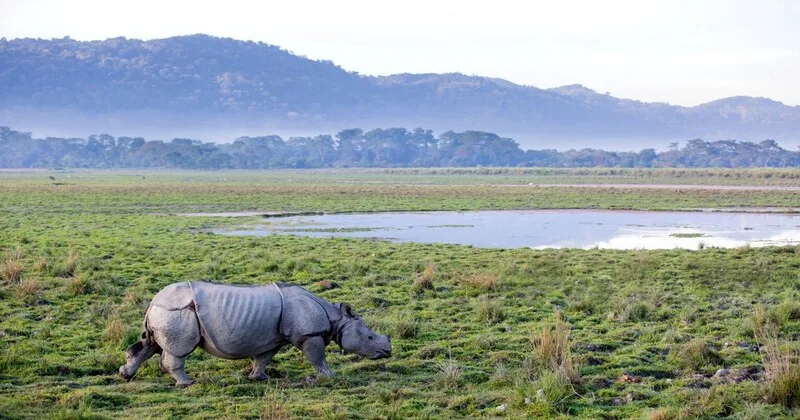
A representative Image of One Horned Rhinoceros

A representative Image of One Horned Rhinoceros

FacebookTwitterWhatsAppTelegramEmail

The global identity of Kaziranga is linked to the image of the Indian one-horned rhinoceros thriving in a landscape of tall grasslands and seasonal wetlands. But recent scientific studies have shown that the landscape and associated fauna are not necessarily static ecological entities but products of climatic and vegetational changes, accompanied by anthropogenic influences over millennia. A recent, very detailed palaeoecological investigation of the landscape history of Kaziranga was published in Catena, a journal of the Elsevier Group. The authors place the Kaziranga National Park within a much broader historical perspective of megafaunal survival, extinction and migration in the Indian subcontinent

Information from fossil records, plant reconstructions, and palaeoenvironmental models is used to show that the contemporary position of rhinoceroses is due to their success in the present. It is a result of a filtering process which began at the end of the Holocene era.

A Subcontinent Once Shared by Megaherbivores

The Indian one-horned rhinoceros is not exclusively confined to the Assam floodplains. Fossil evidence considered in the study confirms that megaherbivores, including rhinoceroses, were once continuously distributed across large parts of the Indian subcontinent. From northwestern India down to the Gangetic plains, suitable habitats supported the large grazers during earlier climatic phases.

This wide distribution started to contract after the mid to late Holocene. Climatic amelioration, resulting in changes in the intensity of monsoons and temperature,e thus changed vegetation patterns over northwestern and central India. Grasslands and swampy forests that earlier supported megafauna gave way to drier conditions and habitat fragmentation. These ecological changes were further exacerbated by increasing human activities such as land use transformation and hunting pressures, which disproportionately affected large-bodied species with poor reproductive rates.

The Little Ice Age and Ecological Divergence

One of the most important findings of the study is its discussion of climatic instability during the late Holocene, especially the Little Ice Age. The climate in northwestern India was quite unstable, while that in northeastern India was stable. All such factors significantly impacted India’s wildlife.

Also Read: Modi govt directs schools, colleges to report foreign admissions within 24 hours to strengthen national security

In regions with low vegetation productivity and declining wetland formation, megaherbivores may have experienced reduced food availability. The study also highlights regional extinctions in the area, including rhinoceroses from northwestern India. The floodplains of the Brahmaputra, including Kaziranga, have supported vegetation consisting of grasslands, shallow swamps, and riverine forests, all of which have allowed large grazers to still thrive.

This stability helped to create a stable climate refuge in northeastern India. Over time, rhinos and other megaherbivores have slowly drifted east, accumulating in locations with more favourable ecological conditions and less human disturbance.

Vegetation, Water and Wildlife Dynamics

Changes in forest density and water depth, and their relationships with wildlife activity in the Kaziranga region, are reconstructed using schematic palaeo-vegetation models. The timing of dense forests and deep swamp conditions corresponds to low megaherbivore movement, while those with relatively open forests and shallow wetlands correspond to high wildlife activity, especially grazing and wallowing.

These findings underline a key ecological principle: Kaziranga’s biodiversity is sustained not by uniform wilderness but by dynamic disturbance regimes. Seasonal flooding of the Brahmaputra rejuvenates grasslands, controls woody encroachment, maintained the open habitats preferred by rhinoceroses and other large herbivores. Over longer timescales, this interplay between water, vegetation and animal movement shaped a resilient ecosystem capable of absorbing climatic variability.

Human Pressure and Survival Thresholds

This is further situated in the context of Kaziranga’s ecological trajectory as human expansion took place elsewhere in the subcontinent. Northeastern India was hardly devoid of human presence, population densities and landscape modification. Remained lower in comparison with the northwest during critical periods, a difference that proved decisive.

Megaherbivores are most susceptible to the combined pressures of habitat loss and hunting. Once populations drop below certain thresholds, recovery becomes ecologically improbable. The disappearance of rhinoceroses from large parts of India reflects a tipping-point dynamic. Kaziranga, by contrast, remained above this survival threshold, allowing populations to persist until modern conservation frameworks came along.
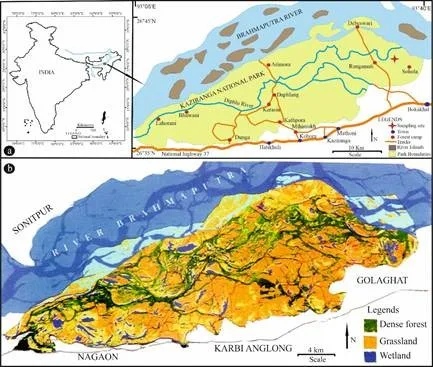
Location map of the sampling site and Vegetation coverage map of the Kaziranga National Park

Lessons for Contemporary Conservation

More than a reconstruction of the past, the Catena study provides insights of direct relevance for current and future wildlife management. Conservation success cannot be understood or sustained apart from long-term ecological processes. Climate stability, habitat heterogeneity and controlled disturbance regimes are as critical as legal protection.

Kaziranga’s current status as a stronghold of the Indian rhinoceros is the creation of deep time ecological resilience rather than short-term intervention alone. This long-term perspective becomes essential as climate change introduces new uncertainties. These include protecting migration corridors, preserving floodplain dynamics, and recognising the role of natural disturbances, which will be key to ensuring Kaziranga remains viable in the decades ahead.

A Living Archive of Ecological History

Kaziranga today works as a living archive, where layers of climatic history, vegetation change and wildlife adaptation may converge. This concentration of rhinoceros within its boundaries does not constitute an accident of geography but rather the end result of thousands of years of ecological sorting. This history enriches the meaning of conservation not just preservation of species but stewardship of landscapes shaped by time, climate and life itself.

By placing modern conservation onto a foundation of palaeoecological evidence, the study hammers home an important message if the future of megafauna is to be protected, then it is to the deep past that people must look, for here nature’s long experiments in survival are already inscribed into the land.


Topics: KazirangaOn-Horned Rhino
ShareTweetSendShareSend
✮ Subscribe Organiser YouTube Channel. ✮
✮ Join Organiser's WhatsApp channel for Nationalist views beyond the news. ✮
Previous News

NIA court sentences two convicts to 15 years jail for providing shelter to Lashkar terrorist Bahadur Ali

Next News

Telangana Local Body Elections 2026: Congress tops ward tally, BRS second, BJP third

Related News

More than 1800 polling stations ready for Lok Sabha election in Sonitpur

Assam: Sonitpur readies over 1800 polling stations for Lok Sabha polls, serving more than 16.25 lakh voters

Prime Minister Narendra Modi to unveil statue at Kaziranga

Assam: Safari under the stars; PM Modi to kick off extravaganza in Kaziranga with statue unveiling on March 9

Assam's Kaziranga National Park records all-time high tourist footfall this season

Assam: Kaziranga National Park records all-time high tourist footfall this season

Assam CM Himanta Biswa Sarma

Assam to build 1000km high-speed economic corridor costing Rs 3000 crore

Big Success of Himanta Govt’s save Rhino Campaign: For first time in many years, no rhinos poached in Assam in 2022

7 German missionaries detained in Assam; Detained preachers attended conversion meets flouting visa norms

Load More

Latest News

Seychelles President Patrick Herminie and Prime Minister Narendra Modi(File Photo)

PM Modi to visit Seychelles as National Day Guest of Honour; Bilateral relations to gain greater momentum

Veena Vijayan, daughter of former Kerala CM Pinarayi Vijayan

Keralam: ED finds contradictions in Veena Vijayan’s statements in CMRL–Exalogic probe, now focus towards ex-CM Pinarayi

Representative Image

Fifty Years of failed doomsday predictions prove climate alarmism is nothing but fake panic

Karnataka: Centre grants support to mango growers with Rs. 1,750 per quintal amid adverse weather & price crash

NIA Chargesheets 11 JMB Terror Operatives in Assam Terror Conspiracy Case

NIA files chargesheets against 11 Islamist terrorists of JMB offshoot terror plot in Assam, Tripura and Bengal

Karnataka: Delayed monsoon pushes the state into water crisis; BJP MP urges action as reservoirs level fall sharply

Viral Video of Crane-Hoisted Van Explosion During Muharram Procession Sparks Nationwide Outrage

MP: Van suspended 40 feet by crane, blown up during Muharram procession; NSA invoked against four

AI Image

Tamil Nadu: BJP cites 10 sexual assault cases in a day, alleges worsening law and order under TVK government

Operation Amistad: India sends relief, medical aid to earthquake hit Venezuela; Death toll rises to 235 & 4,300 injured

Chief Minister Shri Mohan Charan Majhi at CII Eastern Regional Council meeting organised at May Fair convention on 26 June 20

Odisha: CM Mohan Majhi launches ‘Go East’ initiative, announces sweeping industrial policy reforms

Load More
  • Privacy
  • Terms
  • Cookie Policy
  • Refund and Cancellation
  • Delivery and Shipping

© Bharat Prakashan (Delhi) Limited.
Tech-enabled by Ananthapuri Technologies

  • Home
  • Search Organiser
  • Bharat
    • Assam
    • Bihar
    • Chhattisgarh
    • Jharkhand
    • Maharashtra
    • View All States
  • World
    • Asia
    • Africa
    • North America
    • South America
    • Europe
    • Australia
  • Editorial
  • Operation Sindoor
  • Opinion
  • Analysis
  • Defence
  • Culture
  • Sports
  • Business
  • RSS @ 100
  • Entertainment
  • More ..
    • Sci & Tech
    • Vocal4Local
    • Special Report
    • Education
    • Employment
    • Books
    • Interviews
    • Travel
    • Health
    • Politics
    • Law
    • Economy
    • Obituary
  • Subscribe Magazine
  • Read Ecopy
  • Advertise
  • Circulation
  • Careers
  • About Us
  • Contact Us
  • Policies & Terms
    • Privacy Policy
    • Cookie Policy
    • Refund and Cancellation
    • Terms of Use

© Bharat Prakashan (Delhi) Limited.
Tech-enabled by Ananthapuri Technologies