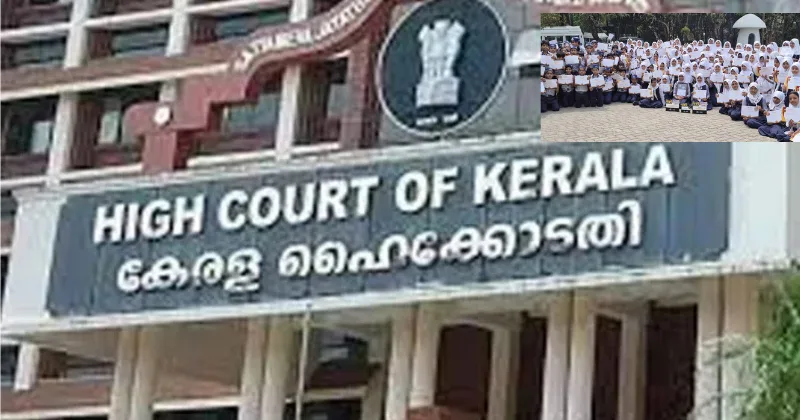
The High Court of Kerala ordered the closure of Ma’din Knowledge Garden Public School in Punnayoor, Thrissur district, an unrecognised school where Quran and related subjects are taught, as the school does not have prior permission to run the educational institution as mandated by the authorities.
The Court said that these sorts of institutions may not be entitled to run without valid recognition as per the provisions of Section 18 of the Right of Children to Free and Compulsory Education (RTE) Act 2009.
The Section refers to the prohibition of unrecognised schools, mandating that no school can be established or function without obtaining a certificate of recognition from the appropriate government authority.
On 2 February, the Kerala High Court used this Section to order the closure of schools operating without recognition. The Court said that these educational institutions may not be entitled to run without valid recognition with reference to the Section of the Act.
It was found that the school in question, Ma’din Knowledge Garden Public School, has been imparting pre-school education and teaching Quran and related subjects to nearly 300 children, without the necessary government approval.
Justice Harishankar V. Menon observed that “in the afore circumstances, I am of the opinion that the educational institution – petitioner in W.P.C. (C) No: 28053 of 2024 may not be entitled to run the same without a valid recognition with reference to the provisions of Section 18 of the Act…. In that view of the matter, I allow W.P. C. (C) No. 21615 of 2023 directing the competent among the respondents to take note of the findings in this judgement and take appropriate steps to shut down the educational institution.”
The school in question is Ma’din Knowledge Garden Public School in Punnayoor, Thrissur district. Punnayoor natives Moidunninkkutty and Bappu were the petitioners. The Court reminded that it had earlier warned unrecognised schools which were teaching religious lessons, in connection with the Hidaya Charitable Trust case.
The Court further said, “This issue has to be examined from yet another perspective. The RTE Act was enacted by Parliament after the insertion of Art. 21A in the Constitution. Under S.29, the Act mandates that the curriculum and evaluation procedure should be as laid down by the appropriate authority to be specified by the government. Appropriate authority, as defined under S.2(a)(ii)(A) in relation to a school within the State, is the State Government. In such circumstances, no school which is required to have recognition shall impart any religious instruction or religious study without permission from the State Government.”
It further said, “In light of the fact that this issue is of great significance, the Secretary of the General Education Department is directed to issue a general government order directing all recognised private schools in the State to desist from imparting religious instruction or religious study without permission from the Government.”
Based on the complaint, the Assistant Educational Officer (AEO) had carried out an enquiry and found that the school lacked recognition, hence recommended taking action to close the school and issue Transfer Certificates (TCs).
The school admitted in the counter affidavit that about 300 students were given pre-school education, Quran and related subjects. The Court said the school cannot be run with NIOS accreditation alone.
The court verdict is a hard blow to the communal agenda of some institutions which even go beyond the rule of the land.