As Bangladesh moves towards national elections scheduled for February 12, the country’s political landscape is facing an unprecedented moment of exclusion. The Awami League, Bangladesh’s largest and most deeply rooted political party, will not be part of the electoral process following an official ban imposed by the interim administration led by Muhammad Yunus.
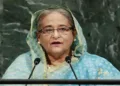
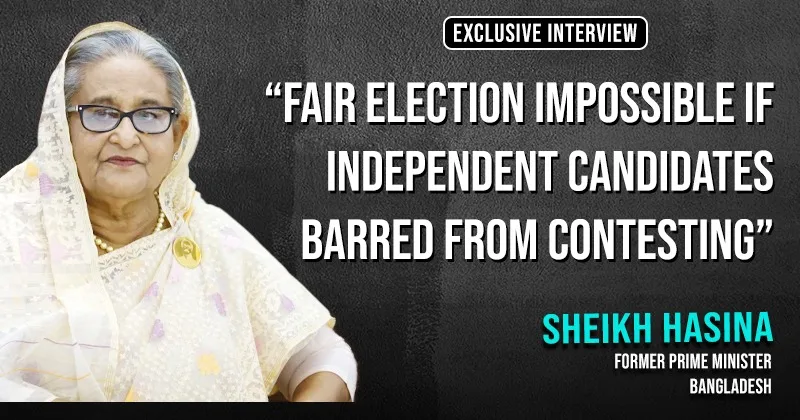
In an exclusive interview with Nishant Kumar Azad, Senior Assistant Editor, former Bangladesh Prime Minister and Awami League leader Sheikh Hasina shares her views on alleged constitutional overreach, voter disenfranchisement, and the future of the country amid escalating political instability and violence against Hindus. Excerpts:
National elections in Bangladesh are scheduled to take place on February 12 without the Awami League. What is your reaction?
Bangladesh urgently needs free, fair and truly participatory elections. What has been organised are elections in name only, orchestrated by an unlawful and illegitimate government that has appointed itself the power to ban the country’s largest and most popular political party. No government that emerges from this sham exercise can claim legitimacy, knowing that it does not represent the true will of the Bangladeshi people.
Yunus came to power promising reform. Instead, he has unilaterally re-written our constitution, amended our legislation and knowingly disenfranchised millions of ordinary people. Rather than face us at the ballot box, Yunus has chosen to remove us from it entirely.
There cannot be a free and fair election when genuine independent candidates have been barred from participating, when legitimate political parties have withdrawn because of persecution, and when ordinary voters are being intimated into voting for BNP or Jamaat candidates under threats of violence. I am disappointed that the United Nations has declined to send observers at such an important time in Bangladesh’s history.
Which party are erstwhile Awami League voters likely to support in the absence of the Awami League this time? Is it the BNP?
Historically, when Bangladeshis cannot vote for the party of their choosing, they do not vote at all. Our supporters understand what is at stake. They will not lend legitimacy to an election designed to exclude them.
Millions of Bangladeshis have confidence in and trust the Awami League. Our party is woven into every village and neighbourhood. Banning us does not erase the millions who support us, it only exposes the interim government’s fear of genuine democratic contest.
Do you expect the next elected government to lift the ban on your party’s political activities?
Whichever party forms the next government must restore proper parliamentary democracy, which means lifting the ban on the Awami League and allowing us to play our role as legitimate opposition. A parliament without genuine opposition is not a parliament at all. Democracy thrives on the healthy competition of ideas, not on exclusion and repression.
Bangladesh has suffered from a destructive cycle of boycotts and bans for too long. Each time political participation is denied to a significant portion of the population, it deepens resentment, delegitimises institutions, and creates conditions for future instability. Breaking this cycle means allowing all legitimate political parties to participate and letting the people decide.
How would you assess Yunus’s performance as interim leader now that his term is nearing its end?
Yunus has overseen the systematic destruction of our country’s economy, democratic institutions, and social fabric. He came to power promising reform, yet all he has succeeded in doing is sow division and chaos.
Under his watch, political affiliation and free speech have become crimes. Today, more than 152,000 people are in custody on fabricated political charges, including over 120 Members of Parliament, enduring conditions that fall well below international standards. Journalists have had their offices set alight simply for reporting the truth. The economy that quadrupled during my 15 years in office has been downgraded at every available opportunity by the IMF. A leader’s most basic duty is to protect those under his care, yet he has overseen a campaign of murder and violence against Awami League members and minorities in Bangladesh.
Yunus built his international reputation on microfinance and a Nobel Prize, but the proof of his rule is in his willingness to crush political rivals, tear up our constitution, and silence any dissenting voice. He has placed extremists from proscribed terrorist organisations like Hizb ut-Tahrir into cabinet positions, released convicted terrorists from prison, and granted immunity to those responsible for horrific acts of violence. Even the President of the United States has spoken critically of him. My concern is that extremists have been using him to project an acceptable international face while they radicalise our institutions domestically.
How do you see the future of India–Bangladesh relations going forward?
India is Bangladesh’s closest neighbour and longest-standing ally. The partnership we built over decades was grounded in mutual respect, regional connectivity, and shared economic interests. Our guiding principle has always been friendship with all and malice towards none.
India is watching with justified alarm as religious minorities face persecution, as the economic partnerships we cultivated over decades unravel, and as hostile rhetoric emanates from officials in Dhaka. The attacks on diplomatic premises, the marches demanding my extradition, the NCP’s threats to shelter separatist groups to isolate India’s ‘Seven Sisters’ – these are not representative of the Bangladeshi people. They are the work of extremists emboldened by an interim government that lacks any mandate to conduct foreign policy.
India deserves a reliable partner in Bangladesh, one that can maintain stability and honour its commitments. Yunus cannot provide this. I am confident that once democratic governance returns, Bangladesh will restore the cooperation that served both our peoples well. I appreciate India’s patience as they wait for legitimate government to return.
Attacks on minorities, particularly Hindus, have drawn global attention. Given the rise of radicalism, do you believe Hindus will be able to continue living in Bangladesh?
The violence facing religious minorities today is the direct result of a government that has abandoned its most basic duty: to protect all citizens equally. The lynching of Dipu Chandra Das, a Hindu garment worker who was publicly killed by his colleagues and hanged from a tree, was not an isolated incident. It was the inevitable consequence of a regime that elevates extremists, releases convicted criminals from prison and grants the perpetrators of horrific violence total impunity.
In the first weeks of Yunus’ rule, over 2,000 attacks targeting Hindus, Buddhists, Christians and indigenous people were reported. The perpetrators have never been prosecuted. Their victims have been denied justice. Meanwhile, Yunus himself continues to deny the clearly religious motivations behind these acts.
Bangladesh was founded as a secular republic where people of all faiths could live without fear. During our years in government, we worked tirelessly to uphold that principle and ensure the peaceful coexistence of all religious communities. That commitment has been abandoned.
I firmly believe that the violence we are seeing is the product of an emboldened minority that does not represent the views of ordinary, tolerant, and peaceful Bangladeshis. The values of secularism, democracy, and respect for all faiths are woven too deeply into our national character.