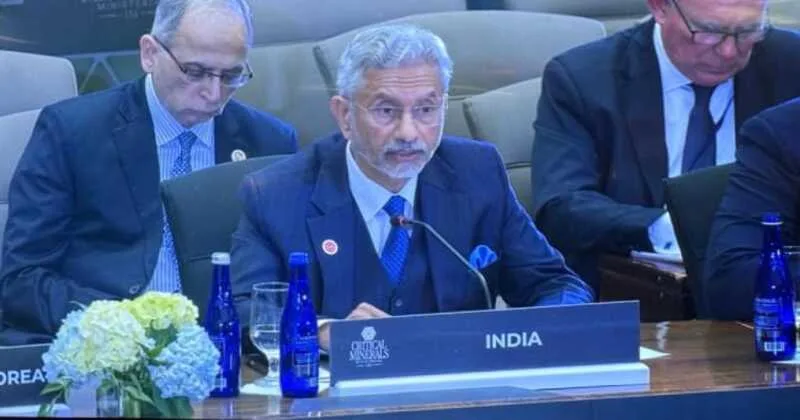
Washington: External Affairs Minister S. Jaishankar held a series of high-level bilateral meetings in Washington, DC, on Wednesday on the sidelines of the Critical Minerals Ministerial, engaging counterparts from several countries as India stepped up its diplomatic push to secure resilient and diversified global supply chains.
Among the key engagements were meetings with Canada’s Foreign Minister Anita Anand and Peru’s Foreign Minister Hugo de Zela. Jaishankar described his interaction with Anand as warm and productive, noting that both sides discussed ways to advance bilateral cooperation and take India–Canada ties forward. In his meeting with de Zela, the two ministers agreed to deepen cooperation across sectors of mutual interest. These engagements took place as delegations from more than 50 countries gathered in Washington for the inaugural Critical Minerals Ministerial, convened by US Secretary of State Marco Rubio. The European Union also participated, marking what many observers described as a landmark moment in global supply-chain diplomacy.
S. Jaishankar calls for de-risked supply chains, backs critical minerals push
Addressing the ministerial, Jaishankar highlighted the risks posed by excessive concentration in the production and processing of critical minerals and stressed the need to “de-risk” supply chains through structured international cooperation. He outlined India’s strategy to build greater resilience, pointing to initiatives such as the National Critical Minerals Mission, the development of Rare Earth Corridors, and a focus on responsible commerce. He also conveyed India’s support for the FORGE initiative on critical minerals.
Spoke at the Critical Minerals Ministerial in Washington DC today.
Underlined challenges of excessive concentration and the importance of de-risking supply chains through structured international cooperation.
Highlighted India’s efforts towards greater resilience through… pic.twitter.com/yfiDHGboau
— Dr. S. Jaishankar (@DrSJaishankar) February 4, 2026
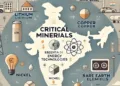
Rubio, in his opening remarks, underscored the central role of critical minerals in infrastructure, defence, industry and advanced technologies. He said the United States planned to sign cooperation frameworks with 55 partners from 54 countries and the European Union, aimed at ensuring resilient, affordable and globally accessible supply chains through multilateral coordination and private-sector investment. Adding to the momentum, US Vice President J. D. Vance called on allies and partners to work together to reshape the global critical minerals market. He observed that modern economies still depend on tangible resources and described critical minerals as being as essential today as oil and gas were in earlier eras. A primary objective of the ministerial is to diversify supply chains for rare earth elements and other strategic minerals such as lithium, cobalt and nickel, in order to reduce global overreliance on China, which currently dominates both mining and processing in several of these categories.
Diplomatic outreach intensifies ahead of Mark Carney’s India visit
Ahead of the main session, Jaishankar held a series of bilateral meetings with foreign ministers from multiple countries. These included discussions with the Netherlands Foreign Minister David van Weel, Italy’s Antonio Tajani, Malaysia’s Mohamad Haji Hasan, Bahrain’s Abdullatif bin Rashid Al Zayani, and Mongolia’s Battsetseg Batmunkh. He also interacted with counterparts from Singapore, Poland, Romania, Israel and Uzbekistan as India explored avenues for collaboration across energy, minerals, trade and emerging technologies. The diplomatic activity comes as Canada prepares for a high-profile visit to India by Prime Minister Mark Carney in the first week of March. The visit is expected to see the signing of agreements covering uranium, energy, critical minerals and artificial intelligence. Sources in India’s Ministry of External Affairs indicated that trade would also be a major focus during Carney’s trip.
Officials said the Washington ministerial reflects a growing consensus among major economies that economic security is inseparable from access to critical minerals. Rubio emphasised that allies must come together not only to correct past policy mistakes but also to pool collective talent and innovation to ensure diversity, affordability and sustainability in global supply chains. Jaishankar’s interventions highlighted India’s intent to play a proactive role in shaping this emerging framework. By combining domestic initiatives with international partnerships, New Delhi aims to strengthen its manufacturing base, support clean-energy transitions and safeguard strategic industries that depend on steady access to rare earths and other vital inputs.
Met many colleagues and counterparts this morning in DC including FM @AnitaAnandMP of Canada, Polish DPM & FM @sikorskiradek, and FM @VivianBala of Singapore.
🇮🇳 🇨🇦 🇵🇱 🇸🇬 🇳🇿 pic.twitter.com/kLqUnl9TrJ
— Dr. S. Jaishankar (@DrSJaishankar) February 4, 2026
The United States-hosted gathering marked the first formal platform of its kind dedicated exclusively to critical minerals at the ministerial level. With participation from more than 50 countries, the event signalled a coordinated effort to advance collaboration on securing and diversifying global supply chains—an issue increasingly seen as central to geopolitics, climate goals and technological leadership.
As Jaishankar wrapped up his Washington engagements, Indian officials said the conversations had laid important groundwork for future partnerships, reinforcing India’s position as a key stakeholder in the evolving global critical minerals ecosystem.