BHUBANESWAR: In a major breakthrough for anti-Maoist operations in southern Odisha, a hardcore Maoist leader carrying a cumulative reward of Rs 21 lakh surrendered before the Superintendent of Police (SP), Malkangiri, on February 4. The surrender is being seen as a significant setback to Maoist activities in the region and a major step towards making the district Maoist-free.
The surrendered Maoist has been identified as Sukram, also known as Suresh or Yogesh, an Area Committee Member (ACM) of the banned CPI (Maoist) outfit. He had been active for nearly 16 years across Odisha and neighbouring Chhattisgarh and was wanted in several serious criminal cases. Police officials said Sukram was involved in multiple incidents of violence, including IED explosions, abduction of civilians, and killings in Maoist-affected areas of Odisha, Chhattisgarh and Andhra Pradesh.
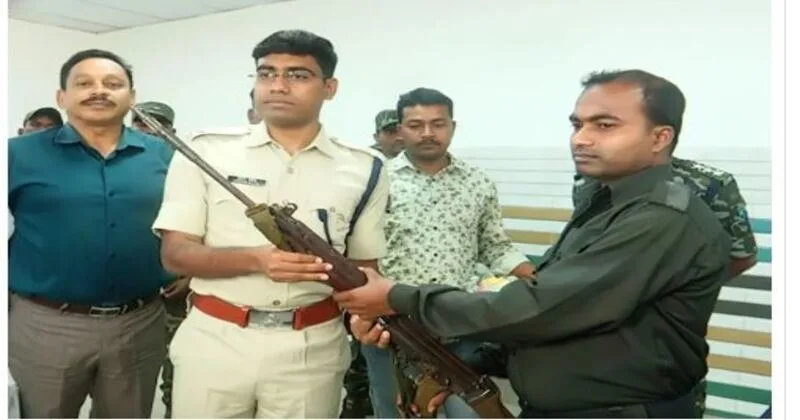
During the surrender, Sukram handed over one Self-Loading Rifle (SLR), 12 rounds of live ammunition, and other Maoist-related materials to the police. He formally severed all ties with the outlawed organisation and expressed faith in the democratic system.
Addressing a press conference, Malkangiri SP Vinod Patil said the surrender of Sukram marks a decisive blow to Maoist operations in the district. “This surrender of an operational and ideological leader of CPI (Maoist) is a significant milestone. It brings us closer to the goal of making Malkangiri completely Naxal-free,” the SP said. Sukram was present during the press interaction.
The SP added that the surrendered Maoist would be extended all benefits under the Odisha government’s surrender and rehabilitation policy. “He has chosen to join the mainstream and will be rehabilitated as per government norms,” Patil said.
According to police sources, sustained pressure from security forces, internal dissatisfaction within the Maoist ranks, and fear for personal safety have led to a growing number of surrenders in recent months. Officials noted that around 22 Maoists have surrendered before the Malkangiri SP in recent times, reflecting the effectiveness of intensified counter-insurgency operations combined with rehabilitation initiatives.
Security agencies have stepped up operations across Maoist strongholds in view of the March 31 deadline set by the state government to eliminate left-wing extremism from affected regions. Police said combing operations, intelligence-based action, and community outreach programmes will continue to dismantle Maoist networks and ensure lasting peace.
Malkangiri, once considered the epicentre of Maoist violence in Odisha, has witnessed a steady decline in extremist activity over the years.
A retired DGP-rank officer noted that Maoist violence in the state originated in Malkangiri before spreading to 21 of Odisha’s 30 districts. “During the 1990s, Maoists active in neighbouring Andhra Pradesh frequently used Malkangiri as a shelter. From here, they gradually expanded their network across Odisha,” he said.
Jharkhand Maoist Surrenders in Sundargarh
In a related development, a Maoist cadre from neighbouring Jharkhand laid down arms in Sundargarh district a day earlier, highlighting the broader impact of intensified anti-Naxal operations along inter-state borders.
The surrendered Maoist has been identified as Umblen Honhaga alias Prabhu, a local guerrilla squad member (LGSM) of CPI (Maoist). He is a native of Halamuli village, under the Chhotanagra police station limits, in West Singhbhum district of Jharkhand, and was active in the Maoist stronghold of Saranda forest.
Prabhu surrendered before DIG (Western Range) Brijesh Kumar Rai and Rourkela SP Nitesh Wadhwani at the district police office. DIG Rai said Prabhu was associated with the South Chhotanagra division of the banned outfit and had become increasingly disillusioned with Maoist ideology.
“He was frustrated with internal torture by senior leaders and feared for his life due to frequent combing operations by security forces. Influenced by the Odisha government’s surrender policy, he decided to quit violence and return to the mainstream,” Rai said.
SP Wadhwani added that Prabhu had been active in the Maoist organisation for the past two years. He said anti-Naxal operations have been intensified along the Odisha-Jharkhand border as part of the state’s focus on eliminating left-wing extremism.
The surrender comes in the backdrop of a major anti-Naxal operation in Saranda forest, where 15 Maoists were killed by security forces under Chhotanagra police limits about a fortnight ago.
Officials believe that a combination of sustained security action, inter-state coordination, and rehabilitation-focused policies is encouraging Maoist cadres to abandon armed struggle, signalling a turning point in the fight against red terrorism in the region.