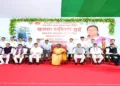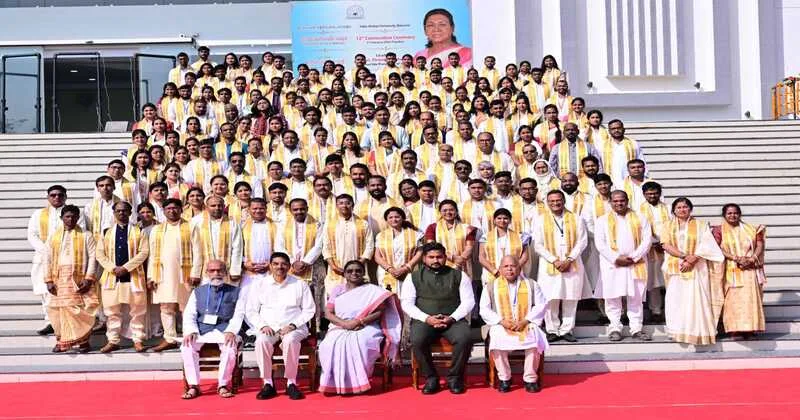
BHUBANESWAR: President of India Droupadi Murmu, on February 3, said that universities have a special responsibility to act as catalysts of inclusive growth, innovation, and social transformation, as she graced and addressed the convocation ceremony of Fakir Mohan University (FMU) in Balasore. The President also inaugurated the university’s newly constructed auditorium during the event, marking a significant milestone in the institution’s academic journey.
Addressing graduating students, faculty members and dignitaries, President Murmu underlined that the nation’s progress depends on the growth, security and technological advancement of all sections of society. In this context, she said institutions of higher learning play a crucial role in shaping a sustainable and equitable future.
“Universities are not merely centres for awarding degrees. They are the backbone of a knowledge-driven society. Institutions of higher learning have a special responsibility to nurture critical thinking, ethical leadership and innovation, and to act as catalysts of inclusive growth and social transformation,” the President said.
She added that universities must encourage research that is responsive to local, national and global challenges while remaining deeply rooted in human values. Expressing confidence in Fakir Mohan University’s academic vision and commitment to community engagement, the President said the institution is well-positioned to play a transformative role in the region’s and the nation’s development.
The President paid rich tributes to legendary Odia writer, social reformer and father of modern Odia literature, Vyasakabi Fakir Mohan Senapati, after whom the university is named. Recalling her personal connection with his literary works, she said she was deeply influenced during her student days by his timeless short story Revati.
Describing Revati as a powerful portrayal of the determination of a young girl who aspired for education in the 19th century, President Murmu said the story continues to inspire generations even today. She shared that she pursued her early education in a remote tribal village before moving to Bhubaneswar to complete her high school and college.
“Like many students from marginalised and remote backgrounds, my educational journey was not without challenges. Fakir Mohan Senapati’s writings gave voice to social realities and aspirations, and his ideals continue to inspire me,” she said, adding that his literary legacy remains relevant in contemporary times.
President Droupadi Murmu graced the convocation ceremony of Fakir Mohan University and inaugurated its new Auditorium at Balasore, Odisha. The President said that the growth, security and technological development of all sections of society will accelerate the country's progress.… pic.twitter.com/tpLRQ4S0RL
— President of India (@rashtrapatibhvn) February 3, 2026
Highlighting Fakir Mohan Senapati’s deep love for the mother tongue, the President quoted his famous words, “My mother tongue is supreme to me.” She emphasised that education imparted in one’s mother tongue enables students to better understand their surroundings, traditions and cultural environment, along with formal academic learning.
Such education, she noted, helps learners stay connected to their civilisational roots and way of life. In this context, President Murmu said the National Education Policy (NEP) 2020 lays strong emphasis on the use of mother tongue and regional languages in education to enhance comprehension, creativity and learning outcomes.
The President also spoke at length about India’s rich and ancient knowledge tradition, observing that the country’s scriptures and manuscripts are vast repositories of wisdom not only in poetry and literature, but also in disciplines such as science, medicine, astronomy, mathematics and architecture.
She encouraged young scholars and researchers to explore academic and research opportunities within this immense knowledge heritage. “By understanding the past and comprehending the present, students can shape their own future as well as the future of the nation,” she remarked.
Congratulating the graduating students, President Murmu expressed confidence that with knowledge, passion and commitment, they would earn respect and recognition in society. She advised them that dedication and perseverance are the keys to success in any field of endeavour.
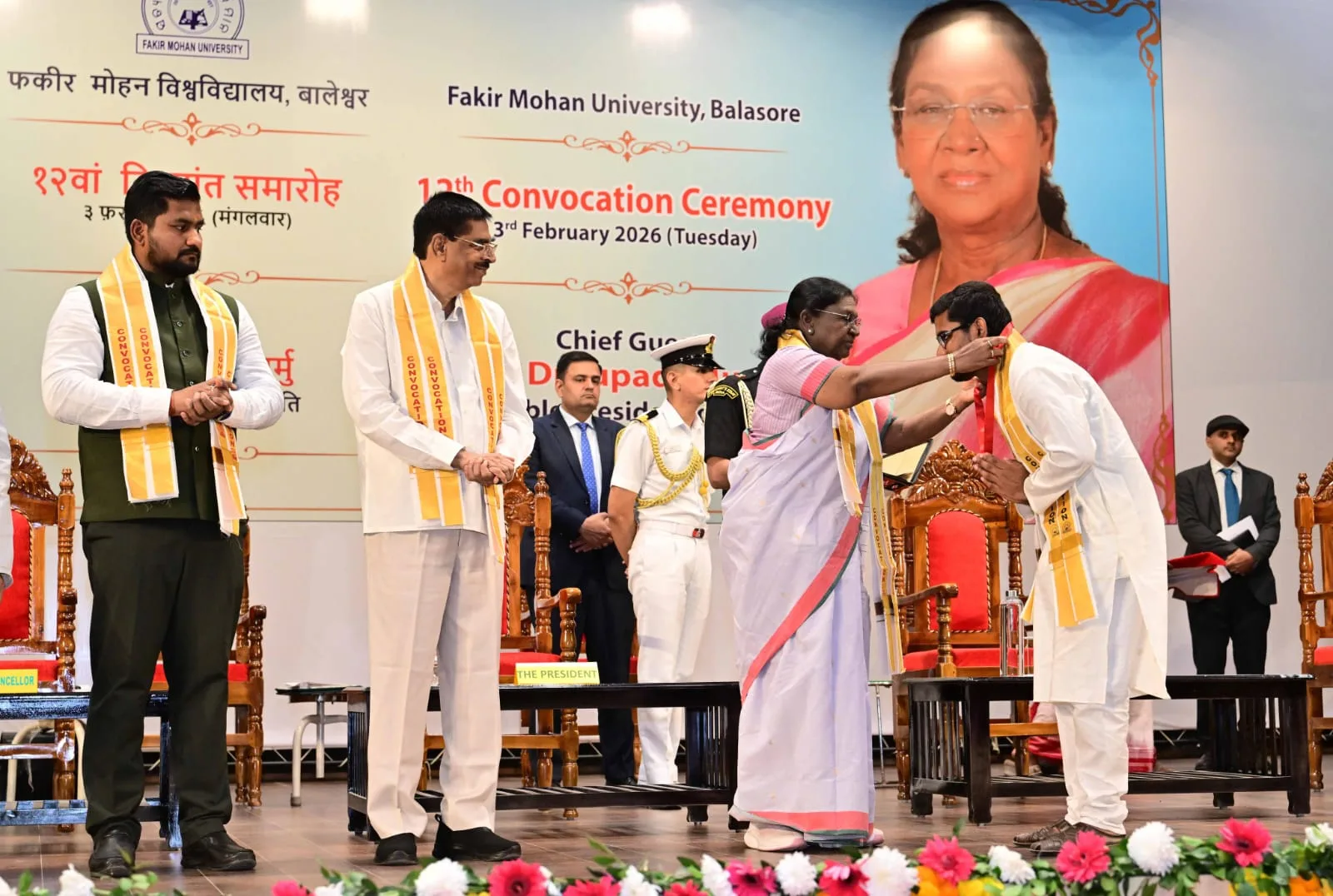
Drawing a distinction between success and purpose, the President said that while a successful life is important, a meaningful life is even more valuable. She urged students not only to seek fame, prestige and financial security, but also to work for the welfare of others, particularly those who have been left behind in the development process.
“The development of society lies in the development of everyone,” she said, calling upon young graduates to contribute positively to nation-building and social upliftment.
President Murmu appreciated Fakir Mohan University’s emphasis on research, outreach and community engagement alongside academic instruction. She noted that the Balasore–Bhadrak region is widely known for paddy cultivation, betel leaf farming and fisheries, and lauded the university for undertaking research, training and extension programmes in these sectors.
She also praised initiatives such as ‘Back to School’, ‘Earn While Learn’, ‘Each One Teach One’, and programmes focused on environmental awareness and beach cleaning, describing them as exemplary models of socially responsible education.
Referring to the abundance of blue crabs and horseshoe crabs along the coastlines of Balasore and Bhadrak, the President said the proposal to establish a dedicated research centre for these species reflects the university’s foresight and commitment to region-specific, sustainable research.
The convocation ceremony concluded with a renewed sense of purpose among students, faculty members and administrators, as the President’s address underscored the vital role of universities in shaping an inclusive, knowledge-driven and socially responsible India.
President Murmu Visits Biraja Temple in Jajpur and Performs Pinda Daan at Nabhi Gaya
Earlier in the day, President Droupadi Murmu visited the historic Biraja Temple in Jajpur, marking her first official visit to the district. The visit generated widespread enthusiasm among local residents, who described it as a historic and memorable occasion for the region.
As per the pre-scheduled programme, the President arrived at the helipad of the administrative building complex in Jajpur at 9.30 am. She was accorded a ceremonial welcome by Odisha Governor Dr Haribabu Kambhampati; Panchayati Raj Minister Ravi Narayan Nayak, representing the Chief Minister; Cooperation, Handlooms, Textiles and Handicrafts Minister Pradeep Bal Samanta; Jajpur MP Dr Rabindra Narayan Behera; MLAs and women MLAs from all constituencies of the district; the Zilla Parishad Chairperson; and senior police and administrative officials.
In view of the President’s visit, the district administration and police made elaborate security and logistical arrangements. From the helipad, President Murmu proceeded to the Biraja Temple under a special security cordon.
Upon arrival at the temple, the President performed ritual ablutions before entering the sanctum. She first performed Pinda Daan at the sacred Nabhi Gaya, offering ancestral rites to her forefathers. The religious rituals continued for nearly an hour and were conducted by four temple priests.
After completing the Pinda Daan, the President offered prayers to Maa Biraja and circumambulated the temple complex. She also paid obeisance at other prominent shrines within the premises, including Gangeshwar, Mukteshwar, Sanghar Bhairav, the 108 Shiva Lingas and Parshva Devata, and received blessings at the Mukti Mandap Sabha.
The temple premises reverberated with Vedic chants and traditional hulahuli sounds, creating a deeply spiritual atmosphere. On the occasion, the district administration presented the President with a Buddhist idol and a Tussar silk saree as tokens of respect. Members of the Brahma Kumaris also met the President during the visit.
Following the temple visit, President Murmu returned to the administrative building helipad under tight security and departed for Balasore by special aircraft. Large numbers of people lined both sides of the roads along the President’s route, welcoming her with enthusiasm, while cultural and spiritual programmes organised along the way reflected the region’s rich heritage and the people’s affection for the Head of the State.