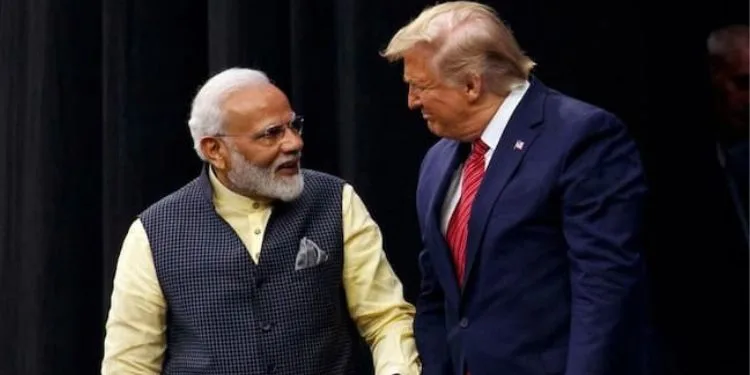
US President Donald Trump on Monday announced that the United States and India have reached a landmark trade agreement, marking a significant turnaround in bilateral economic relations. The breakthrough was achieved during a telephone conversation between Trump and Prime Minister Narendra Modi. Under the agreement, the United States will reduce tariffs on Indian goods from 25 percent to 18 percent. Crucially, Washington has also agreed to withdraw the additional 25 percent punitive duty that had been imposed earlier, easing what had become a major strain on India–US trade ties. The development comes just days after India finalised a historic trade agreement with the European Union, further strengthening New Delhi’s global economic standing.
Prime Minister Modi expressed his appreciation to President Trump in a social media post, thanking him for the tariff reduction and for constructive engagement. Commerce and Industry Minister Piyush Goyal later confirmed that an agreement had indeed been concluded, calling it a positive step for Indian exporters and workers. Since 2025 August, India had been subjected to a cumulative 50 percent tariff by the United States. This included a 25 percent countervailing duty and an additional 25 percent levy linked to India’s import of Russian oil. These measures had severely disrupted Indian exports to the US and placed immense pressure on several labour-intensive sectors.
India’s External Affairs Minister S. Jaishankar, who is currently in the United States for crucial diplomatic engagements, played a key role in parallel discussions. Indian Ambassador to the US Vinay Mohan Kwatra also issued a statement indicating that sustained diplomatic efforts had paved the way for the agreement.
In his remarks, Prime Minister Modi highlighted that President Trump’s leadership was important for international peace, stability and global prosperity, signalling India’s intent to stabilise and recalibrate ties with Washington on equitable terms. Jaishankar’s visit, scheduled for three days, is expected to further consolidate the momentum generated by the trade breakthrough.
Tariff advantage puts India ahead as export rivals face higher duties in US market
With tariffs now reduced to 18 percent, India is poised to gain a decisive competitive edge over its export rivals. Countries such as Bangladesh, Sri Lanka, Taiwan and Vietnam currently face US tariffs of around 20 percent, while Pakistan is subject to a 19 percent duty. Malaysia, Thailand, Indonesia and Cambodia also face tariffs of 19 percent, placing them at a disadvantage relative to Indian exporters. Although Afghanistan enjoys a lower tariff rate of 15 percent, its exports to the US remain negligible. Bangladesh and Pakistan had emerged as major competitors to India in sectors such as garments and textiles, but the new tariff structure decisively tilts the balance in India’s favour. Industry experts say Indian exporters are now better placed to reclaim lost market share.
India is also expected to outperform Vietnam, which has increasingly challenged New Delhi in apparel, electronics and footwear exports. Several other countries continue to face much steeper duties. Brazil is subject to a 50 percent tariff, Myanmar and Laos face 40 percent, South Africa 30 percent, Mexico 25 percent, Canada 35 percent and Switzerland as high as 39 percent.
By contrast, close US allies such as the United Kingdom face a tariff of only 10 percent, while the European Union, South Korea and Japan are subject to 15 percent duties. Despite these lower rates, India’s scale, diversification and manufacturing depth give it a strong advantage under the revised regime.
The earlier 50 percent tariff had dealt a severe blow to Indian export sectors including seafood, garments and coir. Exports stalled, incomes fell and thousands of jobs were threatened. In Tiruppur, Tamil Nadu—India’s knitwear hub—garment factories reportedly suffered losses running into billions of rupees, underscoring the human and economic cost of the trade restrictions.
The reduction to 18 percent now offers major relief on Indian exports worth $48.2 billion (approximately ₹4.38 lakh crore) destined for the US market. India’s total exports to the United States are projected to reach $86.51 billion in 2024–25, and the tariff cut is expected to significantly accelerate this growth.
Relief is expected for textiles worth ₹11 billion, gems and jewellery worth ₹10 billion, and marine products valued at ₹2.7 billion. Chemicals exports worth ₹4.2 billion and leather goods worth ₹1 billion will also gain from the reduced duties. Electronics, pharmaceuticals and petroleum products had already been exempted from the tariffs.
Allies drift away, forcing a rethink of US tariff wars and unilateral diplomacy
President Trump’s earlier unilateral actions, particularly his tariff war, had drawn widespread criticism globally and were increasingly viewed as diplomatically isolating the United States. Even long-standing allies such as Britain began drifting away from Washington in economic, trade and diplomatic spheres. While China was initially the primary target of US trade hostility, Trump, after returning to office in January 2025, extended heavy tariffs to several US partners, including the European Union, India and Canada. His controversial positions on ending the Russia-Ukraine war and proposals related to Greenland further strained US-Europe relations.
The imposition of a total 50 percent tariff on India, justified on grounds of Russian oil imports and India’s trade surplus with the US, deepened bilateral tensions. Trump had even urged the European Union to impose similar tariffs on India. The EU, however, rejected the demand and instead entered into a historic trade agreement with New Delhi, underscoring India’s growing credibility as a global economic partner. India has already concluded a free trade agreement with the United Kingdom, while Canada is seeking to reset relations with New Delhi. India is also cautiously improving ties with Russia and China. Since January, five world leaders, including UK Prime Minister Keir Starmer and Canadian Prime Minister Mark Carney, have visited China and met President Xi Jinping.
The President of Uruguay, Samandu Orsi, is also scheduled to visit China this week. Notably, many visiting leaders, including Starmer, were accompanied by large business delegations. Starmer alone reportedly brought representatives from over 60 companies. Leaders from Ireland, Finland and South Korea also met Xi last month, reflecting China’s expanding economic diplomacy.
Observers note that Washington’s recent approach towards allies and traditional trading partners has caused unease worldwide. Trump’s relations with countries such as Canada, Denmark, Belgium, Japan, Ireland, New Zealand, France, Brazil and South Africa have all faced setbacks. Against this backdrop, India’s ability to secure tariff relief and strengthen its global trade position is widely seen as a diplomatic and economic victory for New Delhi.