
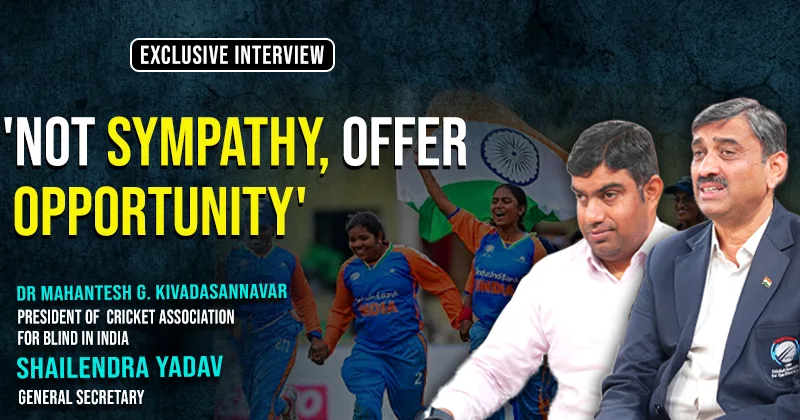
In this special interaction, Organiser Editor Prafulla Ketkar speaks with two pioneers of Bharat’s blind sports movement. Dr Mahantesh G. Kivadasannavar, President of the Cricket Association for the Blind in India and Founder of Samarthanam Trust for the Disabled, has played a central role in building Bharat’s blind cricket ecosystem and taking it to the global stage. He is joined by Shailendra Yadav, the Association’s General Secretary, who balances a professional career in banking with an unwavering commitment to disability rights, sports, and employment-led empowerment. Excerpts:
How did the idea of Samarthanam Trust originate? What inspired you to start it?
Dr Mahantesh:
I became visually impaired when I was just six months old. It was a profound shock for my family, especially since I was the first child in a large joint household. While my birth was initially celebrated, reality soon set in. Yet, my parents accepted me as I was and ensured that I received unwavering support.
The real struggle began when I was five or six years old. Schools in my hometown refused admission, citing a lack of facilities for a blind child. I still remember my mother crying endlessly. Eventually, I was allowed to sit in a school informally, without enrollment, attendance, or promotion, simply holding someone’s hand to reach the classroom.
A turning point came during a school inspection. I answered a question correctly, and when asked to write on the board, my teacher stopped the inspector, explaining that I was blind. The inspector later visited our home and insisted that I be enrolled in a proper school for the blind. That is how I joined the Shri Raman Maharshi Academy for the Blind in Bengaluru.
For the first time, I realised I was not alone. The school shaped my compassion, as many students came from deeply disadvantaged backgrounds – villages, single-parent families and extreme poverty. While I was fortunate to complete my education through university with family support, many of my brighter friends dropped out after Class 10 simply because their families could not afford further education.
This reality created a deep sense of responsibility in me. Along with my schoolmate Nagesh, I realised that addressing this problem required more than individual effort – it required an institution. Influenced by my family’s Rashtriya Swayamsevak Sangh (RSS) background, national thinkers, ideals of Swami Vivekananda and Ramakrishna Mission, service to society became a natural calling.
Where did your journey begin? How did your personal experiences transform into a mission for society and the nation?
Shailendra Yadav: I was born blind, and I have always considered it a blessing – a gift from God. Since I never saw light, I never felt personally challenged by blindness. However, it was extremely difficult for my parents. For the first eight years, they struggled to integrate me into society because of ignorance and lack of awareness.
As I grew older, I realised that society simply did not know how to engage with someone like me. In my village, I was often treated as entertainment. People would hold my hand, ask my name, and laugh when I fell on muddy roads. Yet, like any child, I wanted to run, play, fall, and rise again.
During sports periods, I was initially made to sit under a tree. Hearing other children talk about games made me cry. That same teacher pushed the system to include me and ensured I participated wherever possible. That was where I developed my fighting spirit—I learned that unless you ask, no one offers opportunities.
During my university years, I began playing blind cricket. With no infrastructure, we made our own balls using stones and bicycle bearings. Cricket became our gateway to the outside world. It broke boundaries, allowed us to travel, meet others like us, and see life beyond closed spaces.
I learned that those who have struggled to understand both problems and solutions. Good intentions alone are not enough—help must be given correctly, or it can harm the community.
Despite holding a secure Government job, I committed myself to social service. Persons with disabilities often pay a “double tax”—earning and paying income tax while also bearing the cost of drivers and support systems. I see this not as a burden, but as employment generation.
Samarthanam worked across disability categories. Where did the idea of a separate cricket board for the blind originate? Why cricket?
Dr Mahantesh:
Like most Bharatiyas, we blind people love cricket, especially cricket commentary. As a child, I grew up listening to radio commentary. The voice modulation fascinated me, and I felt a deep connection to the game. Cricket is a highly sequential sport, unlike many others, which makes it accessible to us.
In those days, radio was the only medium for everyone, not just the blind. After matches, we would sit and discuss them as if we had watched them live. My neighbours taught me how to hold a bat and a ball, but no ball made a sound.
When I joined a blind school, I told my father that I would study there only if he gave me cricket gear. This would enable me to play with my blind friends. We played with whatever objects we could find. In 1988–89, the internationally accepted blind cricket ball was developed in Bharat. Competitive blind cricket began in 1990.
When Samarthanam began, one of our main objectives was to support blind cricket beyond the school level. From 1990 to 2010, blind cricket was managed by different organisations in Delhi. When they stepped back, we realised that without intervention, blind cricket—globally, not just in Bharat —could collapse.
We decided to create a separate body focused entirely on the sport. Samarthanam would provide resources and financial support, while the cricket body would focus on governance and development. Thus, the Cricket Association for the Blind in India (CABI) was registered in 2010–11.
Today, leadership is entirely in the hands of those who have played the game and lived its challenges. Technology has enabled efficient management, communication, and outreach. Cricket has connected passionate individuals capable of creating lasting change.
Outside cricket, Divyang athletes have excelled nationally and internationally. Was the term ‘Divyang’ merely symbolic, or did something deeper change?
Shailendra Yadav:
Motivation is essential for any individual. Earlier, we were called viklang. I was known not by my name, but as Surdas or andha. When the term Divyang was introduced, many mocked it. They thought nothing would change.
Before 2014, blind cricket existed but without recognition. In 2014, we won the ODI World Cup in Cape Town. We had travelled on loans. When we returned, three Union Ministers were waiting at the airport. That moment created hope – not just for blind cricket, but for all para sports. Today, Divyang athletes receive more respect than ever. The celebration of the women’s blind cricket team continues months after their victory. Leadership mindset, fast recognition, and inclusive policies have changed outcomes. Disability is a mindset barrier, not a physical one.
Many blind players come from tribal regions. Is there andy specific reason behind it?
Dr Mahantesh:
Bharat has the largest blind population globally. States like Uttar Pradesh, Madhya Pradesh, Jharkhand, Bihar, Odisha, and Rajasthan have higher numbers due to population size, tribal belts, limited healthcare access, nutrition gaps, and cultural practices such as consanguineous marriages.
Samarthanam runs a dedicated healthcare division focusing on prevention, prenatal care, early detection, rehabilitation, and education. We work with ASHA workers, hospitals, CSR partners, and Governments across Bharat.
What policy steps are needed to sustain this transformation?
Dr Mahantesh:
Technology is the biggest enabler. Assistive devices must reach rural and Tier-2/3 areas at affordable costs. Online employment and education can reduce migration pressure. Inclusive education, teacher training, and empowered village-level resource workers are critical.
What support is needed?
Shailendra Yadav:
Samarthanam trains 5,000–7,000 persons with disabilities annually, offering free accommodation and skill training. Jobs are available, but cities are expensive.
Government-supported working hostels for PWDs – with free initial stays and subsidised rent—can transform lives. Samarthanam has conducted over 350 job fairs in 35 months, enabling over 35,000 people to secure employment, contributing more than Rs 600 crore annually to GDP. Employment restores dignity. Wheelchair users now work as delivery agents using adapted vehicles. This is the potential we must unlock.
How should society’s mindset change?
Shailendra Yadav: If every individual empowers one person, transformation begins. Do not offer sympathy – offer opportunity. Disability becomes a limitation only when society decides it is.