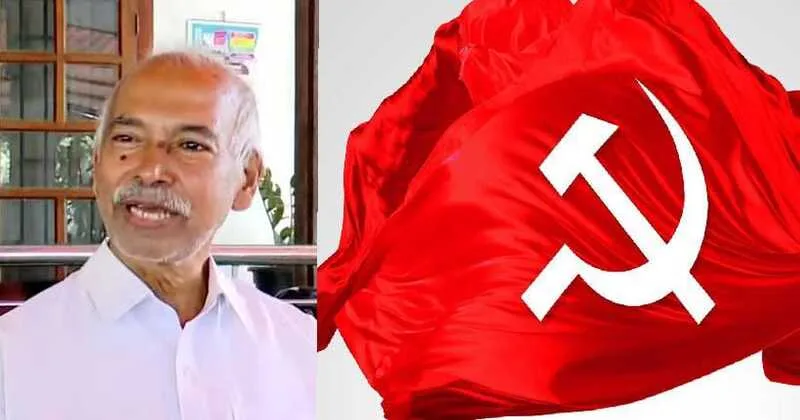
Kannur: V Kunjikrishnan, a former district committee member of the CPI(M) who was expelled from the party after making disclosures related to the alleged Martyrs’ Fund scam, has approached the High Court seeking police protection. His petition requests security arrangements for a book launch event scheduled for February 4, citing fears that the programme could be disrupted.
Kunjikrishnan moved the court after reportedly receiving repeated threat messages. Kunjikrishnan clarified that his appeal is limited to protection for the book launch ceremony alone. He stated that he is not personally afraid and remarked that if anyone intended to attack him, it could have happened at any time. However, he expressed concern that the function itself might face obstruction or violence. He pointed to previous incidents in Payyannur where demonstrations by Congress and BJP workers were attacked, suggesting that tensions remain high. He also confirmed that he had written to the Superintendent of Police requesting security. According to him, a considerable section within the party privately agrees with the issues he has raised, and he believes this internal support has grown. He further claimed that several leaders in Payyannur in Kannur district acknowledge the validity of his concerns.
Kunjikrishnan’s book reportedly contains serious allegations against Payyannur CPI(M) MLA T. I. Madhusoodanan. One of the central accusations is that the MLA created factional groups within the party structure and attempted to exercise disproportionate control over party affairs in the Payyannur area. At the same time, the book criticises the party leadership for shielding Madhusoodanan from scrutiny and avoiding disciplinary action. The narrative suggests that organisational mechanisms were used selectively to protect influential figures rather than uphold accountability.
Titled “Leadership Should Be Corrected by the Workers”, the book spans 16 chapters across 96 pages and presents sharp criticism of several CPI(M) leaders. It argues that many leaders have drifted away from core ideological principles and have instead become aligned with what the author describes as crony capitalist interests. The text alleges that organisational rules are being misused to defend loyalists and suppress dissent. It also characterises the political style of Payyannur MLA T. I. Madhusoodanan as resembling that of a conventional bourgeois politician rather than a representative of a leftist movement.
A significant portion of the book focuses on alleged financial irregularities, particularly those connected to the Martyrs’ Fund, with detailed figures and explanations. Alongside these allegations, the author criticises the broader party leadership, claiming that the state leadership has transformed the CPI(M) from a communist organisation into what he calls a routine electoral machine. According to the book, several leaders have allegedly become beneficiaries of crony capitalism, distancing themselves from grassroots concerns. The author asserts that the scale of irregularities and ideological deviation is substantial enough to warrant academic study and detailed documentation.
One of the concluding chapters is titled “The End of Party Activities,” which symbolically reflects the author’s disappointment with the party’s current direction. The book ends with a dedication to the memory of veteran leader and recent Padmavibhushan awardee V. S. Achuthanandan, whom Kunjikrishnan praises for courageously opposing internal mistakes and social injustices during his political career. This dedication underscores the author’s claim that his criticism stems from ideological commitment rather than personal animosity. Kunjikrishnan has openly positioned himself in opposition to the present CPI(M) leadership, alleging that repeated complaints about corruption within the party were ignored. He claims that no action was taken even after he formally lodged complaints regarding the misappropriation of party funds by the Payyannur MLA.
According to Kunjikrishnan, his book documents several such incidents in detail. He has accused MLA T. I. Madhusoodanan and others of embezzling substantial party funds, and has also named individuals involved in irregularities related to the Martyrs’ Fund, area committee office construction funds, and election expenses. Among the claims is that receipts for building construction funds were forged and that nearly Rs 70 lakh collected from cooperative employees for office construction went missing. He maintains that discrepancies in income and expenditure records form a core part of the revelations presented in his publication.
Meanwhile, the Kerala High Court has ordered police protection for V. Kunjikrishnan’s book launch event after he filed a petition seeking security arrangements. The court also issued notices to the opposing CPI(M) leaders named in the plea, including CPI(M) District Secretary K. K. Ragesh, MLA T. I. Madhusoodanan, and Payyannur Area Secretary P. Santosh. The development has triggered a broader discussion on freedom of expression in Kerala, as concerns surface over the space for dissent and free speech under a government that frequently projects itself as a defender of democratic liberties.