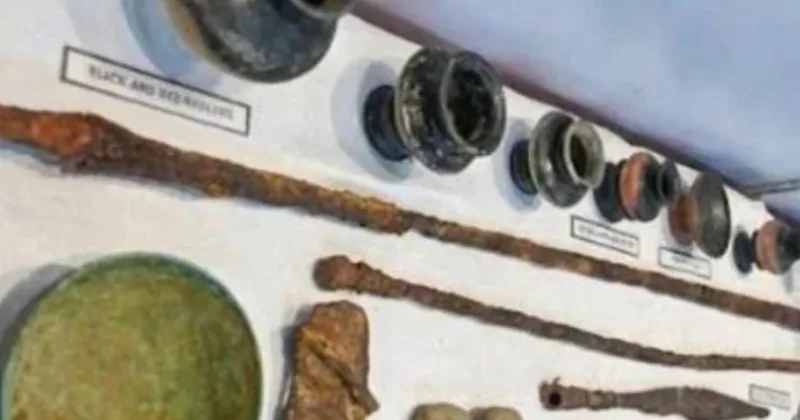
Archaeologists have unearthed an eight-foot-long iron spear at Thirumalapuram, about 80 km from Tenkasi, in Tamil Nadu. It is the longest iron implement discovered in India from such an early period, with experts dating it to around 3345 BCE.
Archaeologists also found a second spear of shorter length in the same area. K Vasanthakumar, who excavated the site, told media, “We found two spears placed in an ‘X’ formation next to an urn. One was 8 ft long and the other 6.5 ft. There were also gold objects inside the urn. The longer spear is slightly rounded at one end, indicating ease of holding.”
Archaeologists in Tamil Nadu have excavated an 8-foot-long iron spear (resembling the Vel of Muruka Bhagavan), the longest iron implement from the Iron Age in India so far.
It may have been used by ancient warriors, to fight enemies, to protect cattle wealth or for ceremonial… pic.twitter.com/Gdmh426N1g
— Jijith Nadumuri Ravi (@Jijith_NR) January 29, 2026
According to media reports, Vibha Tripathi, an archaeological expert, said, “It might have been used by ancient warriors, as such burial sites have thrown up several weapon-grade objects such as daggers, swords, knives, and spears.”
She, a retired professor of archaeology at Banaras Hindu University, added, “They might have also buried them underground, inside a chamber. Preservation of iron is much better here than in other parts of the country. In the Gangetic plains, the soil is moist, making iron corrode faster, so much so that sometimes we get only an impression of iron.”
Experts say the iron weapon has survived in remarkably good condition. It was because of dry soil conditions in Tamil Nadu, which helped preserve the metal over thousands of years. Previous such old burial sites in India have yielded weapons such as daggers, swords, and knives.
The 8-foot-long iron spear, resembling the Vel of Bhagwan Murugan, is the longest iron implement discovered in India from such an early period so far. It may have been used by ancient warriors to fight enemies, to protect cattle wealth, or for ceremonial purposes.
Bhagwan Murugan is also known as Skanda, Kartikeya, Subramanya, Swaminathan, Vaitheeswaran, and Dhandapani. According to legend, Bhagwan Murugan used spears to destroy demons like Sura Padman and others.
Some experts say the unusually long spear may have served either as a ceremonial object or as a weapon used by those old communities to protect cattle and stored wealth, which were considered vital assets during that period. The spear is slightly rounded at one end, possibly to facilitate handling.
It is learnt that producing an iron weapon of this size would have required advanced metallurgical knowledge or technology, as iron smelting typically requires temperatures between 1,200°C and 1,500°C, suggesting the presence of well-developed furnace technology and skilled metalworkers during the period.
The Tamil Nadu State Department of Archaeology has partnered with the metallurgy department of IIT Gandhinagar to proceed further in this regard. The joint research initiative will examine Iron Age sites across Tamil Nadu and is expected to continue until 2028.
K Rajan, academic and research adviser to the TN State Department of Archaeology, said, “It is the technological expression of that period. The iron product was in existence in Tamil Nadu between 3000 BCE and 2500 BCE.”