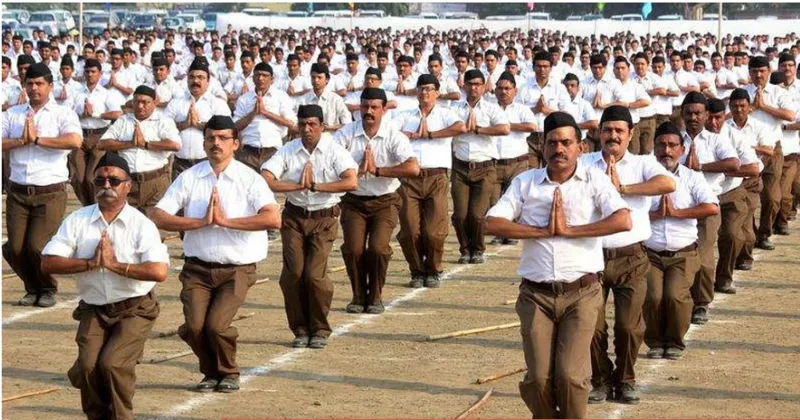
An analysis of the last hundred years of history, work, struggle, advancement, and the impact of RSS will reveal the importance of the role of full-timers in the organisation. The full-timers in the organisation are generally called ‘pracharak’. This institution of RSS is as old as RSS itself. Dr Keshav Baliram Hedgewar, the founder of RSS, was himself a life-long pracharak. It is similar to the ‘sanyasi-order’ prevalent in Sanatan Dharma for the last thousands of years. RSS adopted the same tradition through the institution of pracharakship, with some desirable modifications to the organisation to expand its organisational base and structure. It met with huge success in this experimentation based on simple living, austerity, and a 24/7 focus on the work assignment at hand.
The work of RSS in the Kashmir valley was initiated by a team of Pracharaks in the middle of the 1940s, comprising Jagdish Abrol, Balraj Madhok, and Kidar Nath Sahni. With the passage of time, young, educated, and dedicated swayamsevaks from the Kashmir valley emerged as pracharaks by the end of the 1940s. They were Omkar Nath Kak and Makhan Lal Harkara (Aima). With the onset of the Praja Parishad movement in 1950-51, a band of swayamsevaks emerged as full-time pracharaks from the Kashmir valley and were deputed to various areas of the Jammu and Kashmir state to take the movement to the grassroots level.
Prominent among this dedicated batch of pracharaks from Kashmir valley included Avtar Krishen Kaw, Niranjan Nath Kaul, Jankinath Dhobi, Devkinandan Nakhasi, Brijnath Miyan, Somnath Ogra and Prannath Miyan. All of them belonged to Srinagar city. They remained pracharaks for the full term of the Praja Parishad movement. A number of them were declared persona non grata by the then Sheikh Abdullah regime in Jammu and Kashmir. They worked tirelessly, with deep dedication and commitment to the cause, and returned to their homes only when the movement concluded in and after 1953.
In the early 1970s, Inder Krishen Zutshi, a diploma civil engineer from Srinagar, served for three years as a pracharak. He was also a third-year OTC (Sangh Shiksha Varg) trained swayamsevak. He was followed by Dr Roshan Lal Bali from Baramulla, who emerged as a pracharak and was deputed to the state of Himachal Pradesh for a long time, during which he served as Tehsil Pracharak, Zila Pracharak, and also as the Vibhag Pracharak. He was a homoeopathic doctor and later settled in H.P. Upinder Bhat, from Rainawari, Srinagar, joined as Tehsil Pracharak in Bhaderwah in 1975. He was picked up by the police from RSS headquarters in Jammu, Veer Bhawan-Raghunathpura, during the night when the state of Emergency was declared by the government of India and the RSS was banned thereafter. He was in jail for most of the emergency.
In March 1977, after the Indira Gandhi regime lost the general elections, the state of Emergency ended, and the ban on the RSS was also lifted. In the year 1978, this author also came out as a pracharak after completing his graduation. I was deputed as Mahanagar-Sayamkal pracharak in Jammu for one year, followed by my appointment as a Tehsil pracharak in Doda and Bhaderwah Tehsils for one year. For the third year, I was assigned the responsibility of Doda Zila pracharak. In the year 1981, I returned to my home in Srinagar. It was during my pracharakship that I had the opportunity to complete my third-year OTC in 1980.
In 1985, Ashok Kaul, working at the Government cement factory in Srinagar, left his job and joined as a lifelong pracharak, a role he has held for the last four decades without interruption. After discharging his responsibilities in various capacities at different levels within the organisation, he was deputed to the BJP in 2012. He is currently the General Secretary (Organisation) of the BJP in J&K. He has been in this position for the last one and a half decades and has immensely contributed to the BJP in making it a frontal political organisation in the UTs of J&K and Ladakh.
In the post-mass-exodus period of the Hindu community of Kashmir, two dedicated swayamsevaks of the Kashmir valley joined as the pracharak for the RSS. Virender Kuchroo, originally from Baramulla, served as a pracharak for a couple of years in the middle of the 1990s and was deputed to the Ramban Tehsil. Unfortunately, after his return to his home later, he fell to the Coronavirus epidemic and passed away in 2020 at a young age. Currently in the Ladakh UT, a young swayamsevak named Ashish Ganjoo is serving as the Leh district Pracharak for the last three years. His parents are originally from Shopian, South Kashmir, and he is a post-graduate.
Amarnath Vaishnavi, the senior-most swayamsevak from Kashmir, after retiring from a government job in 1980, joined the RSS as a Vanprasthi full-timer in 1981. He was deputed to the Vishva Hindu Parishad, where he served as the Organising Secretary of the J&K state for five years. During that period, he also led the ‘Balidani-Jatha’ from Jammu and Kashmir to Punjab in response to the terrorism-infested environment there, to build confidence in society as an important project of the RSS. He served as a Vanprasthi for five years and returned to his home in the valley in 1986.
The institution of Vistaraks is another way to dedicate full-time services to the organisation for a brief period, generally 1 to 6 months. In this context, the RSS swayamsevaks in Kashmir took a leading role at various intervals over the last more than fifty years. The first batch of such Vistaraks in Kashmir belonged to the period spanning over five years -from 1972 to 1977. Prominent young and educated swayamsevaks from all sub-regions of the Kashmir valley contributed, in their humble way, in this regard.
Ashok Kaul, now a retired Colonel of the Army, and Anupam Kaul, also a retired senior engineer from the Telecommunication department, came out as Vistaraks and were deputed by the Sangh to work in the Jammu district. They were followed by Rajinder Raina (Kampassi) and Chandji Bhat the next year. Senior swayamsevaks Utpal Kaul and Pramod Durrani from Rainawari were also Vistaraks the same year. They were deputed to work in Jammu city as per the established routine.
In 1977-78, Rajinder Chrungoo was a Vistarak in the border area of Jammu district twice. He also served as a foot-soldier cum organiser for Thakur Baldev Singh, who successfully fought the Lok Sabha elections in March 1977 as per the planning and efforts of the RSS. Shiban Krishen Pandita, who had been in jail during the period of Emergency, also served as a Vistarak in the latter years of the 1970s. He was deputed to Udhampur town in Jammu province. All the above-mentioned active swayamsevaks originally belonged to Srinagar city.
On a number of occasions, young and devoted swayamsevaks from North and South Kashmir also joined their colleagues, primarily from the Central district of Srinagar, and dedicated a couple of weeks as full-time Vistaraks in the valley of Kashmir. It so happened on many occasions, like the 1947 carnage, the Hindu agitation of 1967, the Emergency period of 1975-77, the Ram Janmabhoomi movement and the 1986 communal raid on temples and shrines of Kashmir by the Muslim fundamentalist forces in the valley. They would often be accommodated in the homes of swayamsevaks at the places where they would be deputed by the organisation.
RSS work in the Kashmir valley was always a challenge, but the dedication and commitment of the swayamsevaks translated the dreams of the organisation into a reality. Another challenge was that most swayamsevaks in Kashmir were government employees. The hard training and the inspiring ‘sanskars’ of the RSS swayamsevaks in the valley of Kashmir did a lot of talking on the ground, and history was created eventually based upon the ideology and the hard work of the Sangha-swayamsevaks.