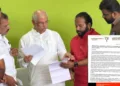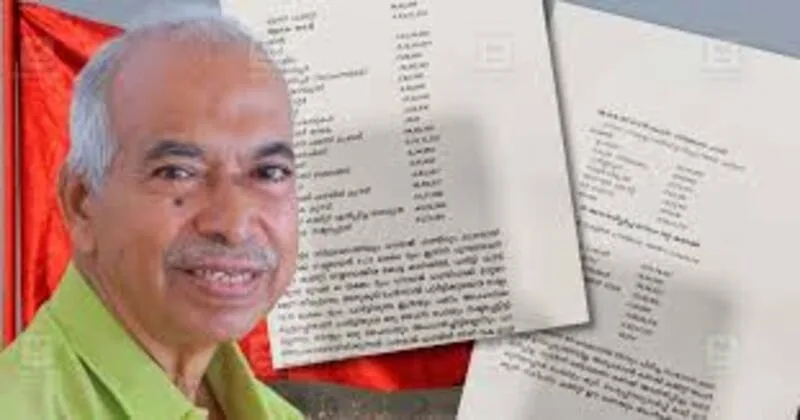
In a move that has triggered serious questions about internal democracy and accountability, the Communist Party of India (Marxist) has expelled Kannur district committee member V. Kunjikrishnan for revealing large-scale financial irregularities involving party-controlled funds. The decision, taken at the CPI(M) Kannur district committee meeting held on Monday, was formally announced yesterday at a press conference by district secretary K. K. Ragesh.
Kunjikrishnan had accused senior party functionaries, including Payyannur MLA T. I. Madhusoodanan, of misappropriating funds collected in the name of the Dhanraj Martyrs’ Fund, the Payyannur Area Committee Office Construction Fund, and the 2021 Assembly election campaign. According to Kunjikrishnan, at least Rs 46 lakh from the martyrs’ fund alone was misused, while irregularities in other funds together crossed Rs 2 crore.
Rather than addressing the substance of these allegations, the party leadership chose to focus on disciplining the messenger. Ragesh accused Kunjikrishnan of “repeating settled issues”, and acting with “partisan and hostile intent.” In an extraordinary escalation, the district secretary even questioned whether Kunjikrishnan’s actions could be considered “communist” at all, alleging that he was working in tandem with “hostile intelligence” forces, an accusation offered without any public evidence.
The CPI(M)’s official position is that all allegations had already been examined through internal inquiry commissions constituted in 2021 and 2022. According to the party, these commissions concluded that there was no embezzlement of funds by any leader, except for procedural lapses such as delays in submitting income and expenditure statements. The district committee claims that Kunjikrishnan himself participated in these discussions, accepted the findings, and later revived the allegations out of personal animosity towards Madhusoodanan. However, Kunjikrishnan’s version sharply contradicts this narrative. He has maintained that the commissions functioned as internal cover-up mechanisms rather than genuine probes. He says he was entrusted with auditing certain accounts ahead of the Assembly session and was alarmed by the figures he encountered, including missing records, fabricated receipts, and unexplained expenditures. Despite submitting documents and evidence to the party, he alleges that no corrective action was taken against those in control of the funds.
The Dhanraj Martyrs’ Fund was reportedly launched in 2016 with the stated objectives of supporting the family, constructing a house, and pursuing legal proceedings. While a house was eventually built, Kunjikrishnan alleges that audited accounts up to 2021 were never properly presented to party committees or contributors. Similar accusations have been made regarding the office construction fund, where around Rs 70 lakh was misappropriated, and the election fund, where fake receipts were used to siphon off money. Instead of ordering an independent audit or a criminal investigation, the CPI(M) leadership has closed ranks around its senior leaders.
The episode lays a culture of institutional defensiveness within the CPI(M), where protecting authority appears to take precedence over addressing allegations of financial misconduct. A party that projects itself as ideologically disciplined and ethically distinct has shown little tolerance for internal scrutiny when accusations point upward. The swift move to discipline the whistleblower, rather than initiate an independent and transparent audit, has intensified doubts about the party’s commitment to accountability.
By expelling Kunjikrishnan without conclusively resolving the financial questions he raised, the CPI(M) leadership in Kannur has deepened perceptions that internal inquiry mechanisms are deployed to neutralise dissent rather than uncover wrongdoing. The outcome reflects an organisation closing ranks to shield influential figures, even at the cost of credibility among its own cadres and supporters.