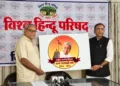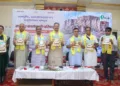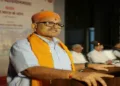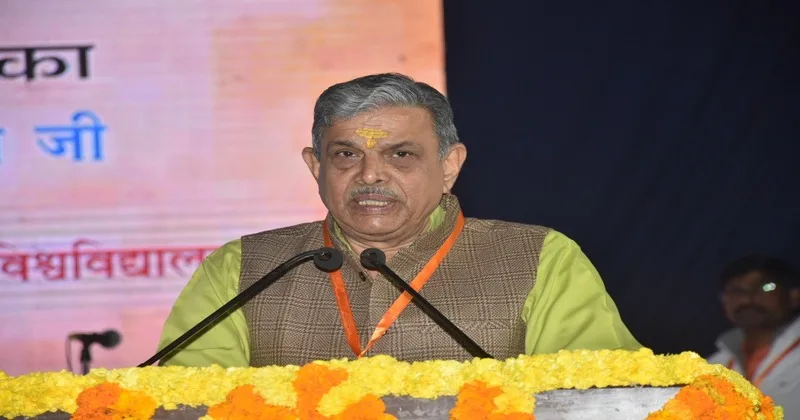
VARANASI: Through divine (God’s) grace and their own efforts, youth will rebuild the nation. Drawing an analogy, a farmer makes every possible effort, but if God does not provide rain and sunlight, there is no outcome. Similarly, even when rain and sunlight are provided, if the farmer does not make efforts, crops will not grow. Both divine grace and human effort are essential for any meaningful work, said Rashtriya Swayamsevak Sangh (RSS) Sarkaryavah Dattatreya Hosabale at a a Yuva Samvad programme organised at Swatantrata Bhavan in the campus of Banaras Hindu University (BHU) on January 24, 2026.
He said that the residents of Kashi take the greatest pride in three things—first, the Ganga, second, Shri Kashi Vishwanath, and third, Banaras Hindu University. Of these, two are creations of divine grace, while one is the result of human effort. Extending greetings on the foundation day of BHU, he noted that just as this university was established through human endeavour, Jamsetji Tata founded the Indian Institute of Science in 1909, inspired by Swami Vivekananda.
Referring to great personalities such as Mahamana Madan Mohan Malaviya, Jamsetji Tata, and Swami Vivekananda, Dattatreya Hosabale said that even during the period of British rule, these visionaries encouraged students to think independently in the fields of education, science, and research. He said that Bharat’s history is often distorted, but eminent Gandhian thinker Dharampal, in his book The Beautiful Tree, has described the strengths of the Bharatiya education system. Ancient Bharatiya texts are not merely compilations of religious traditions, but also repositories of knowledge that today is termed modern science. Bharatiya literature reflects deep contemplation on Dharma, Artha, Kama, and Moksha.
Citing examples from ancient Indian society, he said that Bharat was highly evolved in terms of family systems, village-based organisation, and democratic practices. Speaking on universal brotherhood, he said that Bharat has the moral right to speak of Vasudhaiva Kutumbakam, as in thousands of years of history, India has never exploited another nation. For centuries, communities such as Parsis, Jews, and Tibetan refugees have found shelter in India. He quoted the Dalai Lama, who has said that India is the Guru and Tibet its Shishya. India has never sought to dominate others through force.
Commenting on the present national scenario, he said that anti-India forces remain constantly active. Therefore, without taking the law into one’s own hands, it is the duty of every citizen to remain alert and contribute to national security. He said that the price of freedom is vigilance. Moral values, character, and conduct must be nurtured through family, education, and society, while meeting basic material needs, such as food, clothing, and shelter, is also essential.
During the question-and-answer session, responding to a query on Bangladesh, he said that swayamsevaks have begun efforts to spread awareness in support of Hindus there. On the role of youth in nation-building, he said that even in personal pursuits, there should be a spirit of contributing something to the nation.
Presiding over the programme, BHU Vice-Chancellor Prof Ajit Chaturvedi said that when young students consume news through social media, they often develop the impression that society is full of negativity, which is not true. Many people in society lead dignified lives and uphold family values. He urged students to strive to disseminate knowledge of the Indian Knowledge Tradition within society, regardless of the field they choose.
Vibhag Sanghchalak Prof Jayaprakash Lal was present on the dais. The programme began with floral tributes to the portraits of Mahamana Malaviya, Bharat Mata, Dr Hedgewar, and Shri Guruji.