The fall and rise of the great Somnath temple
September 15, 2026
  • Read Ecopy
  • Circulation
  • Advertise
  • Careers
  • About Us
  • Contact Us
Android AppiPhone AppArattai
Organiser
  • ‌
  • Bharat
    • Assam
    • Bihar
    • Chhattisgarh
    • Jharkhand
    • Maharashtra
    • View All States
  • World
    • Asia
    • Europe
    • North America
    • South America
    • Africa
    • Australia
  • Editorial
  • International
  • Opinion
  • RSS @ 100
  • More
    • World Hindu Congress 2026
    • Op Sindoor
    • Analysis
    • Sports
    • Defence
    • Politics
    • Business
    • Economy
    • Culture
    • Special Report
    • Sci & Tech
    • Entertainment
    • G20
    • Azadi Ka Amrit Mahotsav
    • Vocal4Local
    • Web Stories
    • Education
    • Employment
    • Books
    • Interviews
    • Travel
    • Law
    • Health
    • Obituary
  • Subscribe
    • Subscribe Print Edition
    • Subscribe Ecopy
    • Read Ecopy
  • ‌
  • Bharat
    • Assam
    • Bihar
    • Chhattisgarh
    • Jharkhand
    • Maharashtra
    • View All States
  • World
    • Asia
    • Europe
    • North America
    • South America
    • Africa
    • Australia
  • Editorial
  • International
  • Opinion
  • RSS @ 100
  • More
    • World Hindu Congress 2026
    • Op Sindoor
    • Analysis
    • Sports
    • Defence
    • Politics
    • Business
    • Economy
    • Culture
    • Special Report
    • Sci & Tech
    • Entertainment
    • G20
    • Azadi Ka Amrit Mahotsav
    • Vocal4Local
    • Web Stories
    • Education
    • Employment
    • Books
    • Interviews
    • Travel
    • Law
    • Health
    • Obituary
  • Subscribe
    • Subscribe Print Edition
    • Subscribe Ecopy
    • Read Ecopy
Organiser
  • Home
  • Bharat
  • World
  • Operation Sindoor
  • Editorial
  • Analysis
  • Opinion
  • Culture
  • Defence
  • International Edition
  • RSS @ 100
  • Magazine
  • Read Ecopy
Home Bharat

The fall and rise of the great Somnath temple

Pattan, the ancient town housing the Somnath temple, is rich with remnants of its former splendor. Apart from the ruined shrine of Somnath, several other historical structures dot the landscape. The Jama Masjid, located nearby, is believed to have been constructed using materials from an earlier Sun Temple that once stood at the site

Dr Ujwala ChakradeoDr Ujwala Chakradeo
Jan 25, 2026, 03:00 pm IST
inBharat, Analysis, Culture, Gujarat
Follow on Google News
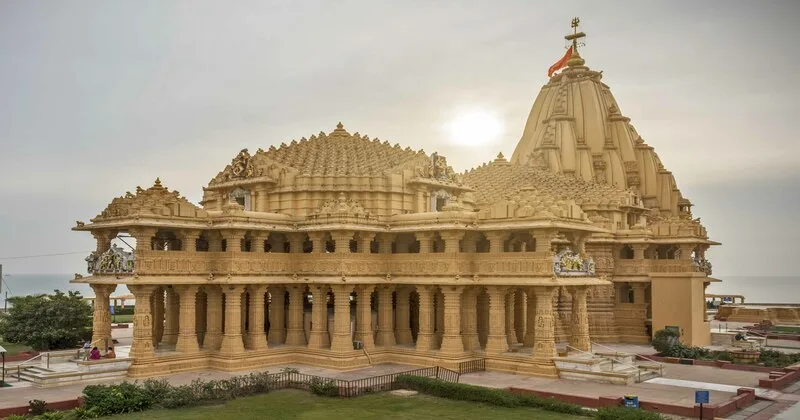
Somnath Temple

Somnath Temple

Facebook
Twitter
WhatsAppTelegramEmail

Among the many temples of western India, the temple of Somnath Pattan holds a place of exceptional prominence. Situated on the southern shore of Kathiawar in Gujarat, at the sacred Triveni Sangam, the confluence of the rivers Kapila, Hiran and the mythical Saraswati, Somnath is revered as one of the twelve Jyotirlingas of Bharat. Dedicated to Lord Shiva, who is also worshipped as the Lord of the Moon, the temple derives its name Somnath (Soma meaning Moon and Nath meaning Lord).

Somnath is as famous for its spiritual significance as for its dramatic history of repeated destruction and reconstruction. The most well-known devastation occurred in 1025 CE, when Mahmud of Ghazni invaded and plundered the temple, leaving it completely destroyed. Despite this, Somnath rose repeatedly from ruins, becoming a powerful symbol of resilience and faith.

In the twelfth century, Kumarapala(r. 1143–1172), the Solanki ruler of Gujarat, rebuilt the temple in “excellent stone and studded it with jewels”, as recorded in a 1169 inscription. He replaced a decaying (probably) wooden structure that had existed earlier. Later, the Chudasama king Mahipaldeva(r. 1308–1325) undertook another reconstruction and Khangar IV re-established the Shiva linga in the temple. In the eighteenth century, Ahilyabai Holkar, known for her patronage of sacred sites across India, also contributed to the restoration of Somnath.

While the temple’s documented history begins in the 11th century, tradition associates Somnath with the Mahabharata period. Although the epic does not explicitly mention the temple, the site is believed to have been an important pilgrimage center from ancient times. It is possible that a temple existed here even before the Valabhi dynasty(c. 480–767 CE). British scholars and archaeologists in the late eighteenth and early nineteenth centuries studied the ruins extensively, offering valuable insights into the temple’s former grandeur.

Repeated cycles of destruction, reconstruction and even conversion into a mosque resulted in the loss of much of the original architectural fabric. However, records indicate that when rebuilt by Kumarapala in the twelfth century, the main temple measured approximately 130 feet in length and 75 feet in width. The nearby Rudra Mala Temple, slightly larger in scale, provides important clues to the architectural style prevalent at the time.

Pattan: The sacred town

Pattan, the ancient town housing the Somnath temple, is rich with remnants of its former splendor. Apart from the ruined shrine of Somnath, several other historical structures dot the landscape. The Jama Masjid, located nearby, is believed to have been constructed using materials from an earlier Sun Temple that once stood at the site.

Historically known as Puttun, the town was also called Wairagya Kshetra, as legend holds that Rukmini and other wives of Lord Krishna performed sati here. The original Somnath temple stood within this sacred town, protected by a heavily built retaining wall that not only separated it from the sea but also safeguarded its foundation.

In 1838, Lieutenant Postans described the temple and its surroundings, noting its grand scale. The temple faced east and featured a central enclosed hall (Gudhmandapa) with three entrances. The Garbhagriha on the western side had a Pradakshina Patha, illuminated by large balconied windows. The exterior walls were adorned with numerous sculptures, beautiful yet tragically mutilated. According to accounts, the temple was supported by 56 pillars, richly ornamented with precious stones such as rubies and emeralds.

Pattan also housed several monumental structures, including stepwells, tombs and shrines. To the east stood the Surya Temple, overlooking the Triveni Sangam. Behind the Somnath temple lay the Bhalka Kund, believed to be the site where Lord Krishna was mortally wounded before departing from the earthly realm.

The current structure and present status

The present Somnath Temple, as seen today, was completed in 1951, marking a significant moment in post-independence India. Sardar Vallabhbhai Patel played a pivotal role in initiating its reconstruction, viewing it as an act of cultural and national rejuvenation. The project was later overseen by K.M. Munshi, with the temple being built entirely through public donations, without state funding.

Architecturally, the temple is constructed in the Maru-Gurjara style, also known as the Chalukya or Solanki style of Nagara architecture. This style is characterized by a richly ornamented Shikhara, elaborately carved walls, grand mandapas and decorative arched entrances. A kund or sacred water tank is an essential element of this architectural tradition.

Also Read: Kerala: Twenty-20 Joins NDA, triggering a major electoral realignment ahead of high-stakes assembly polls

At Somnath, the Maru-Gurjara style manifests as a harmonious blend of Maru Desa (Rajasthan) and Maha Gurjara (Gujarat) traditions. The temple is built on a high platform, symbolizing elevation and sanctity. Sandstone, assembled through an interlocking technique without mortar, ensures both durability and seismic strength.

Today, the Somnath Temple stands not only as a place of worship but also as a vibrant cultural and spiritual centre. Managed by the Shri Somnath Trust, it attracts millions of pilgrims and tourists annually. The temple complex includes a museum, exhibition galleries and facilities for devotees. Daily rituals, grand festivals like Mahashivratri and the evening Aarti accompanied by the sound of waves from the Arabian Sea create a deeply moving spiritual atmosphere.

Topics: GujaratCulturespiritualityHistorySardar Vallabhbhai PatelSomnath Templecivilisation
Dr Ujwala Chakradeo
Dr Ujwala Chakradeo
The columnist is Principal of SMM College of Architecture, Nagpur and specialises in Bharatiya Architectural Heritage [Read more]
Share
Tweet
SendShareSend
✮ Subscribe Organiser YouTube Channel. ✮
✮ Join Organiser's WhatsApp channel for Nationalist views beyond the news. ✮
Previous News

J&K: Jaish-e-Mohammed commander killed after taking family hostage in operation

Next News

Tamil Nadu: DMK targets Centre over VB G Ram G, cries foul over mandatory State funding, passes Assembly resolution

Related News

BRICS media kit reflects India's cultural heritage

BRICS Summit 2026: Bihar’s Sattu, Odisha’s coffee & Gujarat’s craft; Media kit echoes India’s heritage & soft power

Prime Minister Narendra Modi at the ‘NaMo for Viksit Bharat’ event in Vadodara, Gujarat

“Naraaz Fufa” will complain: PM Modi takes dig at opposition as he hails development projects in Gujarat

Representative Image

Jauhar was not patriarchy’s victory, it was defeated people’s last act of defiance

Jauhar, women’s choice and the danger of judging history through a modern lens

Mohammad Reza Naqdi

“Flee Quickly”: Iran’s IRGC threatens Israelis with Banu Qurayza’s fate, reviving a 7th-century tribal genocide

Representative Image

Hindutva: The Dharma of the Universe

Load More

Latest News

Hanuman Singh Rathore, Chairman of the Board of Secondary Education

Journey from ‘I’ to ‘We’ is the essence of Bharat’s thought: Hanuman Singh Rathore

DUSU Elections: ABVP’s Student Outreach Intensifies Ahead of Polls

DUSU Elections| Congress-NSUI resorting to misinformation instead of addressing student issues: ABVP

M.A. Baby with Pinarayi Vijayan - CPIM extended state committee meeting at Kozhikode

Keralam: CPI(M) blames cadre for electoral setback, but keeps Pinarayi and Govindan beyond criticism

Benjamin Netanyahu-Ahmed al-Sharaa
with Recep Tayyip Erdoğan (Left to Right)

Israel–Turkey: A New Strategic Rivalry in the West Asia

BJP Karnataka to launch statewide padayatra against Congress govt over two-stanza Vande Mataram rule

Māori elders invited to India’s global gathering on Ancestral wisdom and modern challenges

BRICS New Delhi Declaration 2026

BRICS New Delhi Declaration 2026: Science, technology, energy & human capital for resilient global south

Representative Image

Post-matric scholarship for SC Students: Who can apply and what does the scheme cover?

Leaders come together at the BRICS Summit in New Delhi on September 12

BRICS Summit 2026: Transforming “Pyramid of privilege” into ” platform of partnership”

BRICS after New Delhi declaration: A strategic makeover

Load More
  • Privacy
  • Terms
  • Cookie Policy
  • Refund and Cancellation
  • Delivery and Shipping

© Bharat Prakashan (Delhi) Limited.
Tech-enabled by Ananthapuri Technologies

  • Home
  • Search Organiser
  • Bharat
    • Assam
    • Bihar
    • Chhattisgarh
    • Jharkhand
    • Maharashtra
    • View All States
  • World
    • Asia
    • Africa
    • North America
    • South America
    • Europe
    • Australia
  • Editorial
  • Operation Sindoor
  • Opinion
  • Analysis
  • Defence
  • Culture
  • Sports
  • Business
  • RSS @ 100
  • Entertainment
  • More ..
    • Sci & Tech
    • Vocal4Local
    • Special Report
    • Education
    • Employment
    • Books
    • Interviews
    • Travel
    • Health
    • Politics
    • Law
    • Economy
    • Obituary
  • Subscribe Magazine
  • Read Ecopy
  • Advertise
  • Circulation
  • Careers
  • About Us
  • Contact Us
  • Policies & Terms
    • Privacy Policy
    • Cookie Policy
    • Refund and Cancellation
    • Terms of Use

© Bharat Prakashan (Delhi) Limited.
Tech-enabled by Ananthapuri Technologies