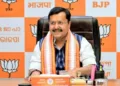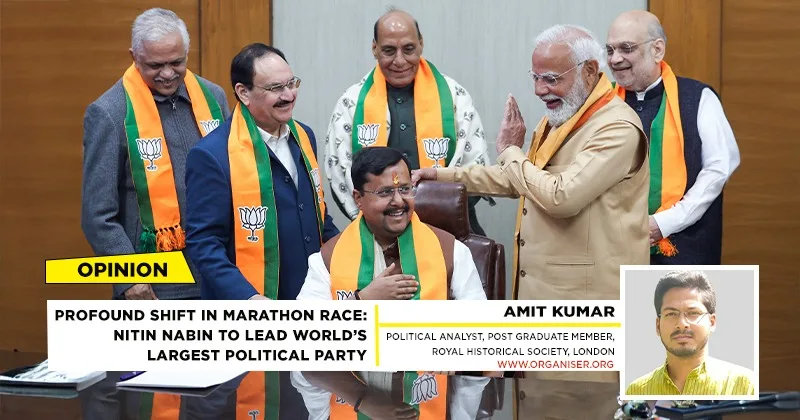
On January 20, 2026, a crisp winter morning in New Delhi, the atmosphere at the BJP’s headquarters was electrifying. PM Modi welcomed the new party chief with a touch of warmth and humour, referring to Nabin as his ‘boss’ in party matters. At 45, Nabin has not only become the youngest person to lead the world’s largest political organisation but has also signalled a profound shift in how the party views leadership, merit, and the deep-seated identity politics of India.
The rise of Nitin Nabin is a story of quiet, calculated ascent within a party that increasingly values performance over rhetoric. His real strength comes from years of silent yet impactful tasks in the youth wing, but what truly made him stand out was his exemplary work in Chhattisgarh. At a time when the state looked like a lost cause for the BJP, Nabin went to work at the grassroots level. He sensed a deep anti-incumbency among rural and tribal voters that was not visible in the mainstream and turned the tide, leading to a stunning victory for the BJP. This knack for translating central strategy into local action is exactly why the top brass has handed him the keys to the kingdom.
Perhaps the most significant aspect of Nabin’s appointment lies in what it says about the BJP’s evolving relationship with caste. In a country where caste arithmetic has traditionally dictated leadership choices, the elevation of a Kayastha leader is a bold departure. The Kayasthas, while educationally and professionally influential, represent a very small percentage of the Indian population, less than 1% in many regions. By choosing a leader from a numerically small community, the BJP has effectively signalled that it is moving toward a post-caste organisational model where merit, loyalty, and administrative capability take precedence over the traditional logic of ‘vote-bank representation.’ It is a move that suggests the party is confident enough in its pan-Hindu identity to bypass the need for a president who represents a massive caste block.
Whereas there is a stark difference in the strategy of the Indian National Congress under the presidency of Mallikarjun Kharge. While Kharge is a veteran leader of immense stature, his election was widely viewed through the lens of identity politics. Coming from the Dalit community, which constitutes a massive and vital electoral demographic unit, Kharge’s leadership was a clear attempt by the Congress to reclaim its traditional base among the marginalised. However, critics argue that by doubling down on caste-based narratives and pushing for a national caste census, the Congress remains tethered to a traditional political framework. While the Congress continues to view leadership through the prism of demographic representation, the BJP’s choice of Nabin suggests it is betting on a ‘New India’ where organisational efficiency and a leader’s ability to connect with the aspirational youth matter more than their share of the population. It is a subtle but powerful message that the BJP is attempting to transcend the very caste lines that have defined Indian elections for decades.
Beyond his organisational skills, Nabin brings a unique cultural profile to the role. Born in Ranchi in 1980 and based in Patna, he is the first leader from Eastern India to head the BJP. He is a millennial leader who naturally fits in with a younger generation looking for someone they can actually relate to. His background gives him an edge with voters who want a leader who speaks their language, both figuratively and literally. Interestingly, his fluency in Bengali is more than just a personal skill, it is a major strategic asset as the party gears up for the intense political contests ahead in West Bengal. He must prove that he can translate his ‘Chhattisgarh model’ to the complex, hyper-local battlegrounds of the East.
The Southern front presents an even steeper climb. In Tamil Nadu and Kerala, Nabin faces the formidable ‘Dravidian Wall’ and the deeply entrenched bipolarity of the LDF and UDF. In these states, the BJP is often viewed through a Northern lens, a perception Nabin must dismantle. In Tamil Nadu, the BJP is trying to manage a tough alliance while building up a grassroots movement from scratch. Then, Kerala, where the electorate is incredibly sharp and has traditionally resisted the party. His challenge there is to make their talk about development actually resonate with people who have heard it all before.
Nabin also faces the daunting task of managing the internal transition of a party at its historical peak. He must lead a National Executive populated by veterans who were in office when he was still in school. It will take a steady hand to mix the experience of the seniors with the speed of the younger crowd. He has a delicate balance to strike: keeping the party’s traditional bond with the Sangh strong, while aggressively modernising its campaign to connect with young voters today.
As he takes charge of the BJP’s presidency, his tenure will be seen as a litmus test for Indian politics. By electing a 45-year-old from Bihar, the party is showing it is ready to move towards the east. It is a quiet reminder to every Party worker that you do not have to shout to be heard in politics. Often, it is the people who keep their heads down, do the work, and truly understand the reality on the ground who end up in the biggest positions. Nabin’s journey from the bylanes of Patna to the corridors of national power draws the new blueprint for aspiring leaders in the saffron fold.