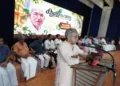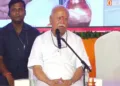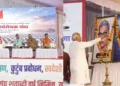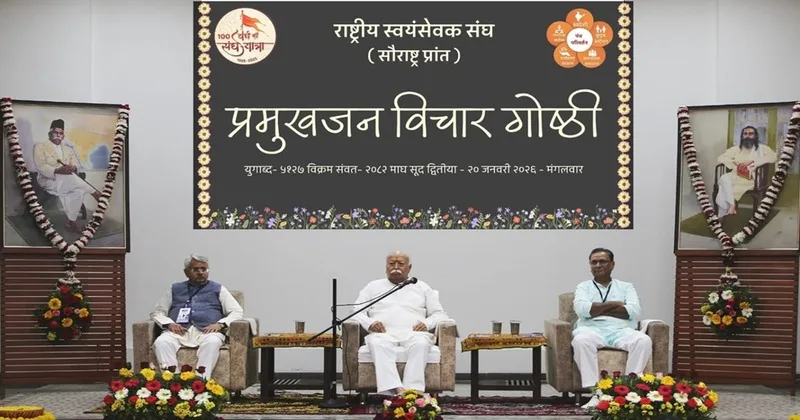
NEW DELHI: The national interest cannot be the monopoly of any individual or organisation. It is our collective responsibility, and the Sangh stands with everyone who works in the interest of the nation, said Rashtriya Swayamsevak Sangh (RSS) Sarsanghchalak Dr Mohan Bhagwat on January 20 at Saurashtra, Kutch at Pramukhjan Vichar Goshthi in Rajkot.
He stated that despite neglect, opposition, and repeated bans, the RSS has reached its present stature solely due to the blessings of Hindu society. Those who work for the nation—whether associated with the Sangh or not—are regarded by the RSS as its own swayamsevaks.
Clarifying the Sangh’s functioning, Dr Bhagwat said that the RSS does not operate anyone through “remote control.” The work of the Sangh is based on pure sattvik affection and a sense of belonging. Through the shakha system, values are inculcated, and swayamsevaks are prepared, who later take decisions for social welfare based on their own discretion and conscience.
Explaining the concept of Hindutva, he said that Hindutva is a way of life. The Sangh works on the same philosophical foundation as the Constitution of India. Bharat is a Hindu Rashtra, and this is precisely why all paths, sects, and traditions are welcomed and respected here.
Dr Bhagwat said that Bharat’s ethos of Vasudhaiva Kutumbakam represents true globalisation. “While other nations view the world as a market, we see the world as one family,” he said.
During the question-and-answer session, the Sarsanghchalak said that Gen-Z youth are like a ‘blank slate’ and are deeply honest. Society must develop the art of communicating with them. He emphasised that people should become masters of social media, not allow social media to become their master, and that it must be used in the national interest.
He also cautioned that attempts are being made in a neighbouring country to reignite Hindu–Muslim animosity, and such divisive thinking must not be allowed to spread in India. He added that corruption exists more in the human mind than in systems, and that corruption can be effectively curbed only when individuals are value-oriented.
Eco-friendly initiative
The programme organised in Rajkot was single-use plastic-free. Special eco-friendly pens were used during the event; after use, they are planted in a pot and dissolve into the soil, growing into plants. On the occasion, Paschim Kshetra Sanghchalak Dr Jayantibhai Bhadesia, Saurashtra Prant Sanghchalak Mukeshbhai Malakan, along with industrialists, doctors, lawyers, and academicians, were present.