Representative image
Bharat is a geo-culturally evolved living civilisation space. Etymologically connoting concentration in enlightenment, the Vishnu Purana defines Bharat as being situated in the north of the ocean and south of the Himalayas and identifies Bharatiyas as her progeny. Puranas are chronicles of past occurrences. The continuity in seeking truth and justice since ancient times makes Bharat and her knowledge tryst identical, where ethicality attains centre stage. Bharatiya knowledge tradition has evolved through the unfolding principles, persuasion, and practices of inquisitive, creative, and sensitive seers, saints, and sages of Bharat. Known as the Rushis, they are worshippers of Nature (and Hindu deities). Here, worship, work and war through body, mind and speech are the eternal endeavours. Devotion, ideation and action characterise the quest for truth and justice in the knowledge tradition of Bharat, conveying ethicality as her cultural essence and civilizational substance.
The urge for liberation inspires the search for truth, as Vishnu Purana says Sa Vidya Ya Vimuktaye: Enlightenment is what liberates. Similarly, the penchant for shared existence encourages the pursuit of justice, as the Taittiriya Upanishad recites Saha Na Bavatu, Saha Nau Bhunaktu, Saha Viryaṃ Karavavahai, Tejasvi Na Vadhitamastu Ma Vidwiṣhabahai: a prayer for mutual protection, nourishment, strength, a sharp intellect, and freedom from animosity. Two Bharatiya epics, the Ramayana of sage Valmiki and the Mahabharata of sage Vyasa, are profound narrations on pursuing truth and justice. Regarded as an incarnation of the Vedas (the most ancient and grandest literary creation in human history), Ramayana narrates the transcendence of Vidya (an integral and organic worldview of the interrelationship between consciousness and matter) over Avidya (mere material indulgence). As the genealogical continuity of Ramayana, the Mahabharata is a manifestation of Vedanta (essence of Vedas articulated in Upanishad texts), narrating a just and comprehensive war in the interest of a shared and equilibrial habitation.
The vast knowledge corpus in oral and written forms unfolds in a three-fold process of Shravan (acquisition), Manan (retention) and Nidhidhyasana (assimilation), as the Bruhadaranyaka Upanishad says in Bharat. This experiential knowledge tradition brings forth its own versions of conceptualisation, causality, location, identification, method application, and social relevance when an attempt is made to narrate it within a contemporary scheme of learning and teaching. Here, the fundamental nature of knowledge is perceived as integral. Yajur Veda reveals, Yatha Pinde Tatha Brahmande, Yatha Brahmande Tatha Pinde: Inter-belongingness between individual and whole or microsom and macrosom and by implication inter-belongingness between local and global.
As Sreemad Bhagvat Maha Purana elucidates, Pinda consists of permutations and combinations of five basic elements: Brahma (Consciousness), Prakruti (Nature), Sattwa (virtue), Raja (will), and Tama (vice). Knowledge, clarity, and memory of inter-belongingness between the individual and the whole arise from Consciousness in an eternal cyclic process known as Vyasa Parampara (memory cycle). The incarnation of thought leaders occurs time and again to restore the Vyasa Parampara, even amid temporal amnesia, through enlightening discourse on principles and practices among preceptors and disciples.
As integrality defines Bharatiya knowledge canvas, causality is located through dialogue in a holistic sense. Narada Purana says Vade Vade Jayate Tattvabodha: Truth is realised through dialogue. Samvada (comprehensive dialogue between preceptor and disciple), Vada (discussion between equals), Jalpa (debate for establishing one’s viewpoint), and Vitanda (refutation of others’ position) are four possibilities to consider when entering into a dialogue. Prudently, the first two options are preferred over the last two to seek clarity.
The enlightening dialogue tradition inspires continuous intellectual encounter between Bharat and the rest of the world through knowledge travellers. Rig Veda says: Aano Bhadra Krtavo Yantu Vishwatah: Let noble thoughts come from all directions. Significantly, Sanskrit is the scholarly treasure of Bharat, inspiring the Oriental Renaissance (Movement) in the West and elsewhere, where the Bharatiya knowledge tradition is appreciated by many philosophers and scientists. The eternity of this knowledge tradition lies in withstanding prolonged ideational and physical onslaughts from the eco-cidal external forces, from medieval-colonial times to today. Consequently, Bharat remains a leading agency during the course of political decolonisation, economic liberalisation, and cultural resurgence worldwide. The unfolding civilizational march is a constant response and reversal of the historically entrenched ‘colonisation of mind’ and ‘hybridisation of ideas’ syndrome, as K. C. Bhatacharya aptly reflects in his “Swaraj of Ideas” essay, afflicting the post-colonial societies.
An enlightening realisation of integral knowledge lies in a holistic dialogue; ongoing endeavours to explore truth involve a just juxtaposition of ancient texts and emerging excavatory findings in Bharat. While excavation is a function of societal insistence and systemic support, revisiting ancient texts requires a comprehensive cultivation through proper consultation and reflection on lexical, etymological, ideational and behavioural treasures of Bharat. Enhancing the intervention of Swami Dayanand Saraswati through his proposition of the Arsh method, which has decisively offered a pioneering direction to the Vedic renaissance, is an intellectually helpful pathway.
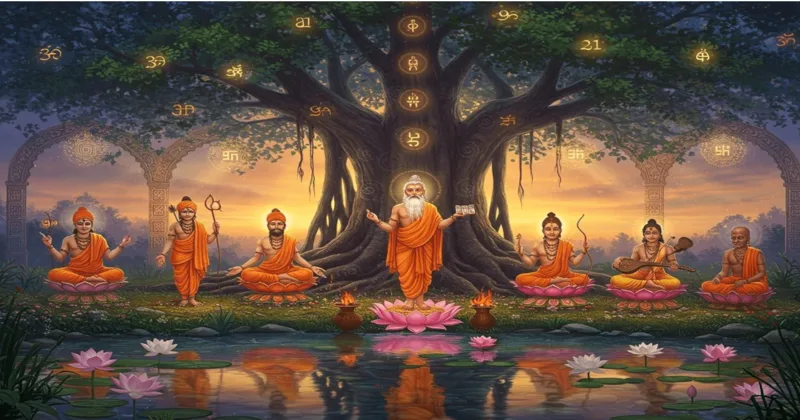
The social relevance of truth and justice-seeking Bharatiya knowledge tradition resonates in a scholarly conversation between Vyasa and his disciple Jaimini in Naimisharanya (an erudition heritage forest) on the core message of his eighteen Puranas. The conversation unfolds as conveying Ashtadasha Puraneshu Vyasasya Vachanam Dwayam, Paropakaraha Punyaya Papaya Parapeedanam: Helping others is a virtue, while causing distress to others is a vice. Again, Shreemad Bhagavat Geeta, a dispassionate treatise on action premised on essential findings of Upanishad texts also authored by Vyasa, envisages Loksangrah: ubiquitous wellbeing through organised endeavours. Thus, Bharatiya knowledge tradition offers an enlightening narration of devotion, ideation, and action through its inquisitive interface with co-existing knowledge traditions of the world.
The intellectual historicity, however, has its own share of irony that afflicts the world with conceptual illusions, including theological uniformism, anthropocentrism, and monocivilisation exceptionalism, perpetrated by the theologians, linguists, and anthropologists of the West. Consequently, the world suffers from the inevitable functional perversions, namely slavery, colonialism, settler-colonialism, racism, relational hierarchy, privilege concentration, systemic pauperisation, domineering wars and terror.
Bharatiya knowledge tradition decisively responds to cultural imperialism inflicted upon Bharat and rest of the world. Vedic renaissance inspires pedagogic interventions of Gandhi, Ravi Thakoor, Mahamana Malavya, Gopabandhu, Ambedkar, Hedgewar and many others through social campaigns and institutional endeavours against eco-cidal mental slavery that keeps appearing in changing forms. It also carries an encouraging legacy of contributing fundamental principles and elevating practices such as ideational oneness, manifestation diversity, shared existence, zero, the ongoing ICT revolution, health and wellness, constitutional governance, peacekeeping, humanitarian interventions, and the restoration of heritage institutions through its accomplished thought leaders and practitioners.
In the quest for truth and justice, Bharatiya knowledge tradition envisions an eco-conscious development aspiration for nurturing the contemporary world that inherits a material modernist legacy of ‘democide’ as conceptualised by an American thinker, R. J. Rummel, who identifies the twentieth century as registering the highest number of people killing people occurrences in human history. Accordingly, an integrative approach of sustainable production, all-inclusive distribution, and ethically restrained consumption is envisaged for ensuring harmony in habitation, happiness in life, and dignity in livelihood. Hence, Dharma, meaning Nature-compliant conduct, remains the guiding template of Bharatiya knowledge tradition that pursues a de-colonial aspiration of repositioning the world from ‘democide’ into, as a renowned Bharatiya educationist S. R. Bhatt describes, ‘Dharmocracy.’
