Former Chief Justice of India Justice D.Y. Chandrachud (retd) on Sunday made significant observations on the contentious issue of bail in serious criminal cases, particularly those invoking national security concerns, while responding to questions on the prolonged incarceration of activist Umar Khalid in the 2020 northeast Delhi riots conspiracy case.
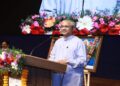
Speaking at the Jaipur Literature Festival during a session titled ‘Ideas of Justice’, Justice Chandrachud underlined that bail before conviction should be the norm in India’s criminal justice system, as it is rooted in the constitutional presumption of innocence. His remarks came amid renewed debate following the Supreme Court’s recent refusal to grant bail to Umar Khalid and Sharjeel Imam, both accused in the alleged larger conspiracy behind the 2020 communal violence in Delhi.
“Bail before conviction should be a matter of right. Our law is based on a presumption, and that presumption is that everyone is innocent until proven guilty,” Justice Chandrachud said. He posed a pointed question about the cost of delayed justice, adding, “If someone remains an undertrial prisoner for five or seven years and is finally proven innocent, how will you compensate for the time lost?”
While strongly advocating the principle of bail, the former Chief Justice clarified that the rule is not absolute. He emphasised that courts have a heightened responsibility when cases involve allegations linked to national security, organised violence or threats to public order.
“Where national security is involved, it is the court’s duty to examine the case in depth,” Justice Chandrachud remarked, noting that indiscriminate grant of bail in such matters could undermine the justice system. However, he also cautioned against the other extreme, where accused persons languish in prison for years without the trial reaching a conclusion.
He explained that bail could justifiably be denied if there is a real possibility of the accused committing the offence again, tampering with evidence, influencing witnesses, or evading the legal process. “The discretion to deny bail must be exercised judiciously and not mechanically,” he indicated.
On January 5, the Supreme Court, while declining bail to Umar Khalid, observed that the accused were allegedly involved in the “planning, mobilisation and strategic direction” of the northeast Delhi riots. The court further held that mere delay in trial cannot act as a “trump card” to automatically override statutory safeguards, particularly in cases registered under stringent laws such as the Unlawful Activities (Prevention) Act (UAPA).
The apex court’s observations have sparked intense debate among legal scholars, civil rights activists and former judges, especially on the balance between personal liberty and national security.
Justice Chandrachud also flagged what he described as a disturbing trend in trial courts and sessions courts, where bail pleas are frequently rejected, forcing accused persons to approach higher courts for relief.
“The denial of bail by district and sessions courts is a matter of concern. Judges often fear that their integrity might be questioned if they grant bail in sensitive cases,” he said, adding that this fear-driven approach is one of the main reasons why bail matters increasingly reach the Supreme Court.
He stressed that judicial independence must extend to bail jurisprudence and that judges should not allow public or institutional pressure to influence decisions affecting personal liberty.
Highlighting systemic delays in India’s criminal justice system, the former CJI reiterated that the Constitution does not permit exceptions when it comes to fundamental rights. “The Constitution is the supreme law. If there is a delay in a speedy trial, the accused is entitled to bail,” he said, underscoring Article 21’s guarantee of life and personal liberty.
Justice Chandrachud warned that prolonged pre-trial incarceration effectively amounts to punishment without conviction, eroding the moral authority of the justice system.
The northeast Delhi riots erupted on February 24, 2020, amid protests against the Citizenship (Amendment) Act (CAA) and the proposed National Register of Citizens (NRC). The violence continued for several days, claiming at least 53 lives and leaving more than 700 people injured.
The Delhi Police Special Cell registered multiple FIRs, including cases under the UAPA and various provisions of the Indian Penal Code, alleging a “larger conspiracy” to incite violence. Several activists, students and political figures were arrested in connection with the case, many of whom continue to remain behind bars as undertrial prisoners.