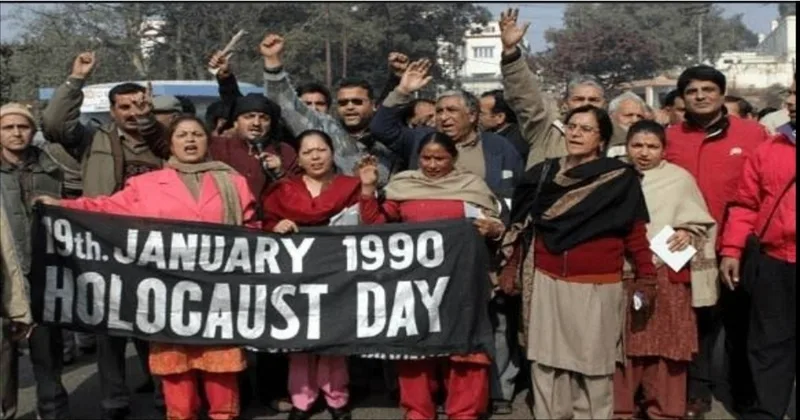
Srinagar: On this day, January 19, thirty-six years ago in 1990, the indigenous people of Kashmir -the Kashmiri Pandits faced their worst in their valley, where they had been living for the last ten thousand years. They have a written history of more than five thousand years in Kashmir. This was not the first time that they faced the slogans of “Raliv-Galiv-Chaliv” (convert-get killed-flee) openly and publicly. It happened earlier, during the despotic rule of Sultans, Cheks, Mughals, Pathans, and even in 1931 and 1947. However, this time it happened despite the existence of the constitution, democratically elected governments, rule of law, and universal human rights & the fundamental rights, which include the right to life.
After experiencing genocide and forced mass-exodus from Kashmir in 1989-90, the displaced community of Kashmiri Pandits decided to organise a convention in Jammu to build a response to their ethnic cleansing and displacement. It was a tall order to think in terms of an appropriate response to the situation that the exiled community was put in their own country. In the climatic intense heat of July 1990, coupled with the heat of having been forcibly thrown on the streets by the Islamic fundamentalists and terrorists in connivance with the political organisations in the valley, the displaced community of Kashmiri Pandits organised a two-day conference on 13-14 July 1990 in Jammu named ‘Kashmiri Hindu Convention-1990’.
The convention was attended by around 500 delegates of the community who adopted a number of resolutions in the conclave. The most important resolution passed unanimously was called ‘Resolution no. 4′, and it gave a call for the creation of a security zone in the valley of Kashmir with constitutional guarantees for the Hindu community of Kashmir. This convention was held under the banner of All State Kashmiri Pandit Conference (ASKPC) -the oldest socio-political representative body of the Kashmiri Pandits headquartered at historic Sheetalnath in Srinagar, Kashmir. With this Convention and Resolution number 4, the struggle for the socio-cultural-political existence of the displaced community began.
After a marathon public contact drive immediately after the convention, the key youth activists of the displaced community, including this author, formed a public platform to pursue the cause of Resolution number 4. It consequently resulted in the formation of Panun Kashmir on 31st December 1990. Panun Kashmir became the biggest rallying factor for the displaced community, and accordingly, a big conclave was organised on 27-28 December 1991, which was attended by the community activists from all over the world. The 1,000 delegates’ conclave named ‘Margdarshan-1991’ adopted the Homeland Resolution on 28 December 1991. The resolution achieved historical importance in the socio-political struggle of the Kashmiri Pandit community post-exodus from the valley, and it caught the imagination of the people at large.
The Margdarshan homeland resolution has three parts, viz. the context, the declaration, and the operative part of the resolution. In the operative part, the resolution demands that, keeping in view the context and the declarations in the resolution, a separate homeland for the Hindus of Kashmir be established in the north and east of the river Vitasta (Jehlum) in Kashmir, where Kashmiri Hindus yearning to return and live in the valley be resettled. The homeland should be declared a Union Territory, and in this territory, the Indian Constitution should have a full flow in letter and spirit. It meant that the historic resolution wanted reorganisation of the state of J&K along with the nullification of Articles 370 and 35A, a separate constitution, flag, and emblem of J&K, along with any sort of special status to the J&K state.
This resolution received great support from the people across the displaced community, and conference after conference held during the 1990s in various parts of the country endorsed and reiterated the demand made in the historic resolution. On 13 July 2000, all frontal organisations of the Kashmiri Pandit community held a ‘Kashmiri Pandit Representative Assembly’ in Jammu, and in the spirit of the Margdarshan resolution, demanded a separate state for the Hindus of Kashmir in the Kashmir valley. Thereafter, the Kashmir Displaced District unit of the BJP in 2013 adopted a resolution in a conference held at Jammu in which it demanded a ‘one-place settlement’ of the displaced community in the valley of Kashmir.
The National Human Rights Commission (NHRC), in the case of genocide and human rights violations against the displaced community filed by this author in March 1994, in its decision in the Commission’s court in June 1999, said that the ‘Community of Kashmiri Pandits was not given the due understanding and relief that they deserved’. It also said that ‘the Commission is constrained to say that the acts akin to genocide were committted against the Kashmiri Pandits in the valley and…..a genocide type design may exist in the minds and utterances of the militants and terrorists against the Kashmiri Pandit community’. The governments and the administration failed to do what they were supposed to do for the victims of genocide in Kashmir, even after their displacement from Kashmir. The Delhi High Court described the displacement as ethnic cleansing.
The responsibility for their genocide rests with the Islamic fundamentalist and terrorist forces sponsored by Pakistan in Kashmir, along with the cunning politicians who worked hand in glove with the radical elements in the valley to execute ethnic cleansing. The J&K government, led by Farooq Abdullah, connived with the conspirators to implement their plan of forced mass-exodus from Kashmir. Equally responsible is the government of India for its failure to take effective measures to stop the unfortunate happenings against the minuscule minority community in Kashmir for decades, despite getting all the intelligence and official reports about the same.
The struggle for the existence of the Kashmiri Pandit community continues for more than three decades, though generations changed over all these 36 years. The spirit of the struggle stands unfazed among the members of the exiled community. In continuation of the struggle, prominent leaders and activists also fought for the reservation of seats for the exiled Kashmiri Pandit community in the J&K Legislative Assembly, ensuring the community’s representation at the highest political platform. This important issue was taken up and presented to the Delimitation Commission, along with other community leaders, thinkers, and intellectuals. The Commission was convinced by the arguments put before it and recommended the nomination of two seats in the Assembly for the Kashmiri Pandit community. Thereafter, in December 2023, the parliament adopted an amendment to the J&K Reorganisation Act 2019, paving the way for the nomination of 5 members to the J&K Assembly, including two members from the displaced community.
There is no doubt that the government of India implemented a large part of the operative part of the historic Margdarshan resolution on August 5, 2019. It was a revolutionary step in the context of J&K that brought significant positive constitutional, administrative, and political changes, sans the resettlement of the exiled Hindu community of Kashmir. Many important people in national political circles believe that these changes will be followed by shifts in social, cultural, and demographic balances in the valley as well. They are of the opinion that such changes can pave the way for the resettlement of the displaced Kashmiri Pandit community back in the valley.
The Margdarshan Resolution explains in detail the reasons for the agony, distress, and repeated exodus of the Hindus of Kashmir. It maintains that Muslim majoritarianism is inherently communal by nature and refuses co-existence, which Kashmir is a glaring example of. For the last seven hundred years of history in Kashmir, the native Kashmiri Pandits were refused co-existence every time in the valley. In recent history, it happened in 1931, 1947, and 1986 when the Hindus faced attempts of genocide in which their life, properties, and places of worship were attacked mercilessly.
It is now important to reconsider the issues of resettlement in view of the continuous struggle for existence by the displaced Kashmiri Pandit community. The whole issue needs to be reconsidered in the new context, which has all the ingredients of a sense of security, political and constitutional guarantees against the repetition of history in it.
Establishment of homeland as per the Margdarshan-1991 resolution or the Demographic Balance in the entire valley are the only two viable options available before the nation for the resettlement of the displaced community in the valley. The community has vowed not to forget and forgive what was done to them. On this day of the 37th Holocaust Day, the exiled community reiterates its will with determination and resolve….!