Bhopal, the capital of Madhya Pradesh, has come under intense public and administrative scrutiny following the seizure of a large quantity of meat late last year, which forensic tests later confirmed contained cow meat. The case has since expanded beyond a routine seizure into a broader investigation involving municipal authorities, slaughterhouse operations, veterinary certification, and the role of contractors associated with the Bhopal Municipal Corporation (BMC).
The matter first came to light after a container carrying frozen meat was intercepted in December. What initially appeared to be a routine police action soon escalated when laboratory reports confirmed that the consignment contained cow meat, an offence under state law. Since then, police action, administrative suspensions, political protests, and public outrage have followed, while investigators continue to examine how such a large quantity of prohibited meat was processed and transported.
Seized consignment and forensic findings
According to police records, the container was intercepted on December 17. The vehicle, bearing a Uttar Pradesh registration number, was found carrying approximately 265 quintals (26.5 tonnes) of frozen meat. Given the volume of the consignment, officials treated the seizure as significant and initiated further checks.
On December 18, veterinary officials collected samples from multiple packets of the seized meat at the Jahangirabad Veterinary Hospital. These samples were sent to a forensic laboratory in Mathura, Uttar Pradesh, for species identification.
The laboratory report later confirmed that the samples tested positive for cow meat, a finding that substantially altered the legal and administrative dimensions of the case. Based on the forensic confirmation, the police registered a First Information Report (FIR) on January 8, invoking provisions of the Madhya Pradesh Prohibition of Cow Slaughter Act, 2004, along with relevant sections of the Bharatiya Nyaya Sanhita (BNS), 2023.
Police action and the ongoing investigation
The FIR was registered at Jahangirabad Police Station, naming the seizure of the container and the laboratory findings as the basis for legal action. The police stated that the meat was being transported illegally and that further investigation was required to determine its origin, processing route, and those responsible.
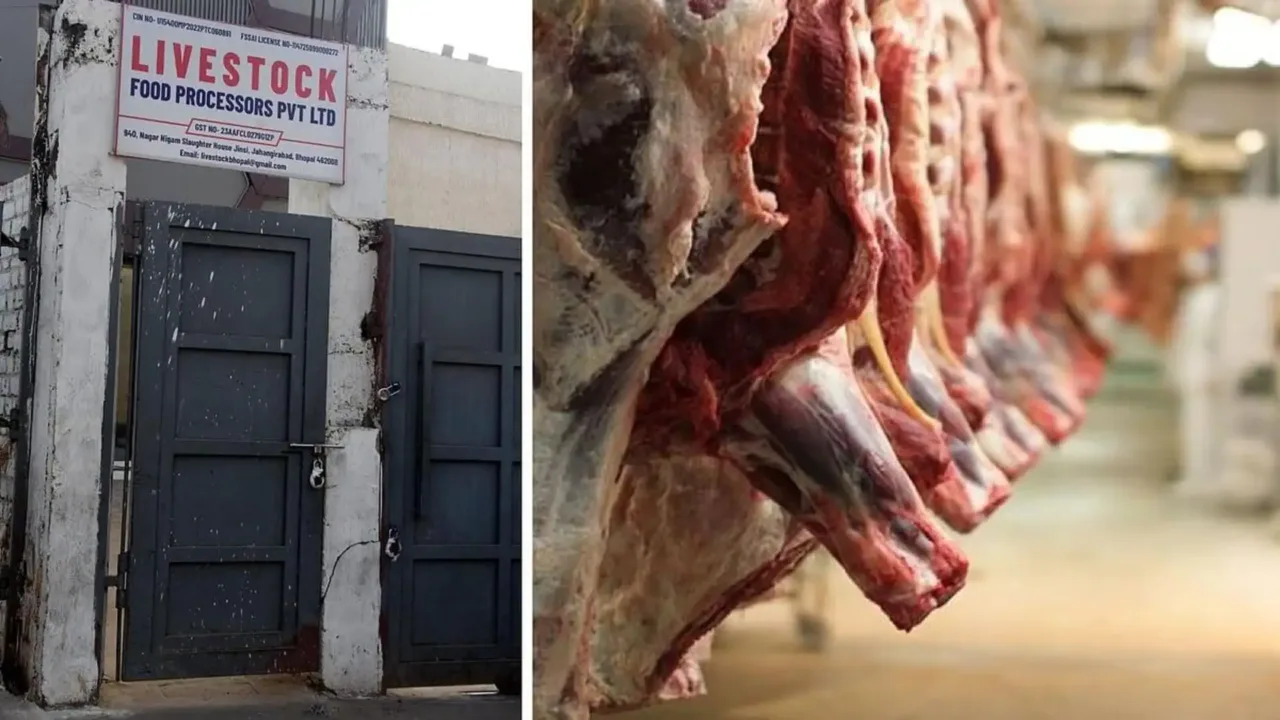
Following the registration of the case, police questioned the owner of the slaughterhouse operating under a public-private partnership (PPP) model in Bhopal’s Jinsi area, as well as the driver of the container. Investigators also conducted a raid at the Modern Slaughterhouse, from where documents and records were seized for examination.
Police officials have clarified that the investigation is still ongoing and that responsibility will be fixed only after a thorough probe, including verification of records, statements of staff, and the role of regulatory oversight.
Municipal slaughterhouse under scanner
The slaughterhouse linked to the seized consignment operates under the Bhopal Municipal Corporation through a PPP arrangement. As per official agreements, the facility is permitted to process only specific categories of animals, excluding cows.
However, the forensic report confirming cow meat raised serious questions about whether there was a breakdown in supervision, deliberate violation of norms, or falsification of records. Many point out that even a single instance of cow slaughter would amount to a serious violation of both the law and the municipal contract.
Despite the seriousness of the forensic findings, the BMC initially maintained that the matter was under police investigation. This position attracted criticism from opposition leaders and civil society groups, who argued that the municipal body should have initiated independent action for breach of contract and regulatory failure.
Under mounting pressure, the Bhopal Municipal Corporation took administrative action. The slaughterhouse was sealed, and a series of disciplinary measures followed.
A veterinary doctor responsible for certifying meat consignments was suspended, after it emerged that certification documents had indicated the slaughter of buffaloes, while laboratory tests confirmed cow meat in the same batch. This discrepancy is now a critical focus of the investigation.
In total, 10 municipal employees were suspended, while three others were issued show-cause notices. A high-level committee was also constituted to examine the lapses and recommend further action.
Municipal officials stated that these steps were taken to ensure accountability and to prevent any recurrence of such incidents.
Questions over veterinary certification
One of the most sensitive aspects of the case relates to veterinary certification. Official documents suggested that the slaughterhouse had processed a specific number of buffaloes, all above the legally permissible age, and that the meat was certified accordingly.
However, the forensic confirmation of cow meat has raised doubts about whether:
Certification procedures were properly followed
Records were manipulated
There was gross negligence or deliberate misconduct
Investigators are now examining certification registers, duty rosters, CCTV footage, and transport documents to reconstruct the chain of events.
The case has triggered strong political reactions in Bhopal. Several Hindu organisations staged protests after the forensic report became public, demanding strict action against all those involved and accountability from civic authorities.
Opposition leaders accused the municipal administration of acting only after public pressure, alleging that earlier complaints had been ignored. During a municipal council meeting, protests led to disruptions, with opposition councillors staging a walkout.
Statements from political leaders across party lines described the incident as a serious breach of public trust, particularly given Bhopal’s sensitivity to issues related to cow protection.
Past incidents add to the controversy
This is not the first time that issues related to slaughterhouse operations and animal carcass disposal have surfaced in Bhopal. Around three years ago, the dumping of dead cattle near a gaushala on the outskirts of the city had sparked outrage, with images resembling a “graveyard” of cattle going viral.
That incident had also exposed gaps in monitoring of municipal contracts related to animal carcass disposal. Investigators are now examining whether systemic failures allowed questionable practices to continue over the years.
Officials familiar with the investigation note that a consignment of over 26 tonnes of meat implies a large-scale operation. Experts point out that such a volume cannot be processed or transported without multiple layers of involvement, including workers, transporters, certifying officials, and supervisors.
This has led to growing calls for a wider probe to determine whether the case is an isolated violation or part of a larger, organised network operating under the cover of legal contracts.
What the law says
Under the Madhya Pradesh Prohibition of Cow Slaughter Act, 2004, the slaughter, transport, or sale of cow meat is a punishable offence. Convictions can result in imprisonment, fines, and seizure of property used in the offence.
Legal experts note that if institutional negligence or collusion is established, responsibility may extend beyond individual operators to supervisory authorities.
As of now, police officials maintain that the investigation is continuing and that conclusions will be drawn only after all evidence is examined. The high-level municipal committee is expected to submit its findings in the coming weeks.
For the Bhopal Municipal Corporation, the case has become a test of governance, transparency, and regulatory enforcement.