India’s search for healthy longevity is no longer confined to lifestyle advice or inherited wisdom alone. It is increasingly shaped by laboratory discoveries that explain why tissues age and how regenerative capacity declines over time. A recent study from Pune adds an important dimension to this understanding that ageing may begin not within stem cells themselves, but in the supportive cellular environment that sustains them
Indian knowledge traditions and the idea of longevity
The context and support systems of the present government with Indian philosophical traditions are visible. The Atharvaveda repeatedly invokes the idea of long, healthy life (dirghāyus) not as a standalone biological condition but as a state sustained by having harmony between body systems, the environment, and social order.
Hymns in the Atharvaveda speak of protecting the body’s internal balance, nurturing strength gradually, and avoiding decay through sustained care rather than sudden intervention. Longevity is portrayed as the outcome of a well-maintained whole, not as the work of a single element.
Ayurvedic texts such as the Charaka Samhita describe ageing as a process influenced by tissue nourishment (dhatu poshana) and systemic balance. Decline begins when supportive processes weaken, long before vital organs fail. The underlying intuition mirrors modern findings where resilience depends on sustaining the systems that quietly enable function.
Rethinking ageing beyond the stem cell
Ageing biology has traditionally focused on damage accumulating inside individual cells. Stem cells have the ability to self-renew and repair tissues, and they have been seen as central to delaying degeneration. Research from the Agharkar Research Institute, an autonomous institute under the Department of Science and Technology, challenges this view.
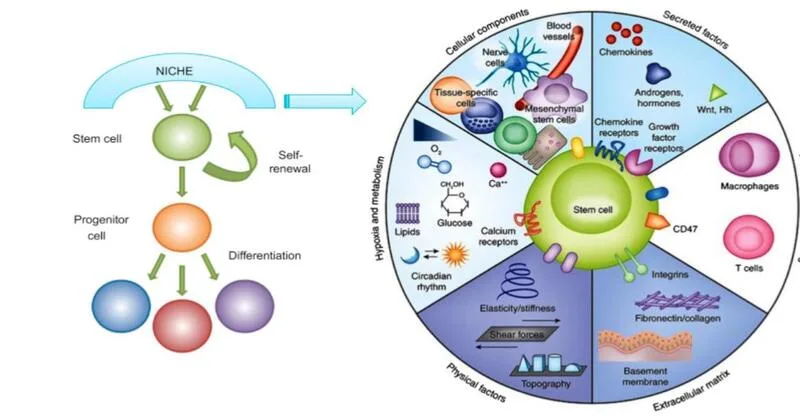
The study suggests that stem cells can remain surprisingly resilient even during midlife. What often fails first is their microenvironment, the network of neighbouring support cells that provide signals, nutrients, and structural stability. When this cellular neighbourhood deteriorates, stem cells are gradually lost, the ecosystem around them collapses.
What reveals about human ageing
In a recent study, this process was investigated in the ovaries of Drosophila melanogaster, a fruit fly species commonly used in ageing research. Despite its simplicity, this model contains conserved biological pathways with humans and is therefore valuable in investigating basic mechanisms.
The focus was on germline stem cells and the surrounding niche cells known as cap cells. Germline stem cells produce eggs and can continue functioning even with minimal activity of autophagy, a process of the cell’s internal recycling system. Cap cells are critically dependent on autophagy for long-term survival.
When the genes involved in autophagy were turned off in these niche cells, these cells showed damage, lost structure, and were unable to provide signals for maintaining the stem cells. Slowly, the stem cells died because the system that supported them was faulty, not because the stem cells had any problems of their own.
Autophagy: The silent protector of tissue health
Autophagy is generally referred to as the cell’s waste and renewal mechanisms. The damaged cell components were removed through autophagy. The study carried out in Pune reveals that autophagy favors cells unequally.
Cap cells demand very strong autophagy in order to support Bone Morphogenetic Protein (BMP) signaling, which constitutes very important biochemical signals for the maintenance of the identity of stem cells. These biochemical signals become weak as one ages due to low levels of autophagy. These findings reinterpret aging in terms of something that happens to all cells simultaneously, so it’s no longer considered an issue of individual cells. The cells in tissues don’t just age; they age because they fail to work in concert with other cell types in their respective way.
The research was conducted in fruit flies; its implications extend to mammalian tissues such as skin, intestine, and muscle, where similar stem cell-niche relationships exist. Fertility decline, delayed wound healing, and muscle loss in ageing individuals may all reflect weakening support systems rather than exhausted stem cells.
The findings also suggest a strategic shift for future interventions. Instead of targeting stem cells directly, a challenging and risky approach for strengthening or protecting niche cells could indirectly preserve regenerative functions. This opens new directions for ageing research that prioritise ecosystem-level resilience.
Convergence of science and civilisational insight
What makes the ARI study significant from an Indian perspective is this convergence between contemporary biology and ancient insight. Modern science now demonstrates, at a molecular level, that decline often starts in the support cells that are overlooked, much like traditional Indian thought emphasised diet, routine, environment, and mental balance as foundations of longevity.
This does not mean ancient texts anticipated molecular autophagy. It shows that Indian knowledge systems intuitively understood ageing as relational and cumulative, not abrupt or isolated. The current research gives empirical grounding to this holistic worldview.
Policy, research and the road ahead
India faces a demographic transition, with a rapidly growing elderly population. Healthy ageing is therefore not just a medical concern but a developmental priority. Research that identifies early weak links in tissues can inform preventive strategies rather than reactive healthcare.
Agharkar Research Institute, a leader in the field of stem cell niche analysis, this study enhances the position of India within the international community of ageing biology. The study is also a part of the country’s efforts to foster the philosophy of preventive health and self-reliance.
Looking ahead, scientists are optimistic about investigating the potential of autophagy modulation in niche cells to help mitigate aging. By doing so, new modalities of fertility preservation, tissue repair, and geriatric care may be realized.
Aging, as this study illustrates, is more than a tale of failing cells; it’s a tale of failing relationships in tissues. Research directed not at stem cells, but at their environment will allow scientists to find more realistic ways to promote healthy longevity.
For India, this work resonates with a more fundamental Civilisational Perspective on life, whereby life persists even when its roots are subtly supported all the time. This work not only provides novel knowledge, but reinstates a novel paradigm for ageing itself.