The dust has finally settled on the 2025 Bihar Assembly elections, and for many of us who spent months in the trenches of the Jan Suraaj movement, the silence is deafening. As a participant in the Jan Suraaj Young India Leadership Programme, I joined thousands of other young men and women motivated by a singular hope: that Bihar was finally ready to move past the binary of caste and communalism. We were told that “Sahi Log, Sahi Soch, Samuhik Prayas” (Right People, Right Thought, Collective Effort) would trigger a quiet revolution. Instead, we witnessed an absolute collapse.
The numbers are brutal. Out of the 234 candidates fielded by Prashant Kishor, not a single one managed to cross the finish line. Rather, in most constituencies, the party struggled to secure even ten per cent of the vote. For a man who built a career on the ’Midas touch’, delivering victories for others ranging all the way from New Delhi to West Bengal, this debut as a principal player was a historic failure. To understand why Jan Suraaj failed so spectacularly, we must look beyond the ballot boxes and into the flaws of the strategy itself.
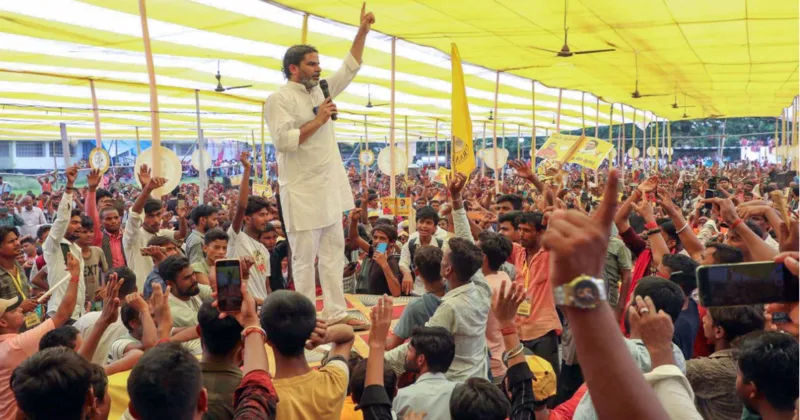
The first and perhaps most fatal error was what political scientists call astroturf politics. While Prashant Kishor walked over five thousand kilometres across the dusty roads of Bihar, the movement he built remained selectively intellectual. Inside our camps, the air was thick with data, social media strategies, and discussions on curbing migration, fostering education and generating employment. We felt like we were part of a sophisticated start-up. But on the ground, politics in Bihar is not a corporate venture; it is an emotional and social contract. By the time we reached the villages, our ‘progressive’ messaging often felt alien to a voter whose identity is still tied to the security of their caste block.
This leads to the second major miscalculation: the gender gap. While Jan Suraaj obsessed over the youth vote through programs like ours, it fundamentally ignored the most powerful silent force in Bihar politics: women. Nitish Kumar has spent twenty years cultivating a loyal base of women voters through the distribution of cycles, granting reservations, and banning alcohol, among others. While our campaign talked about abstract ‘structural changes’ for the future, the NDA offered immediate, tangible stability. When the choice came down to a binary between the feared return of “Jungle Raj” under the RJD and the familiar brand of the NDA, the women of Bihar chose the well-known player.
As a member of the leadership programme, I saw firsthand how our energy was often misdirected. We were a group of well-meaning, educated young people, but we lacked the ’recognisable face’ that rural voters look for. Prashant Kishor’s decision not to contest the election himself was a strategic blunder that drained the momentum from the campaign. In a state where leadership is equated with personal skin in the game, PK remained a strategist standing on the sidelines rather than a general leading from the front. This created a perception that Jan Suraaj was a laboratory experiment rather than a battle-hardened political party.
Furthermore, the opposition successfully painted a narrative that we were merely a ‘vote katuwa’ or a vote spoiler party. The RJD and the NDA both used this to their advantage. In the final weeks, the campaign was reduced to a mere polarising fight. The nuanced arguments for better schools and factories were lost somewhere amidst the noise of religious and caste consolidation. Our failure to build a robust, relatable value proposition meant that we were seen as a distraction rather than a destination.
There is also the matter of the ‘Abhimanyu’, a comparison that Kishor recently used in interviews to describe his loss. While it sounds poetic, it misses the point. Mahabharat’s hero Abhimanyu was a victim of a trap that he didn’t fully understand. Prashant Kishor, however, is a man who designed those very traps for others for over a decade. His inability to read the pulse of his own home state, despite his three-year-long Padyatra, suggests a disconnect between data-driven insights and the raw reality of the Bihari psyche.
For those of us who believed in the Jan Suraaj dream, the outcome is more than just a political loss; it is a moment of deep introspection. We learned that while “Sahi Soch” is necessary, it is insufficient if it cannot be translated into the local vernacular of trust and identity. Bihar did not reject the idea of change; it rejected the specific version of change offered by a consultant’s blueprint.
The dissolution of Jan Suraaj’s organisational units following the drubbing is a sad end to a movement that promised to be a permanent fixture. It serves as a stark reminder that in the arena of electoral politics, there are no shortcuts. A three-year walk and a mountain of data cannot replace decades of social work and a clear, relatable ideology. As we move into 2026, the lesson for Bihar’s youth is clear: if we want to change the system, we must be prepared to build it from within the soul of the state, not just from a spreadsheet in a Patna office.