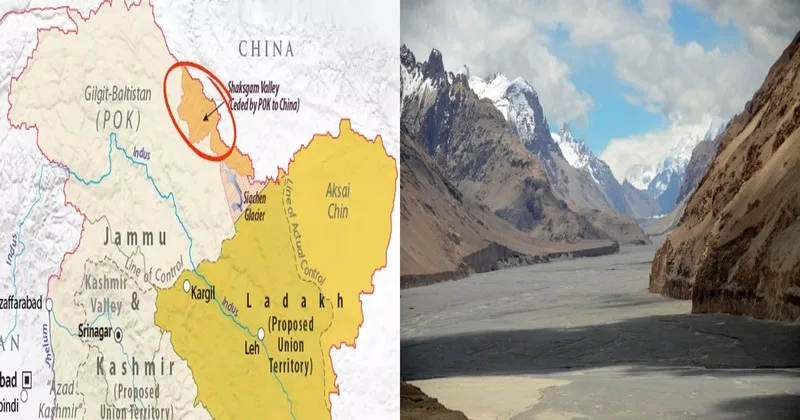
NEW DELHI: China has yet again asserted a provocative territorial aggression over the Shaksgam valley in the Pakistan-occupied Jammu & Kashmir. By citing the 1963 boundary agreement between Beijing and Islamabad, China has claimed that the strategic Shaksagam valley belongs to China. On January 12, Monday, the Chinese Ministry of Foreign Affairs exclaimed that the territory of the Shaksgam Valley belongs to China and it is “beyond reproach”. However, New Delhi has strongly rejected Beijing’s claims and reiterated that the Shaksgam Valley is an integral part of the Union of India. Also, India does not recognise the 1963 deal between China and Pakistan as legal and valid.
The latest prickly relationship between India and China erupted as New Delhi severely objected to the ongoing Chinese infrastructure project across the Shaksgam valley in the Pakistan-occupied Jammu & Kashmir. The Shaksgam valley lies in the Hunza-Gilgit region of PoJK. The Ministry of External Affairs lately criticised the infrastructure projects accelerated by China in the Shaksgam Valley. MEA reiterated that it reserves the right to protect Indian territory and is fully committed to securing the country’s sovereignty, territorial integrity, and national security. “Shaksgam valley is Indian territory. We have never recognised the so-called China-Pakistan boundary agreement signed in 1963. We have consistently maintained that the agreement is illegal and invalid”, the Ministry of External Affairs added, thus strongly rejecting the Chinese claims over the Shaksgam valley.
Baseless counterassertion by Beijing
Reacting to the diplomatic protest of India, the Chinese Foreign Ministry exclaimed that the Shaksgam valley belongs to China. “The territory you mentioned belongs to China”, said spokesperson of the Chinese Foreign Ministry, Mao Ning. It’s fully justified for China to conduct infrastructure construction on its own territory. China and Pakistan in the 1960s signed a boundary agreement and delimited the boundary between the two countries, which is the right of China and Pakistan as sovereign countries”, the spokesperson further added. Beijing reasserts its claim over the Shaksgam Valley in PoJK under the 1963 border agreement.
However, the assertions of China do not seem to stand, as the very territory of Pakistan-occupied Jammu & Kashmir is illegally annexed and held by Islamabad. Pakistan cannot cede the territory to China, which is hitherto illegally occupied by India. This assertion by China thus does not align with international norms. “The entire Union Territories of Jammu & Kashmir and Ladakh are an integral and inalienable part of India. This has been clearly conveyed to Pakistani and Chinese authorities several times. We have consistently protested with the Chinese side against attempts to alter the ground reality in the Shaksgam valley. We further reserve the right to take necessary measures to safeguard our interests”, the Ministry of External Affairs firmly affirmed.
The Chief of the Indian Army General Upendra Dwivedi also asserted, “We don’t agree to the Pak-China boundary agreement of 1963. Any activity in the Shaksgam Valley is something we don’t approve of”.
The 1963 agreement between Pakistan and China
Islamabad and Beijing forged a boundary agreement in 1963 with a clear goal of carving a common international border. To fulfil this agenda, Pakistan-occupied Jammu & Kashmir is the only probable territory. There is no other region or scope in which Pakistan and China share a common boundary. As per the treaty, Pakistan illegally ceded 5,180 sq km of the Shaksgam Valley in the Indian territory of PoJK to China. As aforementioned, this agreement was inevitable for both Pakistan and China to have a common boundary; if not, PoJK would not have been materialised.
But, the agreement doesn’t stand as the very region of PoJK is an illegally held area by Pakistan, which in reality is an Indian territory. The agreement also has a clause which asserts that after the settlement of the Kashmir dispute between Pakistan and India, the sovereign authority of Pakistan will reopen the negotiations with China over the Shaksgam valley to ink a formal boundary treaty. This very clause nullifies the claims of China in the Shaksgam valley. As the Kashmir dispute is unsettled and there is no international recognition that PoJK belongs to Pakistan, the region is an integral part of India. Chinese footprint and infrastructure projects are thus ‘illegal’ and ‘invalid’.
India also has repeatedly raised concerns and objected to the China-Pakistan Economic Corridor(CPEC) project that comes under the umbrella of the Belt and Road Initiative(BRI) of Beijing, as this infrastructure passes through the PoJK. During the affirmation of sovereignty over the Shaksgam valley, the Ministry of External Affairs also reiterated, “We also do not recognise the so-called China-Pakistan Economic Corridor, which passes through Indian territory that is under forcible and illegal occupation of Pakistan”.