After a prolonged pause caused by the COVID-19 pandemic, India’s decennial Census is finally resumed. On January 7, 2026, the Union Government formally notified the Census of India, marking the beginning of one of the largest administrative exercises in the world. The first phase of Census 2026 will begin on April 1 and will focus not on people, but on houses and structures across the country. This phase is crucial, as it lays the groundwork for the population census that will follow in 2027.
The last nationwide Census was conducted in 2011. The 2021 Census, delayed indefinitely due to the pandemic, created a 15-year gap in updated demographic and housing data. This gap has had far-reaching consequences, with governments relying on outdated figures for welfare distribution, urban planning, constituency delimitation, and infrastructure development. Census 2026 aims to correct this imbalance by capturing how India’s population and housing landscape has changed over the past decade and a half.
The Census is conducted by the Office of the Registrar General and Census Commissioner of India under the Ministry of Home Affairs. Headed currently by Mrityunjay Kumar Narayan, the office has functioned as a permanent institution since the 1950s. It works in coordination with state census directorates and district administrations. Nearly 30 lakh enumerators and supervisors will be deployed across India, making it one of the most extensive field operations undertaken by the government.
Two phases of census 2026
Census 2026 will be conducted in two clearly defined phases. The first is the House Listing and Housing Census, scheduled from April 1 to September 30, 2026. The second is the Population Census, planned for February 2027. While the second phase focuses on individuals and their demographic details, the first phase concentrates entirely on structures, homes, and amenities. Understanding this distinction is essential to addressing many public concerns.
The first phase of the Census is designed to create a comprehensive and accurate inventory of all residential and non-residential structures in the country. This includes houses, apartments, shops, offices, institutions, and mixed-use buildings. Before counting people, the government must know how many structures exist, where they are located, and how they are used. This structural framework ensures that no household is missed or counted twice during the population census.
Why your house is listed before people are counted
Many citizens are surprised when census officials arrive to record details about houses months before collecting personal information. The reason is simple and administrative in nature. Accurate population data is impossible without a complete map of housing units. House listing helps identify new settlements, expanding urban areas, slums, vacant homes, and recently constructed buildings. It also ensures that migrant and temporary households are correctly accounted for in the later phase.
During the house listing phase, enumerators collect only housing-related data. They record the type and condition of the structure, whether it is pucca, semi-pucca, or kutcha, and the number of rooms. They also note the usage of the building, whether it is residential, commercial, institutional, or mixed-use. Ownership status is recorded as owned, rented, employer-provided, or vacant. In addition, enumerators collect information on basic amenities such as drinking water, electricity, toilets, kitchens, and cooking fuel, as well as household assets like televisions, refrigerators, vehicles, and internet connectivity.
A key clarification is that no personal or demographic information is collected during the house listing phase. Enumerators do not ask for names, age, gender, religion, caste, education, or occupation. All individual-level data is collected only during the population census in 2027. This separation is deliberate and designed to reduce confusion and misinformation.
What happens if you own more than one property
For owners of multiple properties, the census does not assess individuals or ownership patterns. The house listing phase counts structures, not owners. Each house is listed independently, regardless of who owns it. If a property is rented, tenant household details are recorded. If it is vacant, it is marked accordingly, though information on amenities is still collected. Owning multiple houses does not invite scrutiny, nor is census data linked to taxation, property verification, or income assessment. Census data is used strictly for statistical and planning purposes.
The house listing exercise also supports the updating of the National Population Register. Since the census involves door-to-door enumeration, housing data naturally contributes to population registers. However, it is important to note that this phase remains focused on structures rather than individual identity details, which are addressed later.
Digital features introduced in census 2026
Census 2026 marks a significant shift towards digital governance. For the first time, citizens will have the option of self-enumeration. From March 15, households can submit housing details online through the official census portal or mobile application. Enumerators will also use tablets or smartphones for data collection, enabling real-time uploading and central monitoring. This digital transition is expected to improve accuracy, reduce delays, and minimise human error.
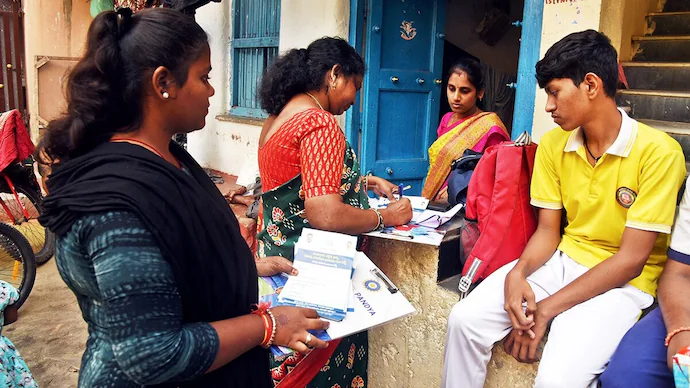
Census work is carried out by personnel appointed by state governments and local administrations. These typically include school teachers, Anganwadi supervisors, patwaris, municipal employees, and panchayat staff. All enumerators carry official government identity cards and census authorisation letters, which citizens have the right to verify before sharing information.
What if the house is locked during a visit
Finding a locked house is a routine occurrence and is accounted for in census protocols. Enumerators are required to make multiple visits, usually two or three, at different times of the day. Temporary markings are made, and basic information may be gathered from neighbours for identification. Only if a house remains locked for an extended period is it recorded as vacant or temporarily unoccupied. There is no penalty for being unavailable during initial visits.
Participation in the census is mandatory under the Census Act, 1948. Willful refusal to cooperate or deliberately providing false information is a punishable offence and may attract fines. However, legal action is rare and typically applies only in cases of repeated and intentional non-cooperation.
Census data does not have legal standing. It cannot be used as proof of residence, citizenship, or entitlement, and no document verification is carried out during enumeration. The data is protected under strict confidentiality provisions and is used only in aggregated form for policy planning.
How the Government uses Census data
Census data forms the backbone of governance and public policy in India. It is used for delimiting Lok Sabha and Vidhan Sabha constituencies, planning welfare schemes, determining municipal and panchayat boundaries, allocating resources, and framing reservation and development policies. In essence, census figures shape how the state understands and responds to the needs of its population.
Though it may seem technical or routine, the house listing phase is one of the most critical components of the Census. It ensures that every structure, urban or rural, permanent or temporary, is accounted for. Census 2026 is not about surveillance or enforcement. It is about capturing India as it exists today, so future policies are based on reality rather than outdated assumptions. Understanding this process allows citizens to participate confidently in an exercise that quietly but decisively shapes the nation’s future.