
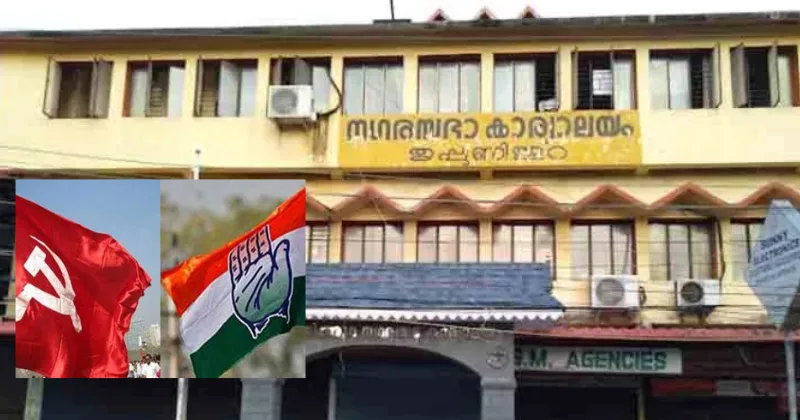
Trippoonithura Municipality in Ernakulam district has emerged as a clear example of how political rivals come together when the BJP rises to power. In this municipality, the BJP and its allies (NDA) formed the council for the first time in its history by winning 21 seats, breaking a pattern where the Congress and the Communists had ruled alternately for decades.
Soon after the BJP’s victory, the CPM-led Left Democratic Front with 20 seats and the Congress-led United Democratic Front with 12 seats, despite being long-standing rivals in Kerala politics, joined hands, making the INDI Alliance is a reality in Kerala after over 2 years of formation. They shared the standing committee chairperson posts among themselves, effectively keeping the BJP out of key decision-making positions.
NDA : 21
LDF : 20
UDF : 12
Total : 53
In the distribution of standing committees in Trippoonithura Municipality, the BJP secured only one of the six standing committees. The LDF got three, while the UDF got two. These positions were bagged through cross-voting between the two Fronts. The UDF secured Public Works and Health, while the LDF took Development, Welfare, and Education. The BJP was allotted Finance alone, as it is the prerogative of the vice-chairperson.
This development in Trippoonithura makes it clear that, at the local level, political differences between the Congress and the Communists are set aside when it comes to countering the BJP.
Both the LDF and the UDF are still not in a position to accept the reality of BJP rule in Trippoonithura Municipality, which they had ruled alternately since its inception four decades ago.
Earlier, the UDF had categorically stated that it would have nothing to do with the LDF. However, when the standing committee elections took place, it went back on its word. The so-called ‘Trippoonithura Pact’ is widely seen as a pilot programme for the imminent Assembly elections. The idea appears to be to strengthen the undercurrent between the LDF and the UDF to counter the BJP. It also exposes their nexus with outfits that advocate a theocratic state.
This has now left the public wondering why these two Fronts continue to fight each other during elections to local self-government bodies, the Legislative Assembly, and Parliament. The BJP has been challenging both Fronts to enter the electoral arena as a single bloc against it. Political observers believe that both Fronts may eventually move towards such a scenario.
Historically, these two Fronts have long enjoyed the blessings of extremist organisations such as Jamaat-e-Islaami, the SDPI (Social Democratic Party of India, the political arm of the outlawed Popular Front of India – PFI), and the PDP (Peoples’ Democratic Party led by Abdul Nasr Madani, the prime accused in the fierce and frightening Coimbatore bomb blasts of February 14, 1998, allegedly engineered to assassinate senior BJP leader L.K. Advani, which left 58 people dead and over 200 injured).
The argument being pushed is familiar. Democracy is described as vibrant and fully functional only when the Congress or its partners win elections. When they do not, the claim quickly shifts to allegations that the electoral process was compromised. If even that argument fails to gain wider acceptance, the next step is to bring all parties together to block the rise of the BJP, branding it with labels such as anti-national, anti-democratic, and fascist.
The observers call that what is never accepted in this narrative is the simple reality that citizens are increasingly choosing the BJP’s ideology. Voters are experiencing its governance from Delhi, silently observing its decisions, and closely tracking its performance. It is on the basis of this assessment that people have elected BJP and NDA candidates in the recently held local body elections in Kerala.
However, to retain control and preserve the long-standing monopoly of the LDF and the UDF, despite being rivals on the ground, both have now come together. Their shared objective is to prevent the BJP and its NDA partners from translating voter support into political power, even when that power comes with the clear blessing of the electorate.
People tracking this development describe it as an insult to the intelligence of voters who gave a clear mandate to the NDA. They argue that such moves amount to bulldozing the democratic rights of the electorate.