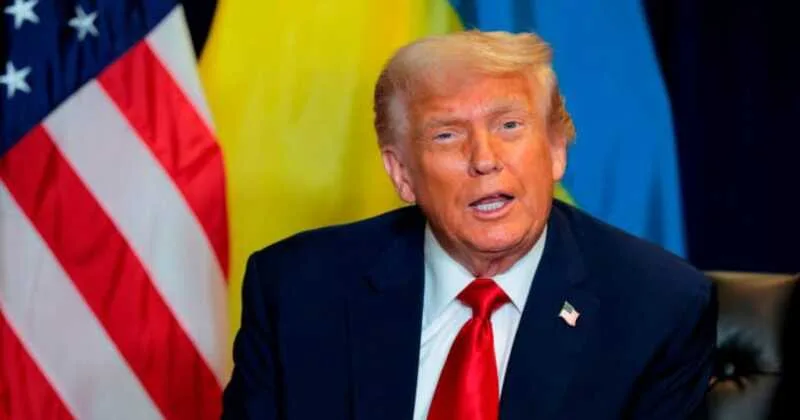
Washington: US President Donald Trump has once again injected uncertainty into India–US economic relations by openly threatening to derail the long-pending bilateral trade agreement. His latest remarks, coupled with aggressive geopolitical posturing elsewhere, underline a pattern of unilateralism that is viewed as undemocratic and dismissive of the sovereignty of other nations, including India.
Following the controversial US military intervention in Venezuela and the forced removal of President Nicolas Maduro and his wife to the United States, Trump escalated pressure on six countries, with India explicitly named among them. Washington has warned New Delhi that continued purchases of Russian crude oil would invite even steeper tariffs on Indian exports entering the US market. This threat comes at a time when India is already grappling with a punitive 50 per cent tariff imposed by the US on several key export sectors.
A major sticking point in the stalled trade negotiations has been India’s firm refusal to open its agricultural and dairy markets to heavily subsidised American products. New Delhi has consistently maintained that such a move would severely harm millions of small farmers and undermine domestic food security. Despite repeated pressure from Washington, India has not yielded, an assertion of policy independence that Trump now appears intent on punishing through economic coercion. The proposed trade agreement, originally expected to be finalised by September–November last year, remains in limbo. Trump’s latest threats, however, have placed even the prospect of renewed talks in serious doubt.
Adding to the pressure campaign, Trump-aligned US Senator Lindsey Graham publicly claimed that he has drafted legislation proposing an extraordinary 500 per cent tariff on countries, including India, that continue energy trade with Russia. Such proposals are widely viewed as reckless, economically destructive, and emblematic of Washington’s attempt to weaponise trade policy for geopolitical obedience. Rather than respecting India’s right to pursue an independent foreign and energy policy, the Trump camp appears intent on enforcing compliance through intimidation.
Beyond India, Trump’s actions are fuelling instability across multiple regions. His renewed demand that Denmark hand over Greenland to the United States, citing alleged threats from Russian and Chinese naval activity, has revived concerns over Washington’s disregard for international norms and territorial sovereignty. In West Asia, protests in Iran, initially triggered by price hikes, have reportedly evolved into calls for political change. There is widespread speculation that Supreme Leader Ali Khamenei could seek refuge in Russia if the situation deteriorates. Trump has issued stark warnings of US intervention, threatening “severe consequences” if protesters are fired upon, remarks that have further heightened tensions. India has prudently advised its citizens to avoid travel to Iran amid the uncertainty. Meanwhile, strategic anxieties are mounting in East Asia. Analysts fear that China may exploit US preoccupation with Venezuela to intensify military pressure on Taiwan, raising the risk of a broader regional conflict.
These cascading geopolitical crises, largely driven or exacerbated by US adventurism, have sent shockwaves through global markets. Investors are fleeing to safe-haven assets, pushing gold prices sharply higher. International gold prices surged by $126 per ounce to $4,458, while domestic prices in India have risen steeply, including a Rs 1,760 jump for one sovereign yesterday alone. If global prices remain elevated, further increases of over Rs 2,000 are expected, with silver prices also set to climb.
In sum, Trump’s confrontational approach, marked by tariff threats, regime-change politics, and open disregard for national sovereignty, poses serious risks not only to India–US relations but to global economic and political stability. India’s insistence on safeguarding its farmers, workers, and strategic autonomy stands in sharp contrast to Washington’s coercive tactics, reinforcing New Delhi’s position as a responsible and sovereign global actor.