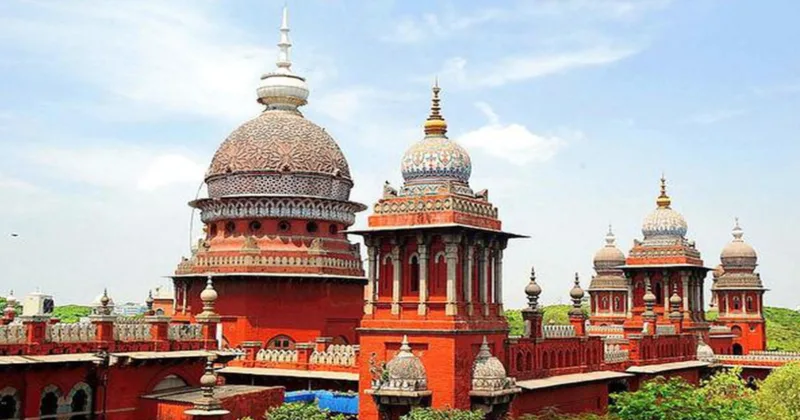
Granting a green signal for the construction of a war memorial on private patta land, the Madras High Court has held that the State cannot insist on prior permission for erecting a memorial on privately owned land. While setting aside an order of the Natham Tahsildar that rejected the proposal for a memorial stupa in Puthur village, the Court drew a direct comparison with an earlier case involving a pillar for Stan Swamy, noting that even though he was an accused under the Unlawful Activities (Prevention) Act (UAPA), no such permission was required then—making the denial in the present war memorial case legally untenable.
The petition challenging the administrative order that denied the request to erect a memorial stupa in Dindigul district was filed by Siva Kalaimani Ambalam, the managing trustee of Thannarsu Kallar Nadu Charitable Trust.
According to reports, the Madras High Court, while allowing the plea, observed that the state cannot insist that an individual obtain permission to erect a memorial on private land. Particularly when the Court has earlier ruled that no such permission was needed to install a pillar in memory of UAPA-accused activist late Stan Swamy on similar land.
Hearing the plea, Justice GR Swaminathan observed that Stan Swamy was regarded as a tribal rights activist; however, he was an accused in a case under the Unlawful Activities Prevention Act (UAPA).
“It is true that Stan Swamy is seen as a fighter for tribal rights by sections of society. But the fact remains that he was an accused in a case arising under UAPA. He died in prison,” observed the Court.
Recounting that in another case, the High Court had quashed a Tahsildar’s refusal to grant permission to install a Stan Swamy pillar on private land, the Court observed that similar principles would certainly apply to the installation of a war memorial on patta land.
“If for erecting stone pillar in memory of Stan Swamy permission is not required, certainly no permission is required for erecting a stupa in memory of Natham Kanavai battle,” the Court said.
The request for erecting the stupa memorial commemorating a battle which is said to have been fought in 1755 at the Natham Kanavai was rejected by an official order issued in May 2024.
During the hearing, the State argued that the petition was belated. The Court, however, accepted the plea, noting “No doubt, the writ petition has been filed belatedly. But then, the doctrine of laches cannot be invoked in this case. So long as the impugned memo (The administrative order) is holding good, the petitioner cannot install the stupa in the petitioned-mentioned site.”
The State authorities, during the hearing, further submitted that the permission was refused because parliamentary elections were in the offing, and that a police report had since been obtained for taking further action.
The Court, however, underlined the significance of preserving historical memory. “The petitioner, after all, wants to erect a stupa to commemorate the victory of native forces over the colonial forces. Such events must be celebrated and preserved for historical memory, the Court said, as reported by the Bar and Bench.
It further noted “Article 51A of the Constitution of India mandates that it shall be the duty of every citizen of India to cherish and follow the noble ideals which inspired our national struggle for freedom and render national service when called upon to do so.”
The ruling further stated, “Imperialism was no respecter of the Biblical saying ‘ask and it shall be given’. The British occupied us and ruled us for close to two hundred years. However, from the outset, there was resistance and struggle. A false historical narrative has been built as if we got freedom without paying any price… Tamil Nadu has contributed.”
Justice Swaminathan further noted that each such victory against colonial forces deserves to be remembered. “Each such victory obtained at great cost and against impossible odds deserves to be relished, and the memory of the martyrs honoured,” he said.