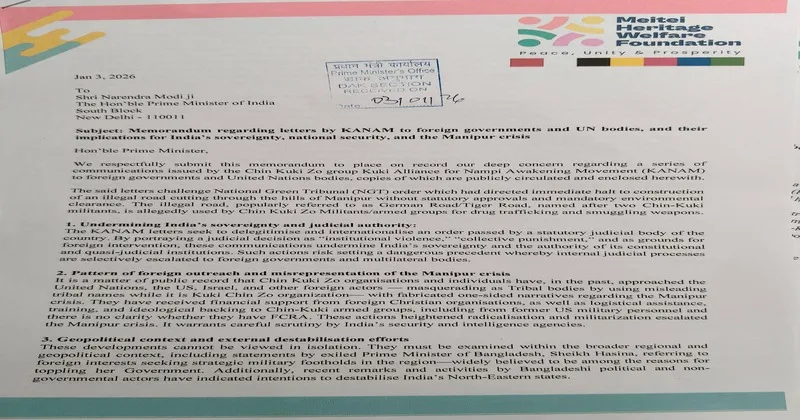
Imphal: Meitei civil society organisations have submitted a memorandum opposing the communication between the Kuki groups and foreign governments and the United Nations(UN). The Meitei groups expressed deep concern over a series of communications issued by the Chin Kuki Zo group Kuki Alliance for Nampi Awakening Movement (KANAM) to foreign governments and the United Nations bodies, copies of which are publicly circulated.
The said letters by the Kuki groups challenge the National Green Tribunal (NGT) order which had directed immediate halt to the construction of an illegal road cutting through the hills of Manipur without statutory approvals and mandatory environmental clearance. The illegal road, popularly referred to as German Road or Tiger Road, named after two Chin-Kuki militants allegedly used by Chin Kuki Zo Militants and armed groups for drug trafficking and smuggling weapons, reads the memorandum.
The Meitei civil bodies also said that with the communication with foreign governments and United Nations the Kuki groups are undermining India’s sovereignty and judicial authority. The KANAM letters seek to delegitimise and internationalise an order passed by a statutory judicial body of the country. By portraying a judicial decision as “institutional violence”, “collective punishment” and as grounds for foreign intervention, these communications undermine India’s sovereignty and the authority of its constitutional and quasi-judicial institutions. Such actions risk setting a dangerous precedent whereby internal judicial processes are selectively escalated to foreign governments and multilateral bodies.
It is a matter of public record that Chin Kuki Zo organisations and individuals have, in the past, approached the United Nations, the US, Israel and other foreign actors — masquerading as Tribal bodies by using misleading tribal names while it is Kuki Chin Zo organization— with fabricated one-sided narratives regarding the Manipur crisis, they said. The Meitei Heritage Society also mentioned that the Kuki groups have received financial support from foreign Christian organisations, as well as logistical assistance, training and ideological backing to Chin-Kuki armed groups, including from former US military personnel and there is no clarity whether they have FCRA.
These actions heightened radicalisation and militarization escalated the Manipur crisis.These developments cannot be viewed in isolation. They must be examined within the broader regional and geopolitical context, including statements by exiled Prime Minister of Bangladesh, Sheikh Hasina, referring to foreign interests seeking strategic military footholds in the region—widely believed to be among the reasons for toppling her Government. Additionally, recent remarks and activities by Bangladeshi political and nongovernmental actors have indicated intentions to destabilise India’s North-Eastern states, the memorandum reads.
Moreover it is pertinent to note that several Chin Kuki Zo organisations and leaders have publicly declared aspirations for the creation of a separate sovereign entity—commonly referred to as “Kukiland”, “Zoland”, or “Zogam”. Such declarations directly challenge the territorial integrity of Manipur and the sovereignty of the Republic of India. MHS further mentioned in its memorandum that the ongoing Manipur crisis appears to be not spontaneous but an engineered conflict, triggered by coordinated attacks on indigenous Meitei villages on May 3, 2023 by Chin Kuki Zo groups and their armed militants. These actions were designed to advance their long-standing secessionist objectives. These events must be examined in their entirety, rather than through selective narratives presented in international forums.
The memorandum appealed the Prime Minister to re-examine the suspension of operations SoO agreements with Chin Kuki Zo Militants in light of current ground realities and national security considerations and pursue a permanent, just and lawful solution to the Manipur crisis that protects all indigenous communities and preserves Manipur and India’s territorial integrity.