Political theorist Thomas Hobbes conceptualises the ‘Social Contract’, a socio-political instrument through which the masses urge for a stable government, though visualised as a monstrous Leviathan, yet much needed for curbing rampant anarchy.
From July-August 2024 onward, the socio-political fabric of Bangladesh has not merely oscillated anharmonically between phases of disequilibrium and those of excitement, but has actually been spiralling on an apparently runaway trajectory of chaotic upheaval.
For Bangladesh, a stable government, grounded in a Hobbesian social contract, is imperative. Else, the bigger fish would devour the smaller, the powerful would feed on the weak, and the radical Islamic mob would chop off the minorities.
The brutal massacre of a hapless Dipu Chandra Das on 18 December 2025 to say the least, is terrible and inhuman. Charged with blasphemy (allegedly of insulting Islam), with no cogent proof to substantiate the vague claims of an entropic mob, Dipu was thrashed, kicked, then tied to a tree and set ablaze. The impunity with which this jungle law was implemented in the open public domain was ghoulish.
Yet, and more dangerously, it is one among a series of such massacres being carried out with outright liberty in a country which gained its independence from Pakistan’s ghastly Operation Searchlight.
Based on the twin pillars of language and culture – reflecting the shared commonalities with their Bengali brethren across the border – Bangladesh surely was not conceived to be what is turning out to be at the end of the first quarter of the present century.
Ironically, after more than five decades of its existence, Islamic radicalism and the notion of jihad has gradually become overwhelming in its social tapestry.
As one professor (presumably at his own peril) of Rajshahi University mentions in a paper that since early August 2024, that is, after the decimation of the Hasina-led Awami League government, Bangladesh has recorded the highest incidence of mob violence in a single year. He writes that human rights organisations reported 128 to 173 lynching deaths in 2024, with approximately 96 occurring after 05 August 2024. In fact, between early August and early 2025, there was about one mob killing every 1.6 days in Bangladesh!
Interlude. Gopal was a name of common occurrence even in the 20th-century Bengali landscape. In the contemporary period however, the name is fast fading to obscurity with the more fashionable variants taking over.
Gopal(a) was one such king who brought in stability in the region of Bengal in the mid-8th century CE. He took over the reins when Bengal was going through Matsya Nyaya (a period of anarchy when the bigger fish was swallowing the smaller) – a period akin to anarchy, chaos and without any supra-authority to usher in a semblance of order and exude confidence in the minds of the inhabitants.
There was another period of anarchy in Bengal’s history – as a prologue to partition – when the Islamic goons and mobs, aided and abetted by Suhrawardy’s Muslim League, vandalised Calcutta in 1946. And emerged another Gopal (Gopal ‘Patha’ Mukherjee) – who was not a mere owner of a meat shop in the northern part of Calcutta (Kolkata) – but a brave, muscular man to have taken up the cudgel in saving the honour of his co-religionists in the face of the onslaught orchestrated by the Muslim League.
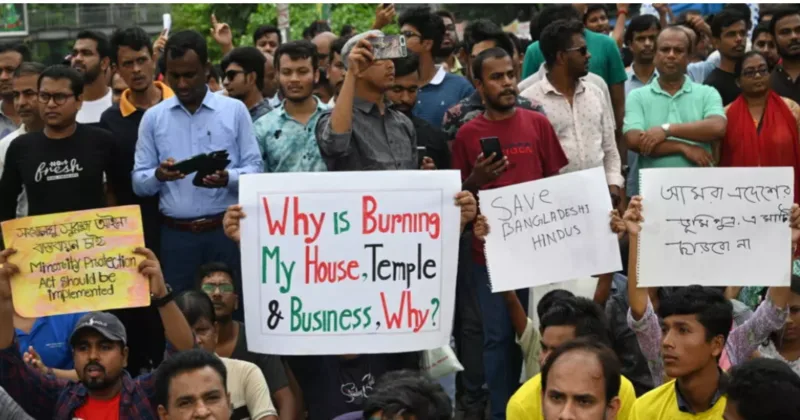
If the less than 8 per cent (of the total population) Hindus of Bangladesh have to survive in the precipice of outlandish jihad cooked up by blatant Islamic fundamentalism, then they have no option but to organize, and in the process form an alliance with other minorities in the ever-turbulent political and religious landscape of Bangladesh.
And for this, they of course need a Gopal-esque character, either in the form of the ruling government, which at this juncture is highly unlikely. Or, they need a messiah who could lead them from a coherent group and resist the invasion of jihadi mobs torching their homes, lynching their men in public glare, while some make live videos of the roasting of human flesh.
When the state fails to provide basic security of life and limb to its citizens, especially the minorities, then it’s no offence to coalesce into a strong formation and combat the assailants. After all, the right to live with dignity is a fundamental human right.
Mob violence and attacks on minorities are, however, not uncommon in Bangladesh and have not just emerged since August 2024. Nonetheless, the rate of such mob (in)justice has systematically risen of late. The International Society for Human Rights (initially based in Germany) notes: “Within a 13-month period, at least 220 individuals have been killed as victims of vigilante justice, a crisis compounded by staggering rates of official inaction and judicial impunity”.
According to Ain-o-Salish Kendra (2024), at least 73 people were killed in mob attacks between January and November 2024. Furthermore, Gargi Das and Saurov Dash in their blogpost of London School of Economics write about the killing of bloggers, desecration of temples and opine that the communal violence in Cumilla (2021) and Narial (2022) were a result of religious extremism based on accusations of blasphemy.
If Dipu’s burning at the stake on 18th December was fresh in the memories, the appalling event was swiftly followed by the arrest of Joy Sarkar a week later, on December 26. What apparently was Sarkar’s crime? He had posted in Facebook that “Sanatan Dharma is the oldest religion”.
Even Italian Giordano Bruno was burned at the stake in circa 1600, naked, in the market square. Yet he, too, had access to the principle of natural justice through a trial, though a mockery. Dipu, on the other hand, after 425 years, did not even receive a single opportunity to plead in his defence.
Though Sarkar has, for the time being, got the respite of not being torn apart by the cruel vigilante mob, as he is in police custody, yet with the notion of the state structures being in cahoots with the Islamic fundamentalists, Sarkar’s fate could also turn out to be as doomed as that of Dipu.
Either Dipu or Sarkar is indubitably not the last victim of mob lynching in Bangladesh. As I write this piece, I am sure several reported as well as unreported cases of Hindus, Buddhists, and other minorities being targeted in Bangladesh are sprouting up.
On Sunday, December 28, I was about to board a flight to Kolkata from the Dubai International Airport. In search of a lounge to lay over, as I asked an apparently south-Asian origin man, his accent indicated that perhaps he was a Bengali. When I asked him whether his mother tongue was indeed the same as that of Rabindranath Tagore’s, he replied in the affirmative but stated that he was from Dhaka. Nevertheless, as a spontaneous gesture, I extended my arm to greet him. Although somewhat late, he responded.
The point I wish to drive home here is that we are all ready to extend our hands of friendship and peace. But not at the cost of appearing frail and submissive. Humanity would surely be upheld, but not at the cost of being thrown in the cauldron of violence.
Eye for an eye is surely not an encouraging philosophy, but to be involved in a ‘just war’ to defend one’s existence is well and truly acceptable.