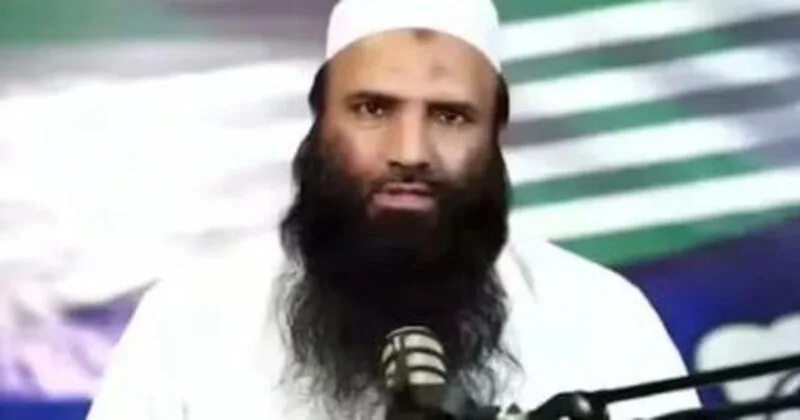
Saifullah Kasuri, a senior commander of the Pakistan-based Islamic terrorist organisation Lashkar-e-Taiba, has publicly acknowledged that terror camps in Pakistan were destroyed during India’s Operation Sindoor. This marks the first such admission by a Lashkar-e-Taiba leader since the Indian military operation was launched in May 2025. Indian security agencies have previously identified Kasuri as the chief mastermind behind the deadly terrorist attack in Pahalgam, Jammu and Kashmir, in which 26 civilians were brutally killed on April 26.
Kasuri is known to be a close and loyal associate of Lashkar-e-Taiba founder Hafiz Saeed, who is designated a global terrorist by several countries and international bodies. A video featuring Kasuri discussing Operation Sindoor has recently surfaced and is now being widely circulated across social media platforms. In the video, Kasuri admits that Indian strikes successfully destroyed terrorist infrastructure, including training camps and hideouts operated by Lashkar-e-Taiba and its affiliates. However, he simultaneously attempts to issue provocative remarks against India, reflecting a mix of acknowledgment and defiance.
In the footage, Kasuri claims that India committed a “mistake” by limiting its operation to terrorist camps rather than broader targets. Analysts say this statement effectively underscores the precision and restraint exercised by India, as it avoided civilian areas and focused exclusively on terror infrastructure. Kasuri also reiterates his refusal to abandon the Kashmir issue, a standard rhetoric frequently employed by Pakistan-based jihadist groups to justify continued violence.
Investigations conducted earlier by Indian intelligence agencies had already confirmed Kasuri’s central role in planning and executing the Pahalgam massacre. Beyond Lashkar-e-Taiba, Kasuri has been deeply involved with Jamaat-ud-Dawah, an organisation that the United States Department of State has explicitly described as a front for Lashkar-e-Taiba. Kasuri also held a leadership position in the Milli Muslim League, the political wing associated with Jamaat-ud-Dawah. The Milli Muslim League is a blacklisted organisation under United Nations sanctions. Over the years, Kasuri’s long-standing association with these groups has elevated him into a prominent figure within Pakistan’s broader jihadist ecosystem.
In OperationSindoor, India made a big mistake by targeting only terrorist bases … Pahalgam Mastermind and Lashkar-e-taiba Deputy Chief Saifullah Kasuri declares#OperationSindoor
https://t.co/CmwGJmvX8V— @ShieldOfIndia (@shieldof_india) December 31, 2025
India launched Operation Sindoor in the early hours of May 7, 2025, in direct response to the Pahalgam terror attack. The operation targeted terrorist camps located in Pakistan and Pakistan-occupied Kashmir, using precision-guided missiles and armed drones. Indian officials stated that more than 100 terrorists were eliminated during the strikes, dealing a severe blow to Pakistan-based terror networks.
At the same time, Indian air defence systems successfully thwarted Pakistan’s attempts to retaliate through drone and missile provocations aimed at Indian civilian and military targets. In response to these escalatory actions, India carried out calibrated strikes on Pakistani military infrastructure, destroying 11 air bases that were used to support hostile operations.
In a significant development, the Pakistani government has also, for the first time, formally acknowledged the impact of India’s precision strikes under Operation Sindoor. The admission came from Pakistan’s Deputy Prime Minister and Foreign Minister Ishaq Dar, who confirmed that Indian drones struck the Nur Khan Airbase in Rawalpindi’s Chaklala area. Speaking at a year-end press briefing, Dar revealed that India launched at least 80 drones within a 36-hour window. While he claimed that Pakistan intercepted 79 of them, he acknowledged that one drone successfully struck the Nur Khan airbase, damaging critical facilities and injuring personnel. He further alleged that India had “made a mistake” by attacking the base in the early hours of May 10, prompting Pakistan’s retaliatory response.
Dar’s comments followed remarks by Pakistani President Asif Ali Zardari, who disclosed that his military secretary had urged him to take shelter in a bunker during the four-day conflict. Zardari said he refused, claiming that leaders should face danger alongside their nation, a statement that nonetheless highlighted the level of alarm within Pakistan’s leadership after India’s strikes.
Adding to the evidence of damage, recent satellite images have shown ongoing reconstruction work at the Nur Khan airbase, further validating India’s claims of having inflicted significant damage. Located less than 25 kilometres from Islamabad, Nur Khan is among Pakistan Air Force’s most strategic installations, housing key logistical and operational assets.
Together, the admissions by both a senior Lashkar-e-Taiba commander and Pakistan’s top political leadership underscore the scale, precision, and impact of India’s Operation Sindoor, marking a decisive moment in India’s counter-terror doctrine.