NEW DELHI: In 2025, Indian governance had decisively shifted towards structural consolidation rather than incremental reform. BJP BJP-led government headed by Prime Minister Narendra Modi has made clear that legislation is not an administrative instrument but a long-term effort. This was the year when number of effective Acts of Parliament of India, as the government focused on the clarity of the law, economic efficiency, modernisation of infrastructure, fiscal discipline and transparency in institutions.
This year has seen constitutional amendments, more fundamental in nature, that involve the unobtrusive rewriting of Indian statutes and regulations governing taxation, markets, ports, shipping, employment, digital activity, and statutory issues. These reforms reflect how the Bharatiya Janata Party views governance not as a series of policy statements but as an ongoing process of legal realignment with India, adapting to economic and strategic realities.
A New Tax Compact: Income-tax Bill, 2025
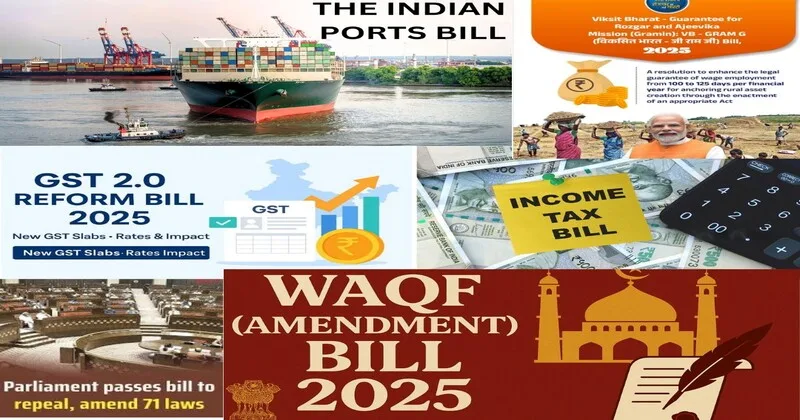
The new Income-tax Bill, 2025, which replaces the Income-tax Act, 1961, was passed by Parliament in 2025 and is expected to take effect from April 1, 2026. This Bill restructures the law to make it more comprehensible and less subject to lawsuits.
Key elements of this Bill
The Bill integrates provisions that eliminate outdated provisions and rearranges chapters to reflect how taxpayers actually calculate income and liability. It reduces the tax year to a single concept, rationalises multiple exemptions, and clarifies controversial issues such as capital gains and the treatment of virtual digital assets, with the aim of simplifying disputes and reducing procedural vagueness.
For the BJP government, this would follow a decade-long trend of relying on trust, technology, and transparency, with faceless assessment and pre-filled returns, rather than on increasing the tax base. The new structure aims to support fiscal stability in an economy that is formalising rapidly by making the law more accessible to salaried taxpayers, MSMEs, and global investors.
Consolidation of Capital Markets: Securities Markets Code
The current capital markets in India are governed by various laws enacted in different years, namely the SEBI Act, 1992; the Securities Contracts (Regulation) Act, 1956; and the Depositories Act, 1996. In 2025, the government took steps to eliminate this fragmentation by the introduction of the Securities Markets Code, 2025 in the Lok Sabha, which is a detailed piece of legislation designed to consolidate and modernise securities law.
The suggested Code reflects three significant changes:
- It combines fragmented laws into one system that minimises overlaps, conflicting definitions and regulatory blind spots.
- It enhances investor protection by providing enforcement authority, civil penalties when minor violations occur and stronger supervision of intermediaries and market infrastructure institutions.
- It specifically embraces technology-based finance digital securities, dematerialised assets, regulatory sandboxes, in line with the Indian markets to understand the changing global practices.
The Code may be undergoing the full legislative process, but its structure indicates that the government intends capital markets to be the infrastructure finance and wealth-generating engine for long-term infrastructure, not an island of scattered legislation.
GST, Fiscal Rationalisation and Cooperative Federalism
Alongside big-ticket reforms, 2025 saw quieter but important tweaks in GST, excise and related tax laws to fix anomalies, rationalise rates and address sector-specific concerns. Many of these changes came through amendments to the Finance Act and specific tax amendment bills, which adjusted definitions, credits, and exemptions.
What stands out is the continued use of institutional mechanisms such as the GST Council, where the Centre and states negotiate changes rather than resort to unilateral measures. This preserves cooperative federalism while allowing the indirect tax system to evolve as the economy formalises and consumption patterns shift.
Colonial Ports Law to Maritime Strategy
Ports and shipping-related law depict how the 2025 reforms have integrated economic efficiency and strategic thinking.
Indian Ports Act, 2025
Indian ports were governed by the Indian Ports Act, 1908, a colonial-era law that did not reflect the scale and effectiveness of a 21st-century maritime economy. In 2025, Parliament considered and debated the Indian Ports Bill, 2025, to replace the 1908 law and establish a coordinated port governance framework.
The new structure, which will be referred to as the Indian Ports Act, 2025, upon enactment by the Parliament, aims to:
- Implement more coordination of Centre-State relations by creating structures such as a Maritime State Development Council and national perspective planning.
- Enables states to establish maritime boards and harmonise standards of safety and environmental protection, tariffs and data reporting in both major and non-major ports.
- Enhance digital adoption through Port Community Systems to reduce logistics delays and improve trade visibility.
The law will facilitate the government’s port-led development vision as part of the Amrit Kaal roadmap to 2047 by reimagining ports as integrated logistics and strategic centres.
Modernisation of Merchant Shipping
Similar to the port reform, the government has revised the Merchant Shipping Act, 1958 to reflect current international standards, environmental standards and enhanced safety of Indian seafarers. Although deliberations and draft proposals suggest a new, modern statute, there is no clear indication when it will be fully operational, or when the Merchant Shipping Act, 2025, will replace the current Act of 1958.
This bill focuses on aligning vessel registration, safety standards, marine pollution control, and crew welfare with current international practices. Thus, enabling India to expand the scope of coastal shipping, shipbuilding, and blue-economy activity while maintaining regulatory credibility.
Digital-Era Regulation
Dissolution and amendment of outdated laws: Since 2014, the Union government has used Repealing and Amending Acts many times to repeal thousands of old, unnecessary, and wasteful statutes, which were complex to comply with and often led to misunderstandings. This process of removing continues in 2025 with new repealing and amending legislation further pruning the statute book and updating cross-references between codes.
The rule of law is enforced not by the size of the list of laws but by the conciseness and applicability. The elimination of dead wood interpretation minimises the risk of litigation and increases the ease with which citizens and businesses are able to comprehend their responsibilities.
Online gaming and management of the digital economy: The rapidly developing digital economy in India has created an industry that exists between technology, finance and consumer protection online gaming is one of the best examples. In 2025, the Centre shifted its approach to a national regulatory framework for online gaming, with discussions and proposals on licensing, KYC standards, anti-addiction and anti-money laundering measures, and methods for distinguishing between games of skill and games of chance.
Rather than a blanket ban or state bans, the new model views online gaming as an economic activity that requires explicit guardrails through consumer protection, financial integrity and platform accountability. This indicates a larger BJP-era trend in digital governance, a promotion of innovation alongside providing statutory frameworks of data, platforms and emerging technology instead of a system of executive orders by ad hoc.
Welfare Delivery, Rural Employment and Waqf Reforms
Beyond codes and sectoral laws, 2025 also saw moves to reshape how the state delivers welfare and regulates community institutions.
Rural employment and outcome-oriented welfare
Reforms to rural employment schemes in 2025 aimed to strengthen transparency, deepen digital monitoring, and better align expenditure with asset creation and skill development. While not always packaged as a single flagship Act, the overall direction has been to:
Link guaranteed work more closely to durable local infrastructure and climate-resilient assets.
Use direct benefit transfers, Aadhaar-based verification and online rolls to curb leakages and ghost beneficiaries.
This continues the BJP government’s broader welfare approach for saturate coverage, transfer benefits directly and use data systems so that welfare becomes both fiscally sustainable and politically accountable.
Waqf amendments and institutional accountability
Debates around reforms to the Waqf framework intensified in 2025, with proposals focusing on the digitisation of records, transparent mapping of Waqf properties and clearer procedures for disputes and encroachments. The proposed amendments focus on strengthening governance, record-keeping, and oversight while maintaining the religious character of Waqf endowments.
From a governance lens, the message is that community and religious assets, irrespective of denomination, must operate under transparent, legally enforceable norms. This sits alongside efforts in other sectors to bring charitable, educational and religious institutions under more standardised regulatory compliance without formally altering their doctrinal autonomy.
Viksit Bharat – Guarantee for Rozgar and Ajeevika Mission- Gramin
In 2025, VB-G RAM-G is introduced as a formal government Bill in the Parliament of India, as an executive scheme. Officially titled the Viksit Bharat – Guarantee for Rozgar and Ajeevika Mission (Gramin), it was framed as a new legislative framework to restructure the delivery of rural employment, rather than as a minor amendment to existing laws.
The Bill underwent parliamentary debate and was passed by both the Lok Sabha and the Rajya Sabha. It also received Presidential assent and became an Act of Parliament in 2025. This legislative route gave the programme statutory force, making its provisions legally binding on the government.
The significance of VB-G RAM-G lies in this transition from Bill to Act. It established rural employment guarantees through law, strengthened accountability mechanisms and linked employment generation with durable asset creation and livelihood sustainability. Within the BJP government’s 2025 legislative agenda, VB-G RAM-G reflected a shift toward legally anchored and outcome-oriented welfare governance rather than purely scheme-based interventions.
Laws as a Long-Term Future of Secure India
BJP government’s 2025 legislative agenda reveals a consistent understanding of law as an instrument of stability and capacity-building, not just for short-term political signalling.
There is a clear pattern in the reforms occurring across all fields. The full codification of policymaking is aimed at reducing fragmentation in the laws governing income tax and securities. There is a trend toward simplicity: using simpler forms of legislation, avoiding ambiguous definitions in statutes, and removing redundant provisions from laws to ensure there are no impediments to sustainable development in tax law.
Another trend that cannot be wished away is the shift from institutional arbitrariness to rule-of-law governance. The establishment of statutory councils, the strengthening of investor protection schemes, and the shift to rule-of-law welfare delivery mechanisms demonstrate a strong focus on future preparedness through the application of technology-responsive global best practices in key economic laws.
For a country navigating rapid growth, technological disruption, and geopolitical flux, such hectic legal groundwork is not beneficial, as it does not produce instant headlines. With improved bills and codes passed by the government, the government will decide how the Indian state treats taxpayers, investors, workers, and communities for decades to come.