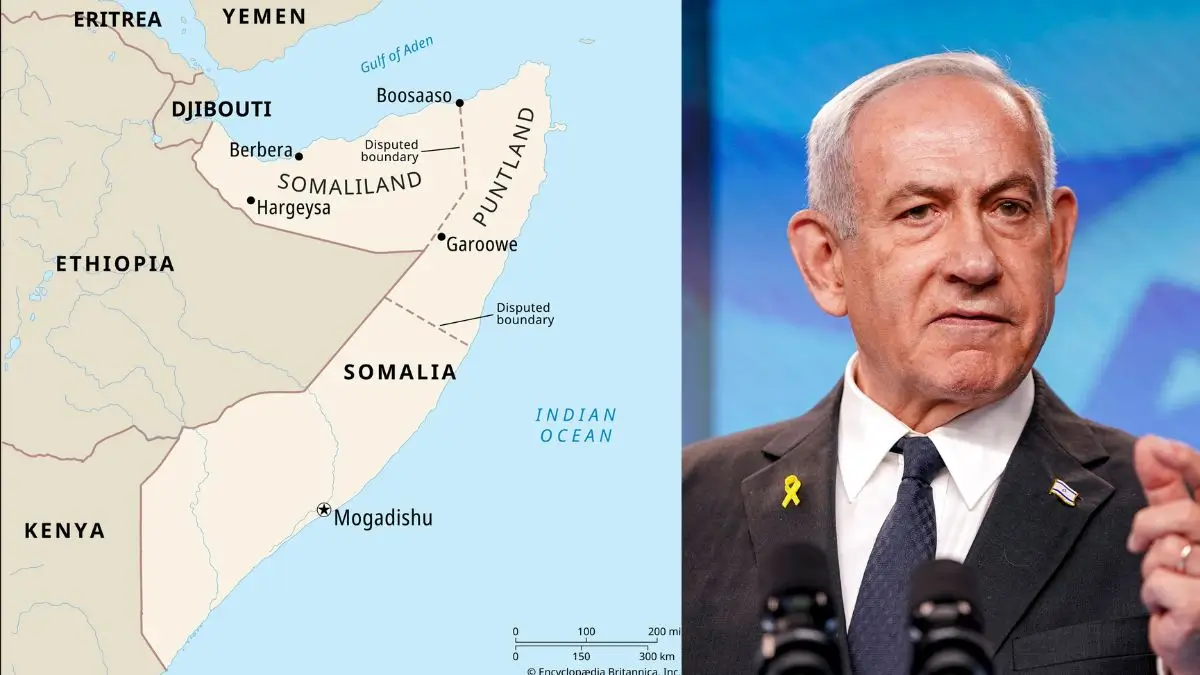
On December 26, 2025, Israel became the first United Nations member state to formally recognise the Republic of Somaliland as an independent and sovereign country, marking a significant diplomatic milestone for the self-declared state that has existed outside international recognition for over three decades.
The announcement followed a joint declaration signed by Israeli Prime Minister Benjamin Netanyahu and Foreign Minister Gideon Sa’ar with Somaliland President Abdirahman Mohamed Abdullahi during a video conference. The agreement establishes full diplomatic relations, including the exchange of ambassadors and the opening of embassies in both territories.
Netanyahu described the recognition as being “in the spirit of the Abraham Accords” and expressed hope that Somaliland would eventually be integrated into the broader US-brokered normalisation framework in the region. Israel also announced immediate cooperation with Somaliland in sectors such as agriculture, healthcare, technology, and economic development.
Celebrations at home, backlash abroad
In Somaliland, the recognition sparked widespread celebrations. Thousands gathered at Hargeisa’s Freedom Square, waving national flags and chanting slogans in what officials described as a historic affirmation of Somaliland’s long-standing quest for international legitimacy.
However, Israel’s move was swiftly met with strong opposition across Africa and the Middle East. Somalia condemned the recognition as a violation of its sovereignty and territorial integrity, while the African Union (AU) reiterated its firm stance against recognising Somaliland as a separate state.
“The Chairperson of the African Union Commission rejects any recognition of Somaliland and reaffirms the African Union’s unwavering commitment to the unity and sovereignty of Somalia,” the AU said in a statement.
Saudi Arabia also issued a sharp rebuke, stating that it “fully supports the sovereignty and territorial integrity of the brotherly Federal Republic of Somalia” and rejects any unilateral actions that violate international law. Egypt, Turkey, Djibouti, and several other regional actors echoed similar objections, warning that the move could destabilise the Horn of Africa.
What is Somaliland and how did it emerge?
Somaliland occupies the northwestern region of what is internationally recognised as Somalia. It borders Djibouti to the northwest, Ethiopia to the south and west, and the rest of Somalia to the east. Crucially, it also boasts an 850-kilometre-long coastline along the Gulf of Aden.
Formerly a British protectorate, Somaliland gained independence on June 26, 1960, as the State of Somaliland. Five days later, it voluntarily united with the former Italian Somaliland to form the Somali Republic. That union, however, soon unravelled.
Northern Somalis increasingly felt politically marginalised under southern-dominated governance. Tensions escalated sharply after Somalia’s defeat in the 1977-78 Ogaden War with Ethiopia under the dictatorship of Siad Barre. Barre’s regime launched brutal military campaigns in the north, including aerial bombardment of Hargeisa, killing thousands and displacing large segments of the population.
In response, the Somali National Movement (SNM) waged a guerrilla war against the regime. When Barre’s government collapsed in 1991, the SNM controlled much of the northwestern territory. At a grand conference of northern clans in Burao that year, leaders formally revoked the 1960 union and declared the independence of Somaliland within the borders of the former British protectorate.
A de facto state without de jure recognition
Since 1991, Somaliland has functioned as a de facto state. It has its own constitution, currency, police, military, and a hybrid governance system that blends modern democratic institutions with traditional clan-based consensus mechanisms.
Unlike Somalia, which remains plagued by civil war, terrorism, and political instability, Somaliland has experienced relative peace, conducted multiple multi-party elections, and overseen peaceful transfers of power. Freedom House classifies it as “partly free,” a distinction rare in the region.
Piracy and terrorism levels in Somaliland are significantly lower than in southern Somalia, where the Islamist terror group Al-Shabaab continues to control large swathes of territory. While Somalia survives largely on international aid and military assistance, Somaliland has built functioning institutions with limited external support.
Yet despite these contrasts, Somalia retains international recognition, while Somaliland remains excluded from the United Nations and major global forums, a paradox that has long frustrated Somaliland’s leadership and population.
Why the sea matters more than the land
The strategic significance of Somaliland lies less in its territory and more in its coastline.
Situated along the Gulf of Aden, Somaliland overlooks one of the world’s most critical maritime corridors linking the Red Sea to the Arabian Sea. This route carries a substantial portion of global trade and energy supplies and has been contested for centuries.
In recent months, the Red Sea shipping lanes have become increasingly volatile due to repeated attacks by Iran-backed Houthi militants operating from Yemen. These attacks have targeted Western and Israeli-linked vessels, raising insurance costs and disrupting global commerce.
For Israel, establishing formal ties with Somaliland offers strategic depth in maritime intelligence and regional security cooperation. Somaliland’s proximity to Yemen provides a vantage point to monitor Houthi activity and counter Iran’s expanding influence in the region.
Berbera port and the regional power play
At the centre of Somaliland’s strategic value is the Berbera Port, a deep-water facility near the Bab al-Mandeb Strait. The port has been modernised by UAE-based DP World, which has invested over $442 million in its expansion.
Ethiopia, a landlocked nation seeking to reduce its dependence on Djibouti for maritime access, has increasingly engaged with Somaliland, although it has stopped short of full diplomatic recognition.
Israel’s recognition also comes amid intensifying global competition in Africa, where powers such as China, the Gulf states, and Western nations are vying for influence over trade routes, ports, and military footholds. Djibouti, just west of Somaliland, already hosts multiple foreign military bases, including China’s first overseas naval base.
While Somaliland remains unrecognised by the UN, its case challenges traditional definitions of statehood. International law often prioritises recognition by multilateral bodies, but political reality on the ground tells a different story.
For over 34 years, Somaliland has demonstrated functional governance, territorial control, public legitimacy, and political stability, criteria many scholars argue define a nation more convincingly than diplomatic paperwork.
Israel’s recognition does not immediately alter Somaliland’s legal status globally, but it breaks a long-standing diplomatic taboo and could encourage other states to reassess their positions.
As global maritime competition intensifies and regional security concerns mount, Somaliland’s relevance is no longer merely a historical dispute with Somalia. It is increasingly a strategic node in the evolving geopolitics of the Red Sea and the Horn of Africa.
Whether or not the United Nations follows suit, Israel’s move has ensured that Somaliland is no longer invisible on the world stage and that the debate over nationhood, sovereignty, and strategic reality is far from settled.