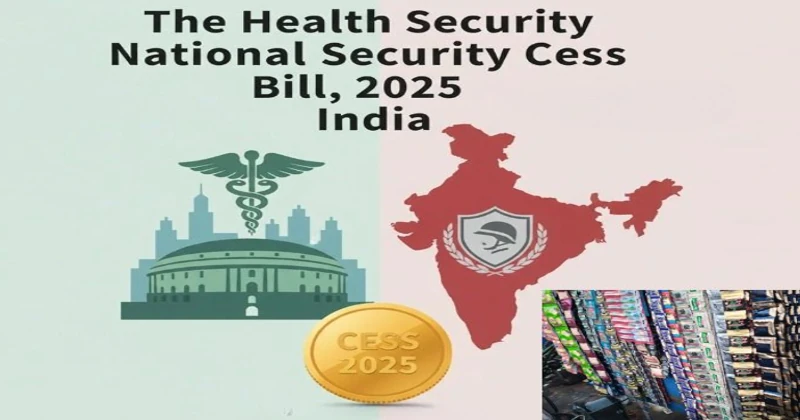
The National Security Cess Bill 2025 or Health Security Cess, indicates that there is a paradigm shift towards recognizing health security as an integral part for national security is occurring. It provides a concrete funding stream for health systems infrastructure or security-related outlays through an intermediary tax/cess imposed on the production of dangerous goods like pan masala. Private consumption behavior helps to inform or regulate broader national resilience strategies
In the context of increased awareness about vulnerabilities in health sector governance after pandemic, the Bill proposes a policy to internalize the social costs of health-damaging products and channelise them towards building state capabilities. The approach to the cess does not fall in the line of punitive taxation but points towards its structural nature with the stated public purpose.
What this Bill aims To Provide
The National Security Cess Bill, 2025 is a special cess by making it mandatory to charge it on the manufacturer of notified products, starting with pan masala with the scope to introduce other health-damaging products in the future by notification of the government. Unlike other indirect taxes that are chargeable at the time of sales, the new cess is to be estimated in terms not of sales, but on production capacity. This change from sales to capacity-based charging is what makes this Bill so novel.
This measure directly tackles the long-standing problem in certain sectors where there has been an issue of under-reporting of output and evading taxes through fragmented distribution channels. The Bill will ensure there is predictability in revenue through the installation of machinery or manual units of production.
Capacity-Based Taxation: A Structural Choice
The cess calculation model distinguishes between automated processes and manual processes. For automated processes, the cess is dependent on the maximum number of pouches or tins produced per minute as well as the weight per unit. However, in instances where there is manual manufacturing, a certain cess is charged per month for each unit setup depending on capacity.
Monthly Cess Amounts (as per defined rates) For Machine based process is Rs 101 lakh/month as prescribed in Bill. Cess for item up to 500 Number of pouches or tins or containers per minute, up to 2.5g for Manual process is Rs 11 lakh/month flat.
The manufacturers have to register, declare machinery and the parameters of their productions, along with payment of the cess, in advance on a monthly basis. Returns have to be submitted within a certain date, ensuring constant flows of finances into the government accounts. In cases of halted productions for a minimum stipulated period, the Bill reduces the cess liability on a justifiable basis after formal intimation by the concerned authority.
This reflects an administrative preference for certainty and enforceability. Capacity-based taxation is less volatile than sales-based taxes and more predictable over the medium term, particularly in industries in which demand volatility or distribution in informal networks make it difficult to estimate revenues.
Where the Money will go?
The amount realised through cess is credited to the Consolidated Fund of India, with an intended purpose of using these resources for health purposes and increased security readiness. The funding under this Bill is not specifically allocated towards specific programs, a distinct policy correlation has, however, been made between finances generated through harmful consumption patterns and expenditures made towards hospitals, disease management, health infrastructure, as well as security readiness
From a policy point of view, it ensures a ring-fenced source of revenue, at least in intent, even if not on balance sheet treatment. The focus is on building capacity rather than augmenting finances for a specific year. This is more significant with regard to capital expenditure investments like healthcare infrastructure, surveillance, and response to crises.
Compliance and Enforcement Architecture
A large part of the Bill is concerned with compliance and enforcement because of the complexities involved in capacity-based taxation. Powers are given to authorities to check the self-assessed specifications of machinery, manufacturing premises, the calibration of production capacity in relation to tax returns and audit of tax returns to ensure that there is no under declaration and use of unregistered machinery.
In instances such as non-registration, forgery of records, unregistered capacity and non-payment, fines, seizure of goods and machinery, arrest and imprisonment are Some provisions that can be made under this Bill. The enforcement mechanism not only uses deterrence but also ensures safeguards in the process, including a hierarchical appeals system where complaints can be challenged at the departmental as well as judicial levels.
The relationship between enforcement and judicial process is absolutely central to its creditability. For capacity based systems to be operational and effective, declarations have to be verifiable and penalties enforceable and arbitrary.
Health Security and National Security: The Logic Behind Policy
The conceptual underpinning of the Bill is based on the realization that health security and state/national security can no longer be considered separate functional areas. High disease prevalence, life-style-related illnesses and prevalence of tobacco-related products continue to challenge health expenditure and emergency preparedness capabilities.
By obliging producers of dangerous products to make a more direct contribution to the exchequer, the government is trying to internalize a certain social cost attached to these products. The Bill is a two-way signal. It says that individual consumer behavior has collective implications. On the other hand, it says that funds raised from these sectors must be used for activities that improve the national level of resilience.
This resonates with the recent trends in global policies where so called sin taxes are progressively rationalized not only on the grounds of generating revenue, but also with the purpose of correcting the externality in relation to health. At the same time, these taxes have understandably been criticized on the grounds
Fiscal Predictability and Planning for Security Cess
One of the most significant implications arising out of the Bill is in the area of managing public finances. The capacity-based cess was less elastic in terms of collection, as it was less prone to market manipulation in terms of demand and prices. It was less affected by market forces in terms of either demand driven by prices.
This predictability is especially helpful for industries such as healthcare, which have infrastructure development, personnel training and technology investments that need funding over a long-term perspective. Volatile or consumption-pattern is linked funding sources, in contrast tend to be more challenging.
Factors That will Influence Outcomes
Several questions will rise in mind of manufacturer, the products to be brought under the bill get expanded from pan masala, also would there be transparency in the usage of the money receipt from the cess imposed? Would the compliance measures hamper small-scale or manual production compared to large-scale mechanized units? The efficacy of the processes of inspection, verification and appeals will also be essential. Capacity-based systems require a high level of administrative ability.
The National Security Cess Bill, 2025 needs to be understood not merely in symbolic fiscal terms, but as a structural turn in how India thinks about security. Through the inclusion of health outcomes in the domain of national security and revenue mobilisation in terms of social cost correction, the Bill seeks to formalize the policy lessons of the pandemic.
This cess when implemented in a transparent, administrative and accountable manner, their will be transformation of dangerous consumption patterns into a sound resource base for a healthier and more secure country. The ultimate success of the cess, would be assessed not merely by financial outcomes but by tangible enhancements in the health capacity and resilience of the nation which is made possible by the resource base created by the cess.