At least 71 incidents linked to blasphemy allegations against Hindu individuals and communities were recorded across Bangladesh between June and December 2025, according to a report released by the Human Rights Congress for Bangladesh Minorities (HRCBM). The cases span more than 30 districts, cutting across northern, central, and coastal regions, indicating a nationwide pattern rather than isolated local disturbances.
Districts cited in the report include Rangpur, Chandpur, Chattogram, Dinajpur, Lalmonirhat, Sunamganj, Khulna, Comilla, Gazipur, Tangail, and Sylhet. Rights groups involved in compiling the data say the geographical spread and repetition of similar sequences underscore the growing vulnerability of religious minorities facing accusations framed as religious offences.
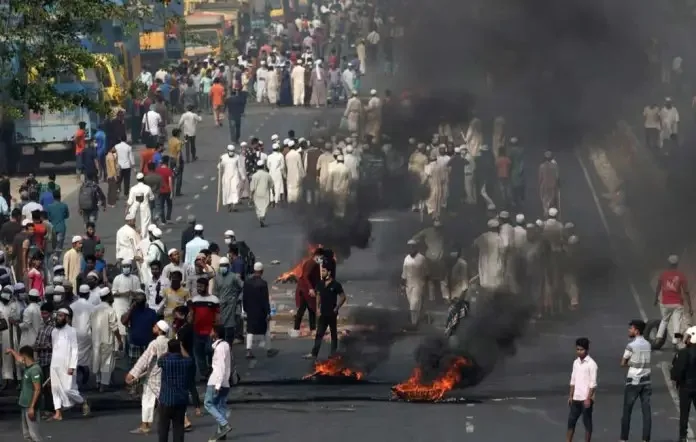
According to HRCBM, blasphemy accusations frequently follow a predictable and dangerous trajectory. Allegations, often originating online or through local rumours, lead to swift police action, followed by mob mobilisation and attacks that extend well beyond the accused individual.
In many cases, entire Hindu neighbourhoods were targeted, with homes vandalised, temples damaged, and families forced to flee. The report stresses that punishment is often collective, with communities bearing the brunt of anger allegedly directed at a single individual.
The report highlights several incidents that illustrate the severity of the crisis. On June 19, 2025, a 22-year-old man was arrested in Barisal over alleged derogatory remarks, triggering unrest in nearby areas. Days later, similar allegations sparked tensions in Chandpur.
One of the most severe episodes occurred on July 27, 2025, in Rangpur’s Betgari Union. Following the arrest of a 17-year-old boy, at least 22 Hindu houses were vandalised, leaving families displaced and terrified. Rights groups note that minors are increasingly becoming targets, both as accused and as victims of retaliatory violence.
Of the 71 documented cases, more than 90 percent of those named or arrested were Hindus, including minors aged between 15 and 17 years. The incidents include police arrests and FIRs, mob assaults, destruction of property, expulsions and suspensions from educational institutions, and deaths following mob attacks.
The report warns that economically vulnerable individuals and socially marginalised groups are disproportionately affected, as they lack the resources or influence to defend themselves against sudden accusations.
A significant number of blasphemy allegations, the report notes, originated from social media platforms, particularly Facebook. In several cases, the allegedly offensive posts were disputed, traced to hacked accounts, or could not be forensically verified.
Despite this, arrests were often made rapidly under public pressure, sometimes before any preliminary investigation was completed. Several cases were registered under Bangladesh’s Cyber Security Act, with students and young workers among the most affected.
Universities and colleges emerged as flashpoints, with multiple students facing suspension, expulsion, or police remand following allegations of insulting religious sentiments. Rights groups expressed concern that academic spaces are becoming increasingly unsafe for minority students.
The report also raises serious questions about state protection, noting instances where violence continued even after the accused were taken into police custody. In such cases, mobs allegedly attacked Hindu localities despite the presence or prior involvement of law enforcement.
Human rights observers say this pattern suggests gaps in policing, accountability, and preventive measures, further emboldening perpetrators.
Several of the documented incidents resulted in deaths. On December 18, 2025, a 30-year-old Hindu man was beaten to death and his body set on fire by a mob in Mymensingh following blasphemy allegations. Earlier, a minor was fatally assaulted in Khulna, reportedly in the presence of security personnel, raising grave concerns about law enforcement accountability.
These killings have become flashpoints for protests in Bangladesh and among diaspora communities abroad, intensifying scrutiny of the interim government’s response.
The recurring sequence, online accusation, rapid arrest, mob mobilisation, and attacks on Hindu areas, indicates that blasphemy allegations are increasingly being weaponised as tools of intimidation and persecution.
The report warns that without stronger legal safeguards, independent investigations, and accountability mechanisms, such allegations will continue to endanger minority communities.
The findings align with recent statements from India’s Ministry of External Affairs, which has expressed concern over repeated incidents of violence against minorities in Bangladesh. New Delhi has condemned recent lynchings of Hindu men and said it expects those responsible to be brought to justice.
According to Indian officials, thousands of incidents involving violence against minorities have been reported during the tenure of Bangladesh’s interim administration led by Muhammad Yunus, placing the issue firmly in the regional diplomatic spotlight.