India under the leadership of Prime Minister Shri Narendra Modi, is making a revolutionary step towards improvement in Agriculture field. This has resulted in the development of a technology and innovation driven vision for the agricultural development of the country. This effort towards the development of the country is a crucial step towards the Aatmanirbhar Bharat vision of the government. These visions include the development of the agricultural ecosystem of the country while aiming the sustainability of the environment.
For this development, an elaborated policy mechanism has been set in place to ensure that there is fast track growth. This ranges from financial and incubation support to entrepreneur’s programs such as the Rashtriya Krishi Vikas Yojana (RKVY), directly subsidizing innovative equipment such as drones in the Namo Drone Didi initiative to benefit farmers and Women Self-Help Groups. The establishment of Digital Public Infrastructure for Agriculture in ‘AgriStack’ reflects an emphasis on evidence based decision making. All these endeavors clearly reflect the proactive initiative of the government to ensure that the integration of Artificial Intelligence, Precision Farming and Climate Smart approaches gets inculcated into the very essence of Indian agriculture itself.
Innovation and Agri Entrepreneurship Development
The Department of Agriculture & Farmers Welfare (DA&FW), Government of India is implementing the Innovation and Agri Entrepreneurship Development programme under Rashtriya Krishi Vikas Yojana (RKVY) from 2018-19 onwards with an objective to promote innovation and agri entrepreneurship by providing financial support and nurturing an incubation ecosystem in the country. This Department has appointed 6 Knowledge Partners (KP) and 24 RKVY Agribusiness Incubators (R-ABIs) from across the country for implementation assistance and incubation of startups under this programme.
Under this programme, for idea/pre seed stage a selected start up shall be eligible for maximum financial assistance of Rs. 5 lakhs in one instalment. For seed stage, the selected start up shall be eligible for maximum financial assistance of Rs. 25 lakhs in two instalments of 50% and 50% based on the recommendation given by the Selection and Investment Committee (SIC). Each KP can select a maximum 20-25 start ups and each R-ABI can select a maximum 10-12 start ups in each category of pre seed and seed stage in a financial year. Trainings, Technical and financial assistance will be provided to startups to launch their products, services, business platforms, etc into the market and facilitate them to scale up their products and operations to attain business viability.
More than 6000 Agri Startups have been trained by KPs and R-ABIs so far under this programme. Till date, 2096 Agri Startups have been supported with technical and financial assistance under this programme during FY 2019-20 to 2025-26. The funding support of Rs. 168.14 crore grants-in-aid have been released in instalments for funding to these 2096 agri Startups to the respective KPs & R-ABIs by DA & FW. Start-ups are taking projects in various field of agriculture and allied sectors like Precision agriculture including applications of sensor, Artificial Intelligence (AI), Internet of Things (IoT), Information & Communication Technology (ICT) & drone, Farm Mechanization, Post Harvest, Food Technology & Value addition, Supply Chain and Agriculture logistics & agriculture inputs, Waste to Wealth & Green Energy in Agriculture & Organic Farming, Allied Sectors etc.
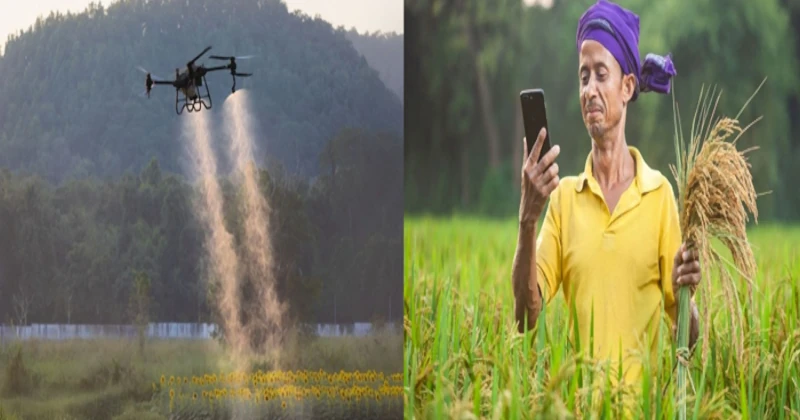
In order to promote use of drones in agriculture under SMAM, financial assistance per cent 100 per cent of the cost of drone up to a maximum of Rs. 10 lakhs per drone is provided for its purchase and demonstration on the farmers fields by the institutes under Indian Council of Agricultural Research (ICAR), Farm Machinery Training & Testing Institutes, Krishi Vigyan Kendras (KVKs), State Agriculture Universities (SAUs), State and other Central Government Agricultural Institutions/Departments and Public Sector Undertakings (PSUs) of Government of India engaged in agricultural activities.
The Farmers Producers Organizations (FPO) are provided grants up to 75 per cent of the cost of Kisan Drone for its demonstrations on the farmers fields. In order to make available drone services to farmers on rental basis, financial assistance at 40 per cent up to a maximum of Rs. 4.00 lakhs are provided for purchase of drones by CHCs under Cooperative Society of Farmers, FPOs and Rural entrepreneurs. Agriculture graduates establishing CHCs are eligible to receive financial assistance at 50 per cent of the cost of drone up to a maximum of Rs.5.00 lakhs per drone. For purchase of drones on individual ownership basis, the Small and Marginal, Scheduled Caste/Scheduled Tribe, Women and North Eastern State farmers are provided financial assistance at 50 per cent of the cost up to a maximum of Rs. 5.00 lakhs and other farmers at 40 per cent up to a maximum of Rs. 4.00 lakhs per drone.
Sub Mission on Agricultural Mechanization (SMAM) is being implemented in 2014-15 through States/UTS Governments. SMAM is now being implemented under the umbrella of the Centrally Sponsored Scheme of Rashtriya Krishi Vikas Yojana (RKVY). The scheme aims at reaching the unreached by bringing to the small and marginal farmers in the core, including women farmers and giving the benefits of farm mechanization, by promoting Custom Hiring Centers, creating hubs for hi-tech & high value farm equipment’s, distribution of various agricultural equipment and creating awareness among stakeholders through demonstration and capacity building activities.
The Government has established four Farm Machinery Training and Testing Institutes at Budni (Madhya Pradesh, Haryana), Garladinne (Andhra Pradesh) and BiswanathChariali (Assam) under the administrative control of the Department of Agriculture and Farmers Welfare. These institutes are imparting training to Farmers, including women farmers/Technicians/ Engineers/ Unemployed Youths/ Machinery Manufacturers, etc., under various training programmes on the latest technology of farm mechanization, including kisan drones.
The Government has approved ‘Namo Drone Didi’ as a Central Sector Scheme for providing 15,000 drones to the Women Self Help Groups (SHGs) with an outlay of Rs. 1261 Crores for the period from 2023-24 to 2025-26. The major objectives of the scheme is to promote advanced technology in agriculture for improved efficiency, enhanced crop yield & reduced cost of operation and to empower SHGs as drone service providers for increasing their income and providing livelihood support to them. Lead Fertilizer Companies (LFCs) have distributed 1094 drones to drone Didi of SHGs in 2023-24 using their internal resources. Out of these 1094 drones, 500 drones have been distributed under the Namo Drone Didi Scheme.
Department of Agriculture & Farmers Welfare is implementing the Centrally Sponsored Scheme of Per Drop More Crop (PDMC) in the Country from 2015-16. PDMC focuses on enhancing water use efficiency at the farm level through Micro Irrigation, namely Drip and Sprinkler Irrigation Systems. The Micro Irrigation helps in water saving as well as reducing fertilizer usage through fertigation, labour expenses, other input costs and overall income enhancement of farmers. The Government provides financial assistance at 55 per cent for small and marginal farmers and at 45 per cent for other farmers for the installation of Drip and Sprinkler systems under the PDMC.
Pradhan Mantri Fasal Bima Yojana (PMFBY) envisages the use of improved technology. Accordingly, the National Crop Insurance Portal (NCIP) and the Application for Intermediary Enrolment (AIDE) app have been developed to disseminate information about the scheme to the farmers. Farmers, can insure themselves through the portal and apps and check the status of their application, claims etc. Village Level Entrepreneurs (VLEs) under Common Service Centres (CSCs) have also been engaged to enroll farmers and disseminate coverage information, claims etc. Government has taken various steps to strengthen implementation of the scheme, leveraging technology in implementation of the scheme, capturing of yield data/Crop Cutting.
The Government has approved the Digital Agriculture Mission, which envisages the creation of a Digital Public Infrastructure (DPI) for Agriculture, such as AgriStack, Krishi Decision Support System and a comprehensive Soil Fertility & Profile Map to enable a robust digital agriculture ecosystem in the country. This would drive innovative farmer centric digital solutions and make reliable crop related information available to all farmers on time. The AgriStack DPI consists of three foundational registries or databases associated with the agriculture sector, i.e., Geo-Referenced Village Maps, Crop Sown Registry and the Farmers Registry, all created and maintained by the State Governments/ Union Territories. The government is providing technical and financial support to all the states/UTs to implement this DPI.
The Mahalanobis National Crop Forecast Centre (MNCFC) under the Ministry of Agriculture & Farmers Welfare also plays a pivotal role by leveraging space and geospatial technologies for agricultural applications as follows:
- Forecasting Agricultural output using Space, Agro-meteorology and Land based observations (FASAL) Project: MNCFC operationalizes this project to generate pre-harvest crop production forecasts at national, state, and district levels for major crops using satellite remote sensing (optical and microwave data). This is a core part of satellite based crop monitoring.
- Drought Monitoring: MNCFC actively provides drought assessment and monitoring using satellite derived indicators for timely disaster response.
- Support to Crop Insurance Activities (PMFBY): MNCFC supports the Pradhan Mantri Fasal Bima Yojana (PMFBY) for various activities through the Yield Estimation System based on Technology (YES-TECH), Planning of Crop Cutting Experiment (CCEs) and addressing disputes for yield and area discrepancies.
These efforts represent an emphatic turning point for Indian agricultural policies which is moving with fast pace and efforts, towards an eco-systemic approach that leverages technology and puts farmers first. By integrating financial services, institutional support and technology solutions for risk protection and mitigation, sustainability and advancement have been ensured for agricultural innovation to have an effective and pragmatic impact at the grassroots and productivity levels.
Initiatives related to supporting agri startups, drone services, micro irrigation techniques, crop insurance plans and satellite-based predictive forecasting point towards an integrated approach that forcefully brings data and technology together. It is important to note that there have been equal efforts towards making these interventions more inclusive and cater towards marginal farmers, women self-help groups and backward areas.
This alignment of innovation and inclusion assure that innovations and advancements do not just stay within laboratories and research boundaries but achieve practical and pragmatic outcomes at different levels of agricultural performance and sustainability.