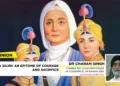
In the harshest winter of 1705, in the provincial town of Sirhind of Punjab, the Mughal emperor chose terror as its State tool to persecute two young warriors. It did not choose the battlefield, nor did it confront armed resistance. Instead, it targeted resolve itself. Sahibzada Zorawar Singh and Sahibzada Fateh Singh, the younger sons of Guru Gobind Singh, were taken into custody after being separated from their family during the evacuation of Anandpur Sahib. What followed would leave a permanent imprint on Bharat’s national conscience.
The Sahibzadas were born into a lineage shaped by sacrifice. Their father, Guru Gobind Singh, the tenth Sikh Guru, was not merely a spiritual teacher but a defender of dharma in an age of persecution. His own father, Guru Tegh Bahadur, had been executed by the Mughal state for refusing to submit to forced religious conversion and for defending the freedom of worship. Earlier, Guru Arjan Dev, the great grandfather of the Sahibzadas had been subjected to torture and execution by the Mughals. The Sahibzadas thus grew up in a tradition where faith was not private, but a public commitment, one that could demand the highest price.
By the late seventeenth century, the Mughal Empire under Emperor Aurangzeb had adopted a far tyrannical approach towards religious freedom. Loyalty to the state was increasingly linked to religious submission and adoption of Islam. Conversions were secured through terror and fear, and inhuman punishments were used to break resistance. Terror was not accidental; it was deliberate. It was meant to demonstrate that the state claimed authority not only over land and bodies, but over belief itself.
It is in this context that the events at Sirhind must be understood. The Sahibzadas were produced before the provincial authorities and given a stark choice: abandon their faith and accept conversion to Islam, or face torturous death. It was a calculated act of intimidation. The state sought to send a message to the wider society — that resistance was futile, and that even the household of Guru Gobind Singh could be crushed.
The Sahibzadas refused. Their refusal was calm and firm. There was no rage, no pleading, no attempt at escape. In that moment, they denied the Mughal sovereign his most dangerous claim — the right to command conscience. By choosing death over submission, they made clear that faith could not be extracted through fear.
What followed was an act of savagery designed to terrorise. The method of execution — bricking alive — was chosen for its psychological impact. It was meant to terrorise, to break the spirit of the people, and to force submission through fear. The state wanted society to witness the consequences of defiance.
But terror depends on fear. At Sirhind, it did not. Instead of submission, the execution of the Sahibzadas exposed the moral collapse of power that relied on cruelty. The empire demonstrated its strength, but in doing so revealed its weakness. Violence could end life, but it could not conquer belief. The Sahibzadas transformed terror into testimony, that conscience has limits beyond which authority cannot pass.
This is why the Sahibzadas are not remembered merely as martyrs, but as national heroes — Martyr who defended the moral core of the Bharatiya civilisation. Their sacrifice was not about preserving one identity alone; it was about protecting the right of Bharatiyas to remain inwardly free. They stood for a principle that would later define Bharat’s national awakening: that faith, dignity and conscience are not negotiable under duress.
The response of society to this act of state terror is equally significant. When the bodies of the Sahibzadas were denied dignity even after death, it was Dewan Todar Mal, a Hindu merchant of Sirhind, who stepped forward. The authorities demanded an extortionate price for a small piece of land for cremation, insisting that gold coins be placed edgewise to cover the area. Dewan Todar Mal complied without hesitation.
This was more than an act of devotion or compassion. It was a moral act of resistance where the state abandoned humanity, but the society upheld dharma. In that moment, Hindu–Sikh brotherhood was not expressed in words, but in action. One tradition produced the heroes; another ensured their honour. Together, they upheld the national conscience against terror.
The sacrifice of the Sahibzadas also cannot be separated from the larger sacrifice of Guru Gobind Singh’s family. Only days earlier, the elder Sahibzadas Ajit Singh and Jujhar Singh had attained martyrdom at Chamkaur, fighting against overwhelming odds. Their deaths on the battlefield and the martyrdom at Sirhind together represent the full spectrum of national courage: resistance with and without arms, heroism in combat as well as in captivity.
This is why Bharat commemorates their martyrdom as Veer Bal Diwas. The observance is not rooted in sentimentality about age. It is rooted in reverence for courage. It affirms a simple but powerful truth: national conscience is not defined by age, rank or strength, but by the courage to stand by what is right when fear demands surrender.
By declaring Veer Bal Diwas, the nation has placed the Sahibzadas where they belong — in the pantheon of Bharat’s national heroes. Their story is taught not to evoke sorrow, but to inspire resolve. It reminds citizens that freedom is not preserved by comfort alone, and that moral clarity often demands sacrifice.
The Sahibzadas offer a timeless lesson, especially for the youth. They did not defeat an empire by force. They defeated it by refusing to be terrorised. In doing so, they taught Bharat that power collapses the moment conscience refuses to submit.
Veer Bal Diwas, therefore, is not merely a day of remembrance. It is a reminder of what sustains a nation at its deepest level. A nation endures because, when tested, people choose courage over fear and conscience over submission.