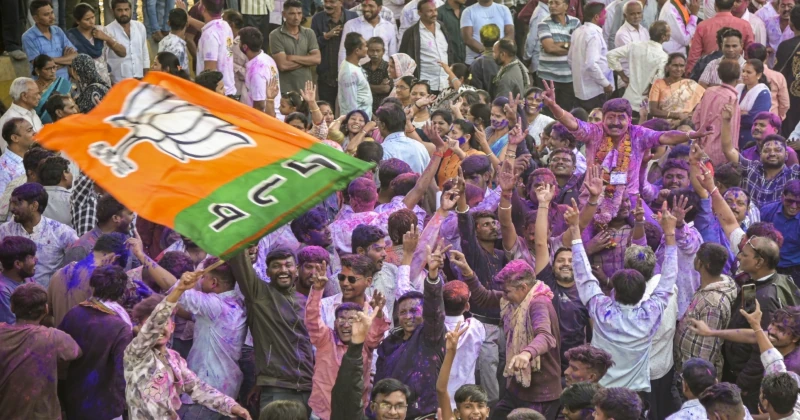
The sweeping mandate won by the BJP-led Mahayuti alliance in Maharashtra’s local body elections (Nagar Parishad and Nagar Panchayat elections) on December 21 reflected the mood of the electorate, in close alignment with the results of the state Assembly polls held in November 2024.
The Mahayuti alliance (primarily the BJP, Shiv Sena (led by Eknath Shinde), and the NCP-Ajit Pawar faction) has won elections to 288 municipal councils and nagar panchayats, securing 207 local body president posts and leaving the opposition Maha Vikas Aghadi with a combined total of 44.
The BJP clearly dominates municipal presidencies statewide, not just as part of Mahayuti but as a standalone force.
Calling this the “public mandate for the politics of development” while also crediting the alliance’s candidates as “the real contributors to this success”, Maharashtra Chief Minister and BJP leader Devendra Fadnavis posted in Marathi on his x.com account that “BJP is the number one party in Maharashtra. In these municipal elections, around 75 per cent of municipal presidents have been elected from the Mahayuti, and in many places the Maha Vikas Aghadi has been completely defeated. Along with this, BJP has created a new record in the number of corporators elected. From around 1,500 corporators in the previous elections, the party has now crossed 3,000 elected corporators. Of the total corporators in the state, 48 per cent belong to BJP alone. This marks a historic milestone in Maharashtra’s political history over the last 30 years.”
विकासाच्या राजकारणाला जनतेचा कौल… यशाचे खरे वाटेकरी सर्व उमेदवारच!
नगरपालिकांमधील ऐतिहासिक विजयानंतर आज नागपूरमध्ये भाजपाचे नवनिर्वाचित नगराध्यक्ष व नगरसेवक, पदाधिकारी आणि कार्यकर्त्यांसमवेत संवाद साधला आणि त्यांचा अभिनंदन केले.
नागपूर जिल्ह्यातील 27 पैकी 24 नगरपालिकांमध्ये… https://t.co/VDv6RF1tkk pic.twitter.com/bmo5dzjJGc
— Devendra Fadnavis (@Dev_Fadnavis) December 22, 2025
The Eknath Shinde-led Shiv Sena won 53 seats, significantly outperforming the Uddhav Thackeray-led Shiv Sena, which won only nine seats. That is a major symbolic blow to the SS-UBT while its Maha Vikas Aghadi (MVA) partner, the Congress Party, remains marginal in urban local bodies.
Fadnavis’ statement celebrates the BJP–led Mahayuti’s sweeping victory in municipal elections in Nagpur district, highlighting record-breaking numbers of elected presidents and corporators.
“In Nagpur district, the Mahayuti has won 24 out of 27 municipal councils, of which 22 have been won directly under the BJP banner,” CM Devendra Fadnavis wrote in his post.
“December 21 results have made one thing absolutely clear: BJP is the number one party in Maharashtra. In these municipal elections, around 75 per cent of municipal presidents have been elected from the Mahayuti, and in many places the Maha Vikas Aghadi has been completely defeated,” Fadnavis wrote.
Notably, that is not the only electoral feat of the Bharatiya Janata Party. Along with this, the BJP has created a new record in the number of corporators elected. From around 1,500 corporators in the previous elections, the party has now crossed 3,000 elected corporators. Of the total corporators in the state, 48 per cent belong to the BJP alone, marking a historic milestone in Maharashtra’s political history over the last 30 years.
Vote for “development-oriented politics” under PM Modi
This sweeping mandate in the BJP-led alliance’s favour positions the BJP as Maharashtra’s leading political force, added Fadnavis. He credited the voters for endorsing the party’s “development-oriented politics” under Prime Minister Narendra Modi. He expressed confidence that this momentum will continue into future municipal and district-level elections.
“The public mandate repeatedly received for the politics of trust and development initiated by Hon. Prime Minister Narendra Modi further strengthens this approach with every election,” he noted.
Key Overall Numbers (Grand Total)
- BJP: 117 (the single largest party by a wide margin)
- Shiv Sena (Shinde faction): 53
- NCP (Ajit Pawar faction): 37
- INC (Congress): 28
- NCP–SP (Sharad Pawar faction): 7
- SS–UBT (Uddhav Thackeray faction): 9
- Other recognised parties (outside Maharashtra): 4
- Unrecognised parties: 28
- Independents: 5
If the above break-up shows who controls the council leadership, let us look at the total elected members (corporators) to shift our focus on grassroots representation and voter spread. Since there are multiple members per council, it covers more than just the council leadership.
BJP and Mahayuti not only won leadership positions but also command a substantial majority of elected representatives across Maharashtra’s urban local bodies.
Grand Total (Members)
- Total seats: 6,589
- Shiv Sena (Shinde): 2,096
- NCP (Ajit Pawar): 824
- INC: 288
- SS-UBT: 244
- NCP-SP: 96
- Others/Ind/Unrecognised: remainder
This reflects the depth of the mandate, not just leadership capture.
“I am fully confident that the impact of this victory will also be clearly seen in the upcoming municipal corporation and district council elections,” Fadnavis said in his social media post.
How the Opposition Views The Results
Congress leader and spokesperson Atul Londhe refused to do an electoral analysis of the poll debacle, saying it is a futile exercise and a lost cause. Londhe alleged that the BJP relied on ‘Sam, Dam, Dand, Bhed’ to win these local body elections. “Money was misused, and there were bogus voters. When Congress workers reported the cases to the officials, cases were registered against the Congress workers and not the bogus voters… We have reported all these malpractices to the CEC, but he is not ready to take any action. The Election Commission is hand in glove with the BJP and the Election Commission is dead,” Londhe said. Maha Vikas Aghadi leaders have alleged tampering with EVMs. Much is happening at my end.
Sam, Dam, Dand, Bhed (साम, दाम, दण्ड, भेद) is an ancient Indian framework of statecraft and persuasion, most commonly associated with Kautilya (Chanakya)’s Arthashastra. It describes four methods a ruler or power uses to achieve an objective—often quoted in politics to suggest hard-nosed or unethical manoeuvring.
Shiv Sena leader and Maharashtra MLC, Manisha Kayande, dismissed the allegations as “untrue and ridiculous”, adding that it made little sense to accuse the party of both EVM tampering and vote-buying. “Congress keeps claiming that we are buying votes and tampering with EVMs. This is untrue and also ridiculous. Why would someone who can tamper with EVMs also need to offer money?” Kayande asked rhetorically.
Meanwhile, the two Thackeray cousins – Uddhav Thackeray and Raj Thackeray – have reunited after 20 years, officially declaring it in a press conference held in Mumbai on December 24. Shiv Sena (UBT) chief Uddhav Thackeray and Maharashtra Navnirman Sena president Raj Thackeray formally announced their alliance for the Brihanmumbai Municipal Corporation (BMC) elections.
Before announcing their alliance, which comes right ahead of the elections to the country’s richest civic administration bodies, Uddhav and Raj Thackeray paid tribute to the late Balasaheb Thackeray at the memorial at Shivaji Park in Mumbai.
#WATCH | Mumbai | Thackeray brothers come together for a family photograph after they announce an alliance of their parties for the upcoming Municipal Corporation Elections. pic.twitter.com/CD4CzI9wIx
— ANI (@ANI) December 24, 2025
Sanjay Raut – the spokesperson of the Shiv Sena (Uddhav Balasaheb Thackeray faction) equated the coming together of the two estranged cousins as an occasion as momentous as the celebration of the arrival of the ‘mangal kalash’ of Samyukta Maharashtra agitation (that fought for a separate state of Maharashtra for Marathi speakers, with Mumbai as its capital) in May 1960.
The reunion between the cousins and the declaration that their respective parties will work together for the 2026 Municipal Corporation elections signals the heating up of political activity in Maharashtra. Raj Thackeray, while announcing the alliance, also refused to speak on the seat-sharing arrangements.
Meanwhile, Shiv Sena (Eknath Shinde) leader Manisha Kayande has called the poll alliance nothing but an attempt by the two brothers to secure the political futures of their respective sons.
“I think this is just a family event and they want to give some cinematic moments to the people of Maharashtra – which shows the drama of two brothers separating and then reuniting – an emotional drama. Someone ought to ask them if they are coming together for the Marathi manoos, why did they separate at all two decades ago – for what purpose?” Kayande pointed out.
“They say they are as thick as Ram-Lakshman ki Jodi. Then why did this self-professed Ram exile his “Lakshman” from the party? People are not going to be fooled by their act,” Kayande reiterated.
The timing of the handshake between the two cousins raises several questions. The State Election Commission (SEC) announced on Monday (December 15) that the elections for 29 municipal corporations in Maharashtra, including the Brihanmumbai Municipal Corporation (BMC), will be held in a single phase on January 15, 2026, and the results will be declared on January 16.
An article in the Nagpur edition of the Marathi daily ‘Divya Marathi’ states that all analysis underlines why the Mumbai Metropolitan Region has become Maharashtra’s true power centre. It claims that with nine municipal corporations controlling budgets totalling nearly ₹9 lakh crore and influencing around 75 Assembly seats, it has become a coveted pie.
Therefore, it is said that as urban governance increasingly determines political relevance, the erosion of traditional Shiv Sena dominance in MMR has left both Uddhav and Raj Thackeray weakened and isolated. A rapprochement between the two is less about sentiment and more about reclaiming space in a region that now acts as Maharashtra’s real kingmaker.
The Nagar Parishad and Nagar Panchayat elections are now done and dusted; all eyes are now on these key municipal corporation elections. “The nomination process will begin on December 23, and candidates are allowed to make their submissions until December 30, while January 2 will be the last date of withdrawal of nominations.
The final list of candidates will be published on January 3,” said Maharashtra State Election Commissioner Dinesh Waghmare. The elections will be conducted for 2,869 seats, and 3.48 crore voters will be eligible to vote.