The history of India has read more obituaries to the Sikhs than any other community. The history is replete with martyrdom and yet is always ready to defend the poor, the persecuted, and to guard the doctrine of the ‘oneness of humanity’ and the right to worship one’s faith in one’s own way.
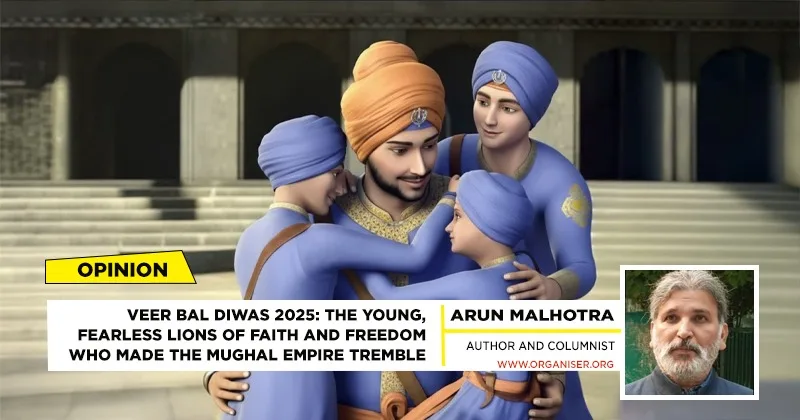
But the obituaries of the Chaar Sahibzaades history will continue to shine in the universe luminously and fearlessly as the Sun dispelling the darkness of fear and false authority. The four Sahibzade-Baba Ajit Singh, Baba Jujhar Singh, Baba Zorawar Singh and Baba Fateh Singh—on whom the Sikhs have reverently conferred the title of Babaji–have taught us fearlessness in the face of extreme terror and the power of authority. As the ultimate role models for generations, their luminous example still speaks to a world that is grappling with fear, terror, injustice, intolerance, corruption and drugs today.
In those tender ages, their martyrdom sent shock waves across India. The empire’s rule of terror began to be viewed with deep scepticism. If its tyranny could not bend or break the spirit of the young sahibzaade, how could it claim to wield the power of Allah and convert an entire people by force?
The utter failure of this extreme oppressive power to shake the faith of the Sahibzade—and their audacity to look into the eyes of a mighty empire—resonated through the Mughal domains. It ignited a powerful current of courage, teaching the next generations of ordinary people the true strength of revolt. The Char Sahibzade became the real role models for the ages, inspiring wave after wave of resistance and uprisings in the centuries that followed. From generation to generation, their example has continued to feed the energy of revolution against injustice and embolden all who refuse to bow before false authority.
When the mighty empire of Aurangzeb rejoiced at what they perceived as having brought the faith to its knees though treachery against Guru Gobind Singh, that same mighty empire could not bend the Chhote Sahibzade who were only 9 and 6 years of age. The fearlessness with which the Vadde Sahibzade fought the war and embraced martyred made it apparent that to be fearless, ones doesn’t need age. The spirit of young ones is as courageous as that of old ones. It was demonstration of extreme fearlessness in the face of extreme terror and brutality.
The empire of Aurangzeb was exposed as powerless before the inner sovereignty of these young souls, and ordinary people witnessed this epiphany with their own eyes. They suddenly understood, with clarity, that an empire claiming divine sanction was actually powerless before the courage of four Sahibzade—and that true power lay in unwavering faith and conscience, not in armies, prisons, or decrees. It was not the Sahibzade who stood small before the empire, but the empire that stood diminished before their luminous courage.
The Sahibzade were born and raised in Sri Anandpur Sahib, they were immersed in Gurbani and Shastar Vidya. They saw the creation of the Khalsa in 1699 by their father, Sri Guru Gobind Singh Ji. Binding together five generations of the Gurus is one common thread–Mata Gujri, who is also called the matriarch of the Sikh Panth.
Mata Gujri was married to Guru Tegh Bahadur ji, and she absorbed the Miri-Piri culture of Guru Hargobind and lived for long years with Guru Tegh Bahadar Sahib in Bakala. As a catalyst who brought forth what lay hidden in young Guru Gobind Singh, she carefully sculpted his education, spiritual path and leadership, thus enabling him to create the Khalsa Panth. Sikh scholars note that when Bhai Jaita brought the severed head of Guru Tegh Bahadur ji, she received it accepting as Hukum (The Divine Command) which showed her spiritual depth. She was a catalytic force in nurturing Guru’s commitment to justice, compassion for the persecuted and readiness to confront tyranny without hatred.
Historians and scholars point out that she was also the foremost educator of the four Sahibzades. Thanda Burj chronicles where Chhote Sahibzade and Mata Gujri were incarcerated, reminds tales of harsh cold ad hardship. Despite that Mata Gujri continually reminded the Chhote Sahibzade that their grandfather and great-great-grandfather had given their heads for the truth. She taught resilience to her grandsons and kept the spirituality of their tradition alive. As a result, the Chhote Sahibzade remained unwavering and calm and rejected all the overtures of Wazir Khan and were martyred. The inner world of the Char Sahibzade that she shaped had prepared them to guard dharma and freedom of conscience, which they manifested both at Chamkaur and Sirhind. Mata Gujri became the first woman martyr of the Panth and the core thread that binding together the lineage of truth.
In today’s language, message of the Char Sahibzade to Generation Z and Generation Alpha is that the world they inherit is a responsibility and not a privilege. The planet is scarred by hatred, violence, division, corruption, falsehood and massive environmental damage, and they must decide what kind of people they will be inside it. The message of real courage means young people should not join hate campaigns but work to build a society where many faiths and identities can live together. It means never selling one’s conscience for comfort, success or convenience.
The disciplined lives of the Sahibzade show us that life’s meaning is not found in escaping into drugs and substance abuse, but in seva, which means serving others and living with purpose. The messages of Char Sahibzade is clear, first, to make courage your default setting and refuse to be intimidated when truth and justice are at stake. Second, to refuse unethical deals or oppose unethical practices and uphold your integrity always. Third, remember that the poor and vulnerable still need you even today to defend those who are being abused, cheated or silenced. Fourth, be a luminous example—use your education, network and come to the front and show the world by being the example through your actions and not by being spectator but a participant in building a compassionate and plural society.